Research shows the US is a low wage country By Mark Thoma
April 23, 2012
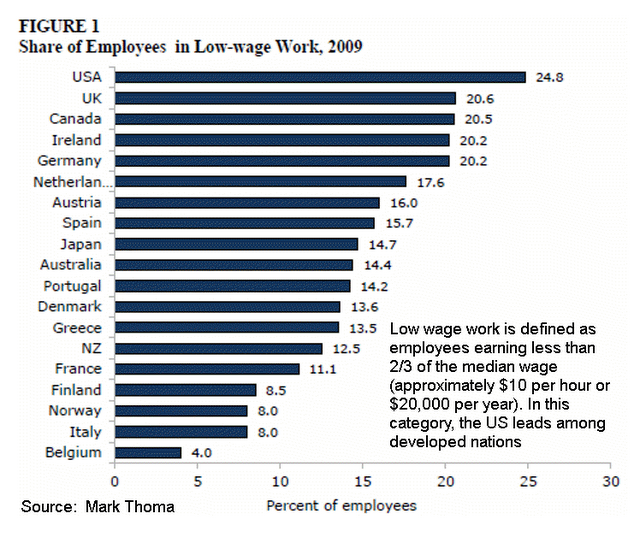
(MoneyWatch) – Recent research from John Schmitt of the Center for Economic Policy Research shows that the US leads developed countries in the share of workers earning low wages. The research also shows that increased wage polarization over the last several decades is one of the reasons for the large share of low wage-work in the US. The bars in this graph represent the share of workers in low wage work, where low wage work is defined as employees earning less than 2/3 of the median wage (approximately $10 per hour or $20,000 per year). In this category, the US leads among developed nations…
Scott Borg: Cyber warfare will require us to rethink every aspect of defence. Our current weapons and defence systems will still be needed, but the way we use them will become very different. A major cyber assault could completely bypass our military forces. It would not require incoming airplanes, missiles, ships, or troops. The attack could suddenly appear inside the computerized equipment of our major industries. The identity of the country or organization that was responsible could be impossible to determine quickly or with complete confidence. The cyber assault could cause almost any kind of damage that could be produced by the human operators of computerized equipment. In fact, a cyber attack could cause many kinds of damage that the human operators of industrial equipment could only achieve by reprogramming their controls.
Phi Beta Iota: Nobody has learned anything since NSA first learned about hackers and then was told to focus on both the security of corporation communications and the need for a national secure information infrastructure. The above perspective is uninformed, and also dangerous for its idiotic suggestion that we should militarize all domestic systems.
“The technology of the current satellite architecture is pretty much at its limit, and the commercial satellites are producing just about the same thing at a much lower cost,” said retired Gen. James E. Cartwright of the Marines, former vice chairman of the Joint Chiefs of Staff. “The government’s satellites are better, but the question is, What do you need? Most studies show that about 90 percent of what the military needs can be solved with commercial.”
The military also favors commercial satellites because imagery from the intelligence community cannot be easily shared with allies. “The beauty of commercial imagery is that it is unclassified,” said Walter Scott, chief technical officer of DigitalGlobe, a satellite company based in Longmont, Colo.
Phi Beta Iota: Kill MASINT, shut down the NRO, cut NSA in half, cut cyber-security by four-fifths, fund the multinational clandestine human intelligence field stations, fund the Open Source Agency (with responsibility for open source software, open spectrum, and in passing cyber-security) and move on. This is not rocket science. All it takes is integrity.
The top elections-heist investigators in the USA need your donation, here today, to complete our comic book, our elections guide book and our film exposing the attempt to Steal 2012 by a combination of billionaire’s hidden cash and vote heists.
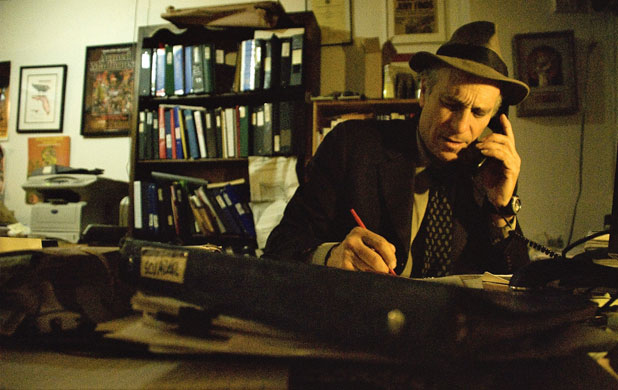
In 1996, Greg Palast filmed the first investigation of The Koch Brothers.
In 2000, Palast uncovered how Katherine Harris purged 56,000 African-Americans from Florida voter rolls.
In 2008, Palast, with Bobby Kennedy, busted the Karl Rove attack on ballots – from ID games to firing US prosecutors.
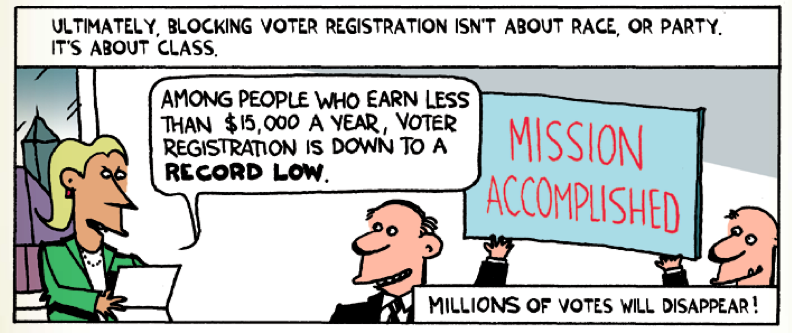
And now, in 2012, there’s once again a full-scale attack on the right to vote.
Click on Image to Enlarge
If we can get $15,000 right now, we can just make our May 3rd deadline to draw and print our BILLIONAIRES AND BANDITS comic book with genius pen man Ted Rall.
The funds will also allow us to edit and broadcast our film shot over the past four years from all over the USA on Karl Rove’s $200 million game to suppress the vote.
I urge that you reject SECDEF's assertions; also urge that you contact your Congressional delegations and ask them to also reject what SECDEF is saying.
At a Pentagon press briefing on Monday, Defense Secretary Leon Panetta said congressional tinkering with the $613 billion 2013 Defense Department budget could have unintended consequences and result in a hollow force. Flanked by Army Gen. Martin Dempsey, chairman of the Joint Chiefs of Staff, Panetta also defended the long-term Defense strategy unveiled in January, saying it will help the Pentagon to slash its budget by $487 billion over the next 10 years.
In March, Rep. Paul Ryan, R-Wis., chairman of the House Budget Committee, told a National Journalforum that senior military commanders were dishonest in presenting Congress with a budget request he doesn't believe they fully support. After Dempsey charged Ryan with calling senior military leaders liars, Ryan backed off and said, “I really misspoke.”
Federal Reserve Board chairman Ben Bernanke delivered a speech on April 13 on “Rethinking Finance.” It certainly needs to be rethought at the highest levels. Unfortunately, Dr. Bernanke has not yet begun the process. Thinking, yes. Not rethinking.
He ended his speech with this:
The financial crisis of 2007-09 was difficult to anticipate for two reasons: First, financial panics, being to a significant extent self-fulfilling crises of confidence, are inherently difficult to foresee.
This is wrong on two counts. First, in a free market, there are no self-fulfilling prophecies. That is because of the widespread distribution of knowledge. A self-fulfilling prophecy is said to take place because lots of people expect it to happen. But why would lots of people expect it to happen? Because (1) there is something fundamental taking place and (2) people share the same economic theory.
Then why is there ever a panic? The free market pits buyers against buyers and sellers against sellers. Why wouldn't those with the best information sell the assets over time, as accurate information spreads? Why is there a panic? Why don't prices come down in a more steady, orderly way? If someone issues a prophecy, it is not widely believed at first. It takes time for people to believe.
They believe it because it explains events in terms of a framework. They draw conclusions. They slowly come to the same conclusions. A panic takes place when the vast majority of investors put their money in the wrong investments. Overnight, the investments turn out to be ill-conceived. The economist should ask this: Why did almost everyone make the same bad investments? The normal process of competition precludes such widespread, simultaneous errors.
Bernanke asked this. His answer self-fulfilling prophesies. He did not ask the more fundamental question: How is it that these self-fulfilling negative prophesies work their black magic against the interests of the vast number of market participants?
This clip from TV Asahi is a lucid explanation of the biggest ongoing news story in the world today: The catastrophic consequences if an earthquake strikes the Fukushima Dai-Ichi No. 4 power plant before its spent fuel rods are moved to safe storage place, a process that will not even begin until December 2013, and could take years. It aired March 8, 2012 on “Morning Bird,” a mainstream Japanese news and information TV program.
NOTE Click the CC button at bottom right (first one from left to right on right side) to show English subtitles!
I made a transcript from the video subtitles (created by tokyobrowntabby), since this interview received no (zero, zip, zilch, nada) coverage in our famously free press, and I’d also like people to be able to quote from it, and search engines to find it. If you just read the transcript, and play the whole video through, at least play the presenters’ reaction shot at [5:04 – 5:07]; “the end” is impactful. The reporter is Mr. Toru TAMAKAWA. The expert is Dr. Hiroaki KOIDE, Research Associate at the Research Reactor Institute of Kyoto University. I’ve marked material from other presenters PRESENTER.