DefDog: 800+ Companies Helping Government Spy on Individuals

Commerce, Commercial Intelligence, Corruption, Government
DefDog

Integrity at risk, extending from an invasive government cloaked under the guise “protection” to the sell out by commercial organizations…..

CISPA supporters list: 800+ companies that could help Uncle Sam snag your data

As the campaign against the Cyber Intelligence Sharing and Protection Act (CISPA) heats up, it's important for the opposition movement to understand just how many companies directly or indirectly support the legislation (i.e. through a trade group). Here, the complete list of CISPA supporters.

During the week of April 23, the House of Representatives is expected to vote on the Cyber Intelligence Sharing and Protection Act of 2011 (CISPA). And starting on Monday, a variety of organizations, including the Electronic Frontier Foundation, the American Civil Liberties Union, the Center for Democracy and Technology, The Constitution Project, Demand Progress, Engine Advocacy, Fight for the Future, Free Press, Reporters Without Borders, Techdirt, and TechFreedom plan to launch a “week of action” campaign against CISPA, a bill they believe remains dangerously broad in its language, which could result in abuse by the government, and damages to our civil liberties.
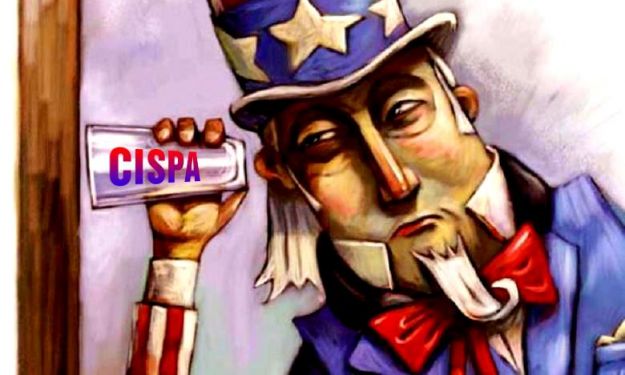
Click on Image to Enlarge

While many are comparing CISPA to the Stop Online Piracy Act (SOPA), the two bills are entirely different for a number of reasons. First, CISPA is a cybersecurity bill that pertains to the sharing of information between the government and private companies. SOPA was an anti-piracy bill that sought to block access to “foreign rogue” websites that illegally distributed copyrighted material. Second, SOPA was opposed by many of the technology and Internet industry’s biggest players. CISPA, on the other hand, effectively has the support of hundreds of technology and Internet companies — a key difference that could drastically affect whether the anti-CISPA crowd can successfully block passage of the bill.

To give you a full picture of just how much political firepower the CISPA has in Congress, we’ve listed most, if not all, of the companies and organizations that have voiced either direct support for CISPA (by writing a letter, or otherwise expressing support for this specific bill), or indirect support through the direct support of a trade group. The organizations or companies listed in bold have voiced direct support. Those companies not in bold have not necessarily given direct support (though quite a few have), but have supported the bill through the trade group, which is listed in bold. The links go to the .pdf files of the letters the company sent to the House Intelligence Committee to express their support of CISPA.

As you can see, the list of CISPA supporters is massive, and should give anyone who thinks this will be an easy political fight a dose of reality. Not that CISPA can’t be stopped but, well, scroll down and you’ll see what we mean.


See full list here.

Josh Kilbourn: Global Systemic Risk Is Rising Rapidly Again

03 Economy, 08 Wild Cards, Commerce, Commercial Intelligence, Corruption
Josh Kilbourn

Global Systemic Risk Is Rising Rapidly Again

Submitted by Tyler Durden on

ZeroHedge, 04/11/2012 15:26 -0400

The risk of the 30 most systemically important financial institutions (SIFI) in the world has risen over 30% in the last three weeks as the effects of LTRO fade and encumbrance becomes the new reality.

This less-manipulated, government-bank-reacharound-driven bond-market sense of reality has retraced almost 40% of its improvement from its peak last November at 311bps to its best level mid-March at 171bps.

The current 226bps level is extremely elevated and as one would expect is dominated by European and US banks (with US banks on average trading wider than Europeans – which may surprise many but Europeans dominate the worst names – most specifically the Spanish banks).

Graphics Below the Line.

Continue reading “Josh Kilbourn: Global Systemic Risk Is Rising Rapidly Again”

Penguin: Why Obama’s Jobs Act Is a Scam Legalizing More Crime

Commerce, Corruption, Government
Who, Me?

Why Obama's JOBS Act Couldn't Suck Worse

Sidebar: Steve Case is evil.

Matt Taibbi

Rolling Stone, 9 April 2012

Boy, do I feel like an idiot. I've been out there on radio and TV in the last few months saying that I thought there was a chance Barack Obama was listening to the popular anger against Wall Street that drove the Occupy movement, that decisions like putting a for-real law enforcement guy like New York AG Eric Schneiderman in charge of a mortgage fraud task force meant he was at least willing to pay lip service to public outrage against the banks.

Then the JOBS Act happened.

The “Jumpstart Our Business Startups Act” (in addition to everything else, the Act has an annoying, redundant title) will very nearly legalize fraud in the stock market.

In fact, one could say this law is not just a sweeping piece of deregulation that will have an increase in securities fraud as an accidental, ancillary consequence. No, this law actually appears to have been specifically written to encourage fraud in the stock markets.

Ostensibly, the law makes it easier for startup companies (particularly tech companies, whose lobbyists were a driving force behind its passage) to attract capital by, among other things, exempting them from independent accounting requirements for up to five years after they first begin selling shares in the stock market.

The law also rolls back rules designed to prevent bank analysts from talking up a stock just to win business, a practice that was so pervasive in the tech-boom years as to be almost industry standard.

Even worse, the JOBS Act, incredibly, will allow executives to give “pre-prospectus” presentations to investors using PowerPoint and other tools in which they will not be held liable for misrepresentations. These firms will still be obligated to submit prospectuses before their IPOs, and they'll still be held liable for what's in those. But it'll be up to the investor to check and make sure that the prospectus matches the “pre-presentation.”

The JOBS Act also loosens a whole range of other reporting requirements, and expands stock investment beyond “accredited investors,” giving official sanction to the internet-based fundraising activity known as “crowdfunding.”

But the big one, to me, is the bit about exempting firms from real independent tests of internal controls for five years.

Continue reading “Penguin: Why Obama's Jobs Act Is a Scam Legalizing More Crime”

Robert Steele: Earthquakes From Oil and Gas Drilling

03 Economy, 03 Environmental Degradation, 05 Energy, Commerce, Corruption, Earth Intelligence, Government, IO Impotency
Robert David STEELE Vivas

One can only look on in anguish as the US Government continues to betray the public trust for lack of intelligence and integrity.

The headlines about earthquakes being related to oil and gas drilling have been common for some time now.  Despite the fact that the federal government has noticed the connection at very low bureaucratic levels, the fact is that the politicized government persists in ignoring the precautionary principle and continues to betray the public trust by not stopping all activities associated with increasing earthquakes.

Earthquakes are now coming to the East Coast just as they are about to become much more frequent, intense, and consequential on the East Coast.

One can only pray that at some point the public will demand an honest government capable of making informed decisions with integrity.

Shale Shocked: “Remarkable Increase” In U.S. Earthquakes “Almost Certainly Manmade”

Federal Study Ties Oil and Gas Industry to Earthquakes

Survey says increase in quakes may have man-made cause

See Also:

Worth a Look: Book Review Lists (Negative)

2012 PREPRINT FOR COMMENT: The Craft of Intelligence

THE OPEN SOURCE EVERYTHING MANIFESTO: Transparency, Truth & Trust

Patrick Meier: Does the Humanitarian Industry Have a Future in The Digital Age?

Blog Wisdom, Civil Society, Collective Intelligence, Commerce, Commercial Intelligence, Cultural Intelligence, Earth Intelligence, Geospatial, Gift Intelligence, Government, info-graphics/data-visualization, InfoOps (IO), International Aid, IO Impotency, Methods & Process, microfinancing, Mobile, Non-Governmental, Peace Intelligence, Threats
Patrick Meier

Does the Humanitarian Industry Have a Future in The Digital Age?

I recently had the distinct honor of being on the opening plenary of the 2012 Skoll World Forum in Oxford. The panel, “Innovation in Times of Flux: Opportunities on the Heels of Crisis” was moderated by Judith Rodin, CEO of the Rockefeller Foundation. I've spent the past six years creating linkages between the humanitarian space and technology community, so the conversations we began during the panel prompted me to think more deeply about innovation in the humanitarian space. Clearly, humanitarian crises have catalyzed a number of important innovations in recent years. At the same time, however, these crises extend the cracks that ultimately reveal the inadequacies of existing humanita-rian organizations, particularly those resistant to change; and “any organization that is not changing is a battle-field monument” (While 1992).

These cracks, or gaps, are increasingly filled by disaster-affected communities themselves thanks in part to the rapid commercialization of communication technology. Question is: will the multi-billion dollar humanitarian industry change rapidly enough to avoid being left in the dustbin of history?

Crises often reveal that “existing routines are inadequate or even counter-productive [since] response will necessarily operate beyond the boundary of planned and resourced capabilities” (Leonard and Howitt 2007). More formally, “the ‘symmetry-breaking' effects of disasters undermine linearly designed and centralized administrative activities” (Corbacioglu 2006). This may explain why “increasing attention is now paid to the capacity of disaster-affected communities to ‘bounce back' or to recover with little or no external assistance following a disaster” (Manyena 2006).

Continue reading “Patrick Meier: Does the Humanitarian Industry Have a Future in The Digital Age?”

Yoda: When Intelligence Loses It’s Integrity, It Is Not Intelligence

Commerce, Corruption, Government, IO Impotency, Military
Got Crowd? BE the Force!

Peak Intel: How So-Called Strategic Intelligence Actually Makes Us Dumber

An industry that once told hard truths to corporate and government clients now mostly just tells them what they want to hear, making it harder for us all to adapt to a changing world — and that's why I'm leaving it.

Eric Garland

The Atlantic, 5 April 2012

I recently quit my job as a “futurist” and “strategic intelligence analyst” after a successful 15-year career of writing books and consulting to corporations and governments around the world. I spent a decade and a half analyzing disruptive new technologies, predicting the effects of the Internet on the international construction industry, helping executives decide whether to spend billions in the nuclear power market, profiling the customer of the future — and training thousands of executives to do likewise for their own companies. It was exciting and fulfilling, but this is the end of the road.  My employment status is interesting to nobody except my wife and I, but why I am leaving the business of intelligence is important to everybody, because it stems from the endemic corruption of how decisions are made in our most critical institutions.

I am not quitting this industry for lack of passion, as I still believe — more than ever — in using good information and sophisticated analytical techniques to decode the future and make decisions. The problem is, the market for intelligence is now largely about providing information that makes decision makers feel better, rather than bringing true insights about risk and opportunity. Our future is now being planned by people who seem to put their emotional comfort ahead of making decisions based on real — and often uncomfortable — information. Perhaps one day, the discipline of real intelligence will return triumphantly to the world's executive suites. Until then, high-priced providers of “strategic intelligence” are only making it harder for their clients — for all of us — to adapt by shielding them from painful truths.

Continue reading “Yoda: When Intelligence Loses It's Integrity, It Is Not Intelligence”

Josh Kilbourn: 51 Months of Recession – Report Card

03 Economy, Civil Society, Commerce, Corruption, Government, Media
Josh Kilbourn

51 Months After The Start Of The Recession, Here Is The Report Card

Tyler Durden

ZeroHedge, 04/06/2012

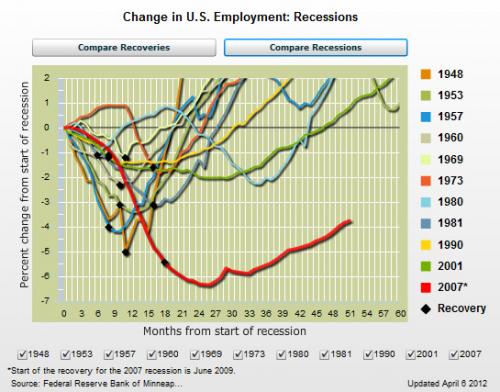
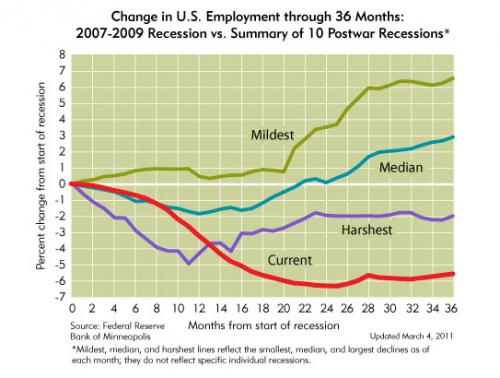
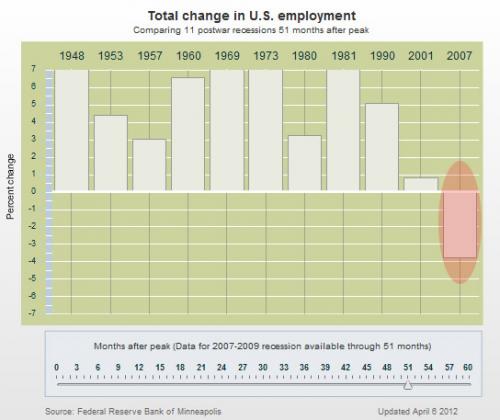
Recovery? What Recovery? 4 years after central banks have progressively injected over $7 trillion in liquidity into the global markets (and thus, by Fed logic, the economy), and who knows how many trillion in fiscal aid has been misallocated, to halt the Second Great Depression which officially started in December 2007, the US “recovery” is the weakest in modern US history! How many more trillions will have to be printed (and monetized) before the central planners realize that fighting mean reversion by using debt to defeat recore debt, just doesnt't work? Our guess – lots.

Incidentally, the US has now generated 3 million jobs since the trough of the recession in September 2010, until which point it had previously lost 8 million. Unfortunately, since the real labor force has grown by 4.6 million over the same period, or at the conventionally accepeted 90,000 labor pool entrants per month for 51 months, despite what the BLS may say, because America is after all growing, this means that the Obama administration has created a negative 1.6 million jobs net of demographics, which in turn have cost the US a modest $5.1 trillion in new debt, or an even modest $3.1 million in debt for every job lost.

Chart 1 – the current “recovery” in the context of all previous ones:

Click on Image to Enlarge

Chart 2 – Min, Max and Average… and now

Click on Image to Enlarge

Chart 3 – in bar chart format

Click on Image to Enlarge

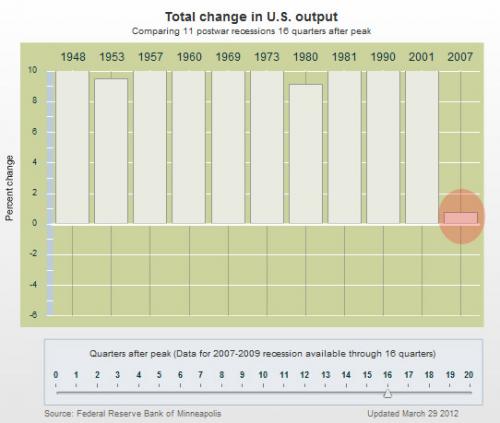
Chart 4 – There is good news: 16 quarters after the start of the recession, US output has turned positive. Just barely.

Click on Image to Enlarge

Phi Beta Iota: What is one to do when the government, with the full complicity of the two parties that monopolize power through various illegitimate means, the full complicity of the five major media corporations whose “mouthpieces” bury their intelligence along with their integrity, all lie to the public? Have we really become a nation of idiot sheep?  At what point is the government impeachable for lies to the public?

See Also:

THE OPEN SOURCE EVERYTHING MANIFESTO: Transparency, Truth & Trust

Journal: Reflections on Integrity UPDATED + Integrity RECAP

noble gold