John Robb: Technology, Corruption, & Depressions

03 Economy, 09 Justice, Blog Wisdom, Commerce, Corruption, Government, Methods & Process, Technologies
John Robb

Technology Shifts and Economic Depression

Joseph Stiglitz (the Nobel prize winning economist) has a great new article: “The Book of Jobs“(behind Vanity Fair's paywall, sorry).   In it, he makes a convincing case that the first global depression was caused by a process similar to what we are seeing today (I'm very happy somebody in the social sciences is actually attempting to show how technological change was a driver of the first depression, it's about time).  Here it is in a nutshell:first depression, it's about time).

  1. Technological change in the form of the internal combustion engine (cars, tractors, trucks) improved transportation and farm productivity.  This led to an agricultural revolution that impacted a huge percentage of the US population.
  2. Farm productivity soared and prices dropped.  This forced many farmers into bankruptcy and led to a steady migration of people from rural to urban locations driving down incomes/demand.
  3. The downward pressure on incomes this caused resulted in a protraced economic depression that only ended when the US and Europe mobilized/nationalized every segment of the economy during WW2 (put everyone to work, trained them, etc.).

At this point in the article Stiglitz stumbles.

Continue reading “John Robb: Technology, Corruption, & Depressions”

Michel Bauwens: Reclaiming the Right to Insolvency

Civil Society, Commerce, Commercial Intelligence, Corruption, Cultural Intelligence, Ethics
Michel Bauwens

Reclaiming the Right to Insolvency


Michel Bauwens
5th December 2011

Excerpted from Franco Berardi:

“A new concept is coming out from the fogs of the present situation: a right to insolvency. We’ll not pay the debt.

The European countries have been obliged to accept the blackmail of debt, but people are refusing the concept that we have to pay for a debt that we have not taken. Anthropologist David Graeber, in his book Debt the first 5000 years, (Melville House, 2011), and philosopher Maurizio Lazzarato, in La fabrique de l’homme endetté (editions Amsterdam, 2011), have started an interesting reflection on the cultural origin of the notion of debt, and the psychic implications of the sense of guilt that the notion of debt brings in itself. And, in his essay, Recurring Dreams The Red Heart of Fascism, the Anglo-Italian young thinker Federico Campagna locates the analogy between the post Versailles Congress years and the present in the debt-obsession:

Read full article.

Phi Beta Iota:  Gripping.  Mankind is at a philosophical turning point.  Organized people are confronting organized money, and the integrity of humanity is in the balance.

John Robb: Libertarians Give Up Sea, Focus on Honduras

08 Wild Cards, Civil Society, Commerce, Commercial Intelligence, Cultural Intelligence, Ethics, Government, Hacking, Methods & Process
John Robb

Libertarian seasteaders give up on the sea, focus on autonomous regions starting with Honduras.

Former “Seasteaders” Come Ashore To Start Libertarian Utopias In Honduran Jungle

Forgoing the plan to build independent floating cities away from chafing laws, some libertarians—led by Milton Friedman’s grandson, no less—have found something better: desperate countries willing to allow the founding of autonomous libertarian cities within their borders.

The seasteader-in-chief is headed ashore. Patri Friedman (that’s Milton Friedman‘s grandson to you), who stepped down as the chief executive of the Peter Thiel-backed Seasteading Institute in August, has resurfaced as the CEO of a new for-profit enterprise named Future Cities Development Inc., which aims to create new cities from scratch (on land this time) governed by “cutting-edge legal systems.” The startup may have found its first taker in Honduras, whose government amended its constitution in January to permit the creation of special autonomous zones exempt from local and federal laws. Future Cities has signed a non-binding memorandum of understanding to build a city in one such zone starting next year.

. . . . . . .

The brainchild of New York University economist Paul Romer (read his thoughts on FCI here), a charter city combines a host nation’s vacant land (in this case, Honduras) with the legal system and institutions of another (e.g. Canada) and residents drawn from anywhere. Romer’s central insight is that good governance is transplantable—rather than wait for a basket case nation to come around begging, a charter city could help show it the way, as Hong Kong did for Deng Xiaoping.

Read full article.

Phi Beta Iota:  The focus on eradicating corruption from day one is most interesting.  While  the group does not appear to have fully thought through their role as a magnet for criminals, there are regions of Africa, Latin America, and even the now warming Arctic North that could permit this kind of innovation to test its premises.

John Steiner: US Chamber of Commerce – Kill It?

01 Poverty, 03 Economy, 07 Other Atrocities, 09 Justice, 11 Society, Blog Wisdom, Budgets & Funding, Commerce, Corporations, Corruption, Counter-Oppression/Counter-Dictatorship Practices, Misinformation & Propaganda, Money, Banks & Concentrated Wealth, Non-Governmental, Politics of Science & Science of Politics, Power Behind-the-Scenes/Special Interests
John Steiner

Click here to sign your name:
“Google, stand up for democracy and your users—quit the U.S. Chamber of Commerce!”

Dear MoveOn member,

Right now we have a huge opportunity to deal what's being called a “serious blow to one of Washington's most powerful lobbies.”1

The U.S. Chamber of Commerce is an army of lobbyists for hire by mega-corporations like banks and those in the fossil fuel industry. In 2009, it spent more corporate money on lobbying than the next five biggest spenders combined.2 And 93% of its campaign spending goes to support Republicans and attack Democrats.3

Google is a paying member of the Chamber, which means that part of the money they make from Google users—ordinary people like us using Gmail, Google search, and other Google products—goes into the Chamber's pockets to fight for Wall Street and Big Oil. But the Washington Post and Politico recently reported that at Google headquarters, employees are intensely debating whether Google should quit the Chamber in the next few weeks.4

Continue reading “John Steiner: US Chamber of Commerce – Kill It?”

Steve Denning: Itemization of How We Blew Up the World

03 Economy, 07 Other Atrocities, 09 Justice, 10 Security, Analysis, Blog Wisdom, Commerce, Commercial Intelligence, Corporations, Corruption, Misinformation & Propaganda, Money, Banks & Concentrated Wealth, Policy, Power Behind-the-Scenes/Special Interests, Secrecy & Politics of Secrecy
Steve Denning

Lest We Forget: Why We Had A Financial Crisis

Steve Denning

Forbes, 22 November 2011

When a true genius appears in the world you may know him by this infallible sign, that the dunces are all in confederacy against him.

Jonathan Swift

It is clear to anyone who has studied the financial crisis of 2008 that the private sector’s drive for short-term profit was behind it. More than 84 percent of the sub-prime mortgages in 2006 were issued by private lending. These private firms made nearly 83 percent of the subprime loans to low- and moderate-income borrowers that year. Out of the top 25 subprime lenders in 2006, only one was subject to the usual mortgage laws and regulations. The nonbank underwriters made more than 12 million subprime mortgages with a value of nearly $2 trillion. The lenders who made these were exempt from federal regulations.

How then could the Mayor of New York, Michael Bloomberg say the following at a business breakfast in mid-town Manhattan on November 1, 2011?

It was not the banks that created the mortgage crisis. It was, plain and simple, Congress who forced everybody to go and give mortgages to people who were on the cusp. Now, I’m not saying I’m sure that was terrible policy, because a lot of those people who got homes still have them and they wouldn’t have gotten them without that. But they were the ones who pushed Fannie and Freddie to make a bunch of loans that were imprudent, if you will. They were the ones that pushed the banks to loan to everybody. And now we want to go vilify the banks because it’s one target, it’s easy to blame them and Congress certainly isn’t going to blame themselves.”

Barry Ritholtz in the Washington Post calls the notion that the US Congress was behind the financial crisis of 2008 “the Big Lie”. As we have seen in other contexts, if a lie is big enough, people begin to believe it.

Full Story Below the Line with BLOCKBUSTER Itemization

Continue reading “Steve Denning: Itemization of How We Blew Up the World”

Mini-Me: US Gasoline Exports–Reason for Tar Sands Fraud

03 Economy, 03 Environmental Degradation, 05 Energy, 07 Other Atrocities, 11 Society, Civil Society, Commerce, Corruption, Earth Intelligence, Government, Power Behind-the-Scenes/Special Interests
Who? Mini-Me?

Gasoline: The new big U.S. export

Steve Hargreaves

CNN Money, 5 December 2011

NEW YORK (CNNMoney) — The United States is awash in gasoline. So much so, in fact, that the country is exporting a record amount of it.

The country exported 430,000 more barrels of gasoline a day than it imported in September, according to the U.S. Energy Information Administration. That is about twice the amount at the start of the year, and experts and industry insiders say the trend is here to stay.

The United States began exporting gas in late 2008. For decades prior, starting in 1960, the country used all the gas it produced here plus had to import gas from places in Europe.

But demand for gas has dropped nearly 10% in recent years. It went from a peak of 9.6 million barrels a day in 2007 to 8.8 million barrels today, according to the EIA.

Read full article.

Phi Beta Iota:  The entire Tar Sands scheme is a scam on the US public, and atrocity against the Canadian public.  In Canada, they are proposing to use precious water they do not have to spare, to flush tar we do not need out of the sands; in the US, there is no need for the tar sands as the sleazy campaigns suggest, the oil companies want the tar sands so they can externalize the costs to the US public and privatize the profits of exporting the gasoline.

Josh Kilbourn: 46 Million Americans on Foodstamps

01 Poverty, 03 Economy, 09 Justice, 11 Society, Civil Society, Commerce, Corruption, Government
Joshua Kilbourn

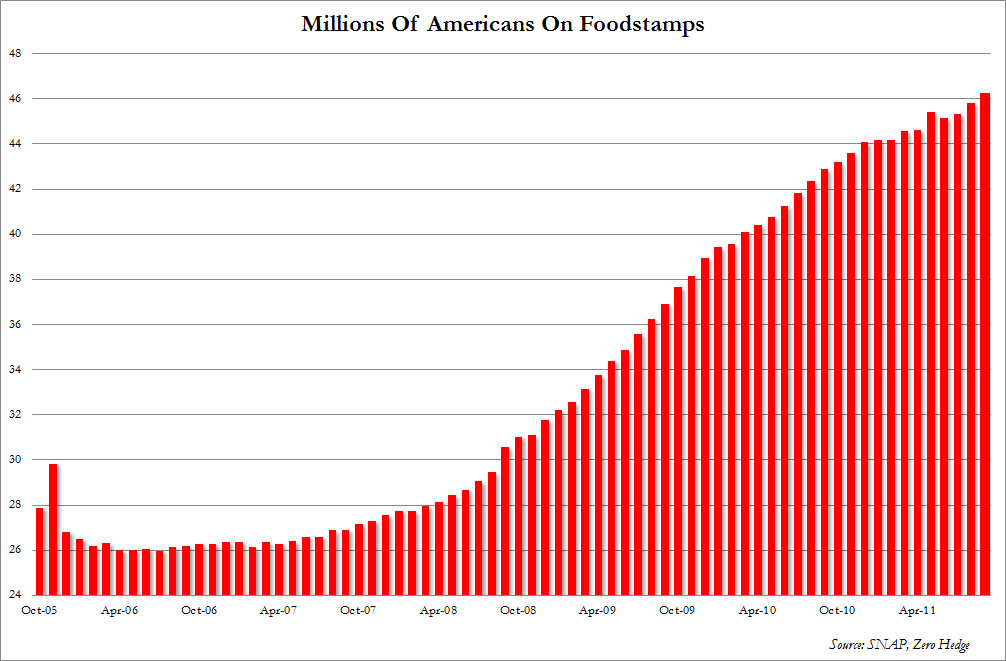
Over 46 Million Americans On Foodstamps For The First Time Ever

Tyler Durden

Zerohedge.com, 12/05/2011

While the capital markets may be cheering that in the past month 120,000 people supposedly found jobs, even if these were largely temporary or part-time just in time for the year end shopping sprees, we wonder how they will react when learning that according to the latest update from the Supplemental Nutrition

Click on Image

Assistance Program (SNAP), some 423,000 Americans found their way to minimum way subsistence, courtesy of Food Stamp handouts from Uncle Sam. Since the start of the Second Great Depression, food stamp participation has increased by 18.7 million, and is now at an all time higher 46.3 million. All Bush's fault, or something. At least the chart below appears to be plateauing… Actually, sorry, no isn't.

See Also:

Food Stamp Use Surges By Most In Years As Alabama Foodstamp Recipients Double In May

US Food Stamp Usage Hits New Record

6M young U.S. adults live with their parents

Cost of federal unemployment benefits so far: $434 billion

noble gold