The United States and many other nations across the globe are sending water, food and troops to benighted Haiti. Charity groups and NGOs from New York to San Francisco are collecting money. The French are calling for a “conference on Haiti's reconstruction and development.” At least in these first few weeks following the horrific earthquake that shook the once-beautiful Caribbean isle, it seems that the world wants to give Haiti everything — except the truth.
It is time for serious soul-searching regarding the role of the CIA and the intelligence community. Last month's operational and intelligence failures led to the deaths of seven CIA officers in Afghanistan and might have resulted in nearly 300 deaths on a Northwest Airlines plane headed for Detroit.Myths Covered:
The Greatest Myth: The 9/11 Commission offered insight into the systemic problems of the CIA and the intelligence community.
Myth Number Two: The intelligence community is a genuine community that fosters intelligence cooperation and the sharing of intelligence information.
Myth Number Three: The Office of the Director of National Intelligence offers a genuine possibility for exercising central control over the intelligence community.
Myth Number Four: The CIA is not a policy agency, but is chartered to provide objective and balanced intelligence analysis to decision-makers without any policy axe to grind.
Myth Number Five: The 9/11 and Christmas Day failures were due to the lack of sharing intelligence collection.
Myth Number Six: The CIA successfully recruits foreign assets.Highlights garnered by a Brazilian observer:
– Centralization
– Lack of cooperation within the Intelligence Community
– Inability to learn from its failure
– A culture of cover-up to conceal failures
– Crazy-quilt Burocratic structure
– lack of centralized authority and responsibility within the community
– much clandestine collection over the years has been designed to collect information that supports policy
– lack of sharing intelligence collection.
– inadequate flow of information between intelligence agencies
– lacks one central depository for all information on national and international terrorism, and the proliferation of intelligence agencies makes sharing of intelligence products even more cumbersome
– Tremendous amounts of useful intelligence are collected, but intelligence analysis has not been appreciably improved.
– there has been a trend toward militarization of the entire intelligence community.
– The absence of an independent civilian counter to the power of military intelligence threatens civilian control of the decision to use military power and makes it more likely that intelligence will be tailored to suit the purposes of the Pentagon.
the Congressional intelligence oversight process has made no genuine effort to monitor CIA's flawed intelligence analysis or its clandestine operations, and failed to challenge the illegal activities of the CIA that were part of the policy process.
Muscling Latin America: The Pentagon has a new Monroe Doctrine (The Nation)
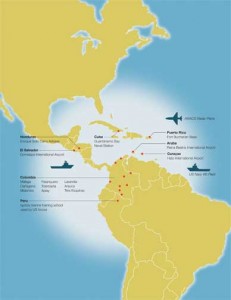
In September Ecuador's president, Rafael Correa, delivered on an electoral promise and refused to renew Washington's decade-old, rent-free lease on an air base outside the Pacific coast town of Manta, which for the past ten years has served as the Pentagon's main South American outpost. The eviction was a serious effort to fulfill the call of Ecuador's new Constitution to promote “universal disarmament” and oppose the “imposition” of military bases of “some states in the territory of others.” It was also one of the most important victories for the global demilitarization movement, loosely organized around the International Network for the Abolition of Foreign Military Bases, since protests forced the US Navy to withdraw from Vieques, Puerto Rico, in 2003. Correa, though, couldn't resist an easy joke. “We'll renew the lease,” he quipped, “if the US lets us set up a base in Miami.”
Funny. Then Washington answered with a show of force: take away one, we'll grab seven. In late October the United States and Colombia signed an agreement granting the Pentagon use of seven military bases, along with an unlimited number of as yet unspecified “facilities and locations.”
Connect these dots: In Nigeria this week, Muslim youths set fire to a church, killing more than two dozen Christian worshippers. In Egypt, Coptic Christians have been suffering increased persecution including, this month, a drive-by shooting outside a church in which seven people were murdered. In Pakistan, Christian churches were bombed over Christmas. In Turkey, authorities have been closing Christian churches, monasteries and schools. Recently, churches in Malaysia have been attacked, too, provoked by this grievance: Christians inside the churches were referring to God as “Allah.” How dare infidels use the same name for the Almighty as do Muslims!
After reading this report by my good friend Werther, I would urge you to compare Werther's analysis to the “inside the beltway,” K Street analyses published in today's Washington Post — then decide which you like better.
By Werther (Pseudonym) Electric Politics January 22, 2010
The Supreme Court's wholesale rejection of a century of statutes regulating corporate contributions to political campaigns is a breath of fresh air in a hypocrisy-ridden political process. It certainly ought to sweep away the tendency of timid rationalizers to deny the existence of corporate domination and control of every aspect of governance in the United States — a fact which should have already been made abundantly clear by the terms of the bank bailout and the health care travesty.
It is not inconceivable, using the Court's logic, that antitrust laws could be thrown out as well. Since natural persons have freedom of association, why should not artificial persons have a similar freedom of association? The Court has in fact created a species of Nietzschean Übermensch: a non-human human endowed with the strength of many people and theoretically immortal.
Now that our Supreme Court, with the assistance of a little medieval alchemy, has ruled that property can be transmuted into persons, is it conceivable that it could do the opposite? Before one dismisses the thought, the executive branch, with the connivance of lower federal courts, has already been busy establishing the precedent that persons held at Guantanamo prison and other facilities can be converted into the property of the United States Government, to be held indefinitely.
CLETA MITCHELL : The Supreme Court has correctly eliminated a constitutionally flawed system that allowed media corporations (e.g., The Washington Post Co.) to freely disseminate their opinions about candidates using corporate treasury funds, while denying that constitutional privilege to Susie's Flower Shop Inc
ROBERT LENHARD: The balance of power in political contests has shifted dramatically away from candidates running for office and toward corporations and unions seeking to advance their policy agendas.
KENNETH GROSS: Contrary to popular reports, the sky is not falling.
ANNA BURGER: There can be no doubt: The voice of everyday working Americans in the political process will be muted.
BEN GINSBERG: The voices of candidates and political parties just got much quieter.
MARK ELIAS: While few individuals exercise their right to fund multimillion-dollar advertising campaigns, we should expect that corporations will eagerly do so. Given corporate wealth and the legislative stakes, in many elections corporations will dominate paid campaign communications — leaving candidates and political parties as secondary actors.
KAREN FINNEY: At the very moment Americans' mistrust of big corporations, big government and large institutions has reached a fever pitch, the Supreme Court moved to replace a government of, for and by the people with a government that can be bought and paid for by just about any major corporation — from Exxon to Russian-owned Lukoil to China's CPC Corp.
U.S. District Judge Vaughn Walker’s decision was a major blow to the two suits testing warrantless eavesdropping and executive branch powers implemented following the 2001 terror attacks. The San Francisco judge said the courts are not available to the public to mount that challenge.
“A citizen may not gain standing by claiming a right to have the government follow the law,” (.pdf) Walker ruled late Thursday.
Cindy Cohn, the legal director of the Electronic Frontier Foundation that brought one of the cases, said the decision means “when you’re trying to stop the government from doing something illegal, and if the government does it to enough people, the courts can’t fix it.”
The greatest human achievement is the subordination of government to law. This was an English achievement that required eight centuries of struggle, beginning in the ninth century when King Alfred the Great codified the common law, moving forward with the Magna Carta in the thirteenth century and culminating with the Glorious Revolution in the late seventeenth century.
The success of this long struggle made law a shield of the people. As an English colony, America inherited this unique achievement that made English speaking peoples the most free in the world.
As Lawrence Stratton and I show in our book, The Tyranny of Good Intentions (2000), the protective features of law in the U.S. were eroded in the twentieth century by prosecutorial abuse and by setting aside law in order to better pursue criminals. By the time of our second edition (2008), law as a shield of the people no longer existed. Respect for the Constitution and rule of law had given way to executive branch claims that during time of war government is not constrained by law or Constitution.
This country needs to get a grip. We need a slap in the face, a splash of cold water.
On Saturday, 57-year-old Jules Paul Bouloute opened an emergency exit inside the American Airlines terminal at Kennedy airport. Alarms blared and sirens flashed. Bouloute later told police that he'd opened the door by accident.
Which is what you'd assume. Sure, the exit was clearly marked, but it happens all the time, does it not?
All of Terminal 8 was evacuated for more than two hours. Police then swept through the building with dogs and SWAT teams (because, you see, a terrorist wouldn't quietly drop an explosive device into a trash barrel; he would first set off alarms, in order to…?). Before being allowed back in, thousands of travelers were forced to undergo rescreening at the Transportation Security Administration checkpoints, giving guards a chance to snag any butter knives or 4-ounce shampoo bottles they might have missed the first time. Inbound planes were stranded on the tarmac and departures were delayed for several hours.
This is both a very intelligent search and a very funny search. CIA and the rest of the IC do not have a “method” because they do not do “learning” in the classical sense. It is virtually all “on the job” training and the culture across the board is one of hubris as in “we know best, if you have time for training–which we consider a vacation–then you must not be essential or having anything urgent to do.”
The National Intelligence University has taken a few baby steps, perhaps moving the US Intelligence Community from the first grade to the fourth grade, absolutely no further. The legal, security, management, budget, and cultural mind-sets are simply too daunting.
The ONE THING that could be taught early, and is not, because all of the management levels crush it along with creativity and freedom of expression, is INTEGRITY. The truth at any cost reduces all others costs. Most managers in most of the secret agencies believe they are the sole arbiters of the truth, the truth must by definition be secret, and anyone who disagrees with them is a traitor, stupid, or a loose-cannon.
Phi Beta Iota: From an individual who trained many of the NCTC analysts, is fully familiar with the database mess as well as the management mind-sets, and wishes to see America get the best value for its $75 billion a year. We have added emphasis (bold) to the two paragraphs below.
18 January 2010
The New York Times article provides yet more evidence that the U.S. Intelligence System is indeed broken. Now although such experienced experts as J. Briggs and Herb Meyer dislike thinking in terms of a ‘system’ I think it is a useful concept. In this case the Time’s article focuses on how this system did or did not operate in the specific case of the underwear bomber, Umar (Omar) Farouk Abdul Mutallab (how many analysts are aware that as transliterated from Arabic script his name can be spelled several ways).
Based on the evidence from the article, the U.S. Counter-Terrorism Intelligence effort consists of the National Counter Terrorism Center (NCTC) in the ODNI, CIA’s Counter Terrorism Center (CTC) and an NSA Counter-Terrorism Office. The article argues that senior U.S. Government Officials failed to note, what in retrospect, were obvious warning signs of a possible al Qaeda threat to the U.S. homeland. The thrust of the article however is that working level analysts at the NCTC failed to “connect the dots” and that this failure was mirrored by CTC analysts at CIA.
The apparent basic failure lay in a false assumption by both Centers that al Qaeda was incapable of mounting sophisticated or carefully planned attacks. Although the assumption was without bases it was and probably still is accepted as fact by analysts in both Centers. This reminds one of “the Japanese lack the technical capability and training to attack Pearl Harbor” another false assumption that had disastrous consequences.
This erroneous assumption was compounded by failures of research and analysis by the analytic staff of NCTC. These failures were facilitated by what must be the most absurd organizational structure in the history of intelligence analysis. One group of some 24 analysts at NCTC are assigned as “watch list analysts”, whose job apparently is to maintain lists of names kept in several data bases including one with a reported 500,000 names. This group apparently did not interact with a second group of 300 ‘all source analysts’ whose job apparently is to sift through all available evidence to identify and asses threats to U.S. Security whether from individuals or generic, that is to connect the dots. They completely failed to do this. In the article individuals in both groups are called analysts or ‘specialist’ and are assumed to be CT experts. In point of fact when the NCTC opened this was not the case and is probably not the case now. It is an article of faith among senior intelligence officials that all analysts are the same and are interchangeable as long as they have the title of analyst. This is of course nonsense and causes unqualified people, including contractors, to be placed in sensitive analytic positions that are really beyond there abilities.
Contributing to this failure is the inexcusable fact reported in the article that of the some 80 data bases available to these analysts many are hard to use, there are apparently no relational data bases, and clearly no one has any training in the art of information retrieval and management.
Finally if one reads between the lines there were clearly multiple failures of technical leadership across the board so that managerial incompetence could not be corrected at the working level.
So when President Obama referred to a “systemic failure” he was right. The U.S. Intelligence System failed because its human sub-system (analysts) failed; its information management systems failed; and its frontline leadership sub-system failed. Its management sub-system did not fail because it was not operable in the first place.
So what will come of all this? My guess is that even more unqualified or under-qualified analysts will be ‘surged’ to NCTC and CTC, more expensive and ill designed information systems will be added to those already there, and a host of bogus statistics will be dredged up to prove that both centers actually work perfectly. And of course cash bonuses for all hands to prove what a good job they actually did.

 CAN HAITI SURVIVE?