Capt. Robert Salas (USAF, Ret.) testifies and then describes a series of incidents that he witnessed both first hand and then has continued to study, where US Nuclear capabilities were disabled or compromised in conjunction with sightings of UFOs and unexplained phenomena in the vicinity of the bases.
In the attached essay, my very good friend Mike Lofgren raises the question of whether defense spending is good for the economy. This is a current issue because the threat of defense budget reduction is being countered by arguments asserting that these reductions will push the economy into recession. More generally, the political addiction to defense spending has been a major contributor to our nation's economic decline and our political stagnation — i.e., what I have called Americas Defense Dependency, the subject of an essay I wrote last November for Counterpunch. Mike comes at these issues from a different albeit complimentary and equally important angle.
Readers interested in learning more about this important subject will find the work of the late Professor Seymour Melman of Columbia University to be particularly edifying. In his prescient book, Profits Without Production (Knopf, 1983), Melman explained how the growing militarization of our economy was one of the central causes of the decline in America’s manufacturing competitiveness. This decline started in the 1970s, but Melman showed how it grew out of seeds planted by the permanent military mobilization of a huge defense industry in the 1950s.
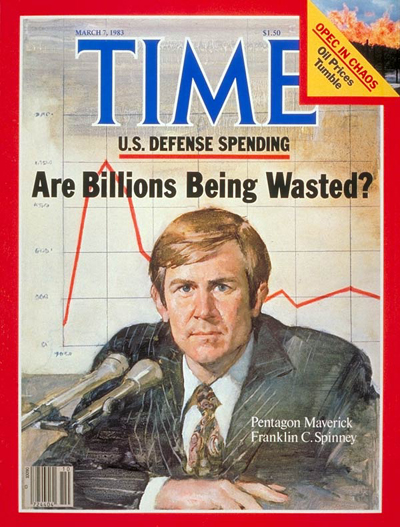
The 1960s comedy show Laugh-In included an occasional sketch in which co-host Dan Rowan played a comic general whose tag-line was “war is good for business!” In an ironic echo of that skit, an April 27 Washington Post story delivers the same message: “A steep slowdown in defense spending tied to the end of the wars in Iraq and Afghanistan is undercutting the country's economic recovery, new government data released Friday revealed.” An 11.5-percent annual drop in Pentagon spending resulted in slower growth in the gross domestic product (GDP) during the first quarter of 2013 than economists expected.
So did the dozen years of war, with all the deaths, destruction, and expense they entailed, have the perverse silver lining of being good for the economy? Most mainstream economists — who, like cynics, know the price of everything and the value of nothing — would answer in the affirmative.
Gross domestic product, which they tend to treat as a surrogate for economic well-being, is only a tote board of all spending that occurs in an economy. Statistics like GDP are arbitrary, subject to incomplete data, and can mislead us about underlying economic conditions. A dollar spent on a cancer cure has the same worth to the GDP as a dollar spent to bribe an Afghan drug lord. This convention can reach absurd lengths, such as massive hurricane damage possibly increasing the GDP: money must be spent just to get conditions back to the way they were, but it counts it as “growth.”
Based on my almost three decades on Capitol Hill, most of them involved in defense budgeting, I can say authoritatively that military spending evokes an almost mystical reverence among many members of Congress. A $325-billion defense program like the F-35, however technically flawed, typically engenders less floor debate than relatively miniscule domestic programs such as the Corporation for Public Broadcasting.
The author of the attached report, Patrick Cockburn, is one of very best reporters reporting on the Middle East, and perhaps the most knowledgeable on Iraq. This is a very important report, in my opinion.
Partition could really have a destabilizing influence on the entire Arab region, but especially Syria, as well as non-Arab Turkey. The neocon (and Israeli) dream enhancing Israeli security by breaking up the Muslim state system into a directionless mass of insecure weak warring statelets may well be on its way to fruition. Next stop – Iran????
Soldiers are deserting a beleaguered Iraqi army as it struggles to keep its hold on the northern half of Iraq in the face of escalating hostility from Sunni Arabs and Kurds who dominate in the region.
Around the oil city of KirkukKurdish troops have advanced south to take over military positions abandoned by the army, while in Baghdad senior Iraqi politicians say that for the first time there is talk of partitioning the country.
The current crisis was sparked on 23 April when the Iraqi army attacked a sit-in protest in the Sunni Arab town of Hawijah, killing at least 50 people and injuring 110. Outraged Sunni Arab protesters have since stepped up their demonstrations against the Shia-led government. Demonstrators are increasingly protected by armed men, some of whom are accused of dragging five military intelligence soldiers in civilian clothes from a car that came near a protest in Fallujah and killing them.
There are signs that the Iraqi army can no longer cope with a crisis in which it is confronting both Sunni Arabs and Kurds.Many soldiers prefer to desert the army rather than shoot at protesters said Najmaldin Karim, the Kurdish Governor of Kirkuk, where Hawijah is situated, in an interview with The Independent. Most deserters are Sunni, Mr Karim said, but he added that some are Shia who don’t want to fight in strange places for something they don’t believe in.
WASHINGTON (AP) — Built to dominate the enemy in combat, the Army‘s hulking Abrams tank is proving equally hard to beat in a budget battle.
Lawmakers from both parties have devoted nearly half a billion dollars in taxpayer money over the past two years to build improved versions of the 70-ton Abrams.
But senior Army officials have said repeatedly, “No thanks.”
It's the inverse of the federal budget world these days, in which automatic spending cuts are leaving sought-after pet programs struggling or unpaid altogether. Republicans and Democrats for years have fought so bitterly that lawmaking in Washington ground to a near-halt.
Yet in the case of the Abrams tank, there's a bipartisan push to spend an extra $436 million on a weapon the experts explicitly say is not needed.
“If we had our choice, we would use that money in a different way,” Gen. Ray Odierno, the Army's chief of staff, told The Associated Press this past week.
For reflection — a number of well-sequenced photographs are included. Concludes that only three people actually died across entire event, virtually all those injured were actors.
‘The conscious and intelligent manipulation of the organized habits and opinions of the masses is an important element in democratic society. Those who manipulate this unseen mechanism of society constitute an
invisible government which is the true ruling power of our country. We are governed, our minds are molded, our tastes formed, our ideas suggested, largely by men we have never heard of.' — Edward Bernays, 1928, pg.1, Propaganda
A shocking report detailing horrific atrocities committed against Brazilian Indians in the 1940s, 50s and 60s has resurfaced – 45 years after it was mysteriously ‘destroyed’ in a fire.
The Figueiredo report was commissioned by the Minister of the Interior in 1967 and caused an international outcry after it revealed crimes against Brazil’s indigenous population at the hands of powerful landowners and the government’s own Indian Protection Service (SPI). The report led to the foundation of tribal rights organization Survival International two years later.
Brazilian Birth Control: Cut Mother in Half – Click on Image to Enlarge
The 7,000-page document, compiled by public prosecutor Jader de Figueiredo Correia, detailed mass murder, torture, enslavement, bacteriological warfare, sexual abuse, land theft and neglect waged against Brazil’s indigenous population. Some tribes were completely wiped out as a result and many more were decimated.
The report was recently rediscovered in Brazil’s Museum of the Indian and will now be considered by Brazil’s National Truth Commission, which is investigating human rights violations which occurred between 1947 and 1988.
. . . . . . . . .
Other examples include the poisoning of hundreds of Indians with sugar laced with arsenic, and severe methods of torture such as slowly crushing the victims’ ankles with an instrument known as the ‘trunk’.
Yesterday, during a radio talk show hosted by Mike Harris with Dr. James Fetzer and me as guests, Colonel James Hanke, a longtime friend and senior US Army intelligence officer (retired) phoned in. Hanke is the highest ranking intelligence official every to admit to false flag terrorism and to speak of it openly.
Hanke, former chief intelligence officer of NATO’s largest command, 3rd Army, former Military Attache to Israel and a recognized leader of the “mainstream” special operations community is still active within the intelligence community.
The interview below is a unique opportunity to view the “sea change” in awareness among senior intelligence personnel as to the breakdown in America’s government and security structure, enough of a “breakdown” to allow organizations to stage attacks, even assassinations, inside the United States.