Robert Steele: World Brain / Global Game Update with Concept for School of Future-Oriented Hybrid Governance and Centre for Multinational Multiagency Multidisciplinary Multidomain Information-Sharing and Sense-Making (M4IS2)

Advanced Cyber/IO, Collaboration Zones, Communities of Practice, Key Players, Policies, Serious Games, Threats
Robert David STEELE Vivas

As the global economy collapses and increasing numbers recognize that no one is addressing our common problems with intelligence and integrity, it seems like a good time to quickly survey the state of the World Brain /Global Game. Here are a few headlines with short comments.

2011-07-07 Complex Global Issues Explored in the World Brain Trust’s Annual Reports

The Network of Global Agenda Councils, launched by the World Economic Forum three years ago, comprises more than 1,000 thought leaders who meet at least four times a year – three times in virtual meetings and once during the annual Summit on the Global Agenda in the United Arab Emirates, arguably the biggest intellectual brainstorming in the world.

RS:  This is the World Economic Forum / 1% “front” version of the World Brain.  There is a great deal that can be harvested from this endeavor, but it lacks a strategic analytic model, a commitment to open source data access and other fundamentals of the M4IS2 process.  It is inherently elitist.  Of interest is the fact that all of its community lists have been blanked out
Click on Image to Enlarge

1964-10-06 Towards the World Brain – Eugene Garfield

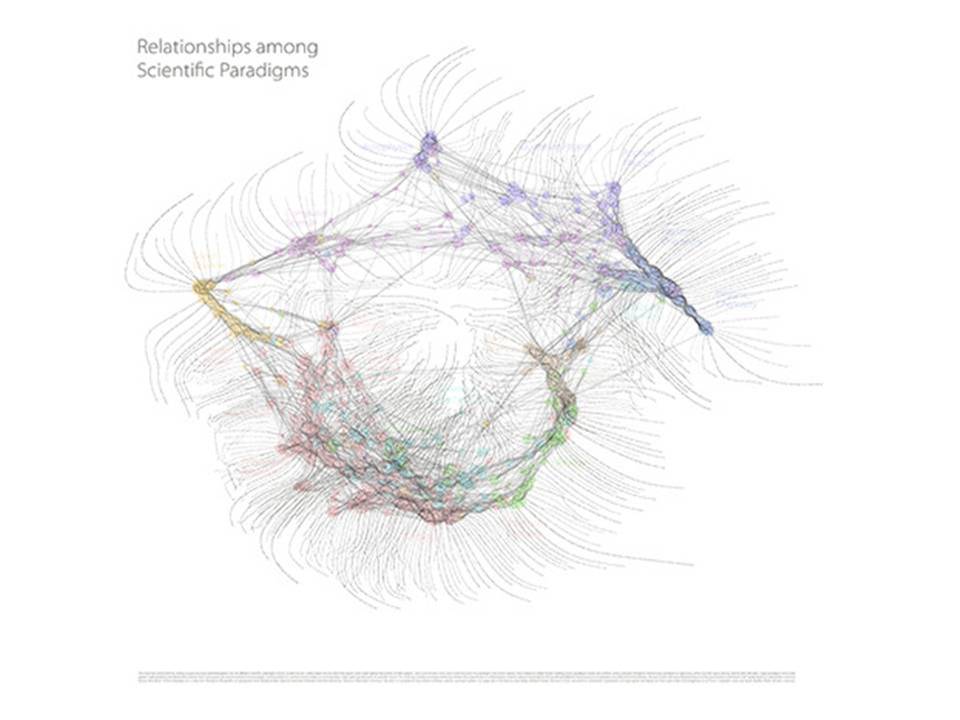
RS:  Eugene Garfield with the Institute of Scientific Information (now Thompson Reuters), and then Dick Klavans with Maps of Science, have done more than any other to actually create a structure for identifying strengths, gaps, and emergent possibilities in the World Brain on the basis of published formal knowledge.  One of my most prized possessions is the internal massive PDF file (shown here as a snapshot) that allows for drilling down all the way to each and every sub-discipline.  Here are two of the seminal works:

2009 Mapping the Backbone of Science – Klavans Boyack

2005 Mapping the Backbone of Science – Boyack Klavans Borner

Click on Image to Enlarge

RS: Using techniques developed by Garfield and Klavans (much of this done prior to computing advances, by hand), Thompson Reuters now offers a service that can show, by country, region, university, or discipline, where the strengths and weaknesses are on the basis of citation analysis.  One example for the USA is shown here to the side.  This remains severely deficient for two reasons: first, the persistence of inbred citation cabals; and second, the extremely poor coverage of languages other than English, French, and German.  There is a third deficiency beyond that of citation analytics, and that has to do with the identification of unpublished experts of various kinds–I am especially interested in the indigenous experts and the oral historical knowledge they have inherited from prior generations.  Finally, there is a fourth deficiency yet to be addressed that will eventually turn citation analytics on its head: most research is isolated from both a strategic analytic model and true cost economics.  When these two are eventually factored in, I believe there will be a revolutionary shift in interest away from Western citation cabals and toward those in Brazil, China, India, Indonesia, Russia, South Africa, and Turkey, among others.

RS:  To the best of my knowledge, and having failed to get Jeff Bezos to think of Amazon as the World Brain is gestation (including reviewers and readers down to the zip code level of specificity), no one, anywhere, is actually putting together a strategic analytic model, global true cost data, and a global grid of published and unpublished experts in all languages.  Some of the Earth Science networks have the right idea, but are missing some big pieces.

2012-03-29 EarthGame

EarthGame™ is a massively multiplayer online strategic design and planning real-world “game.” It is also a set of tools for recognizing, defining and solving global and local problems onboard Spaceship Earth. It combines the vast and growing wealth of global data available on the web with sophisticate data visualization techniques, embeds these within a powerful strategic planning and design methodology, and places all this into a gaming context.

RS: Medard Gabel, co-creator with Buckminster Fuller of the analog World Game, remains the only person I know of (i.e. in the English language) who is serious about creating the Global Game.  Earth Intelligence Network (EIN) funded his definition of the preliminary staffing and cost, as well as the trademarking (in his name) of EarthGame.  I have approached one massive multi-player game firm about joining with Wolfam Alpha and EarthGame, but they were not interested.  Below is the high-level summary he created for EIN.

2012-03-29 EarthGame 1.0 Version 3.3-1

RS:  I am aware of the World Game as managed by the Buckminster Fuller Institute  and commercialized by OSEarth.  Neither of these has the mind-set, depth, or breadth that Medard and I have envisioned together.  The Global Economics Game has some laudable aspects to it, but accepts so many false assumptions about true cost and corruption and the way the world actually works that it would need a considerable make-over–never-the-less, it is a most impressive endeavor and not to be over-looked.
Click on Image to Enlarge

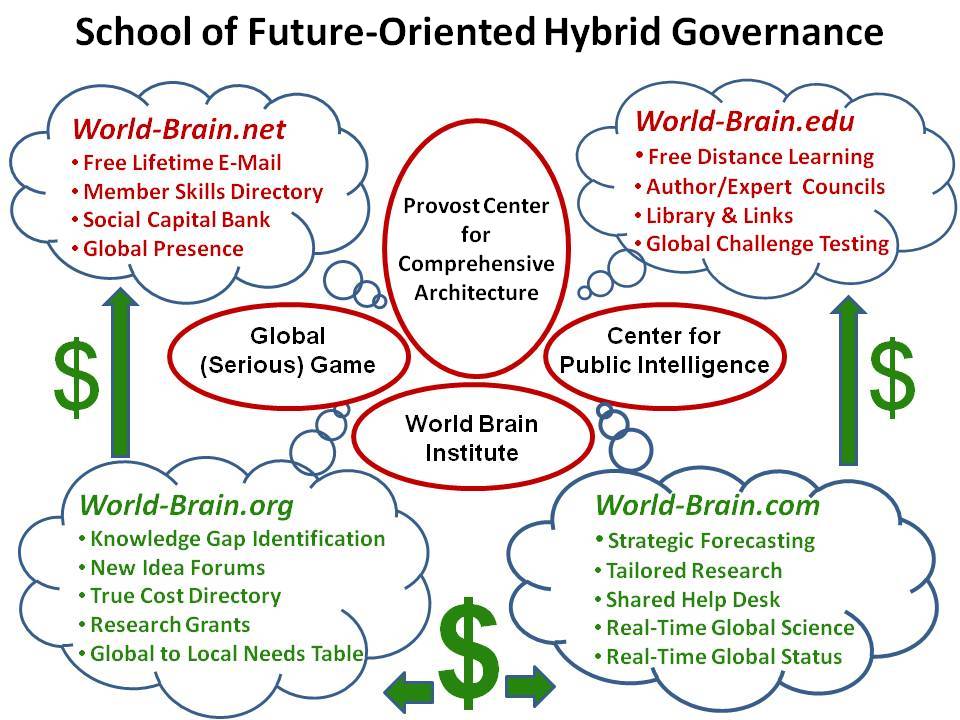
RS:  The whole point of the Global Game is to connect all human minds with all information in all languages — and embedded open source everything tools — so that every person can play themselves, fully informed in a timely fashion, on every issue from local to global.  I myself am actively in search of a major university interested in creating a School of Future-Oriented Hybrid Governance with a Center for M4IS2, a World Brain Institute, the Global Game (with Medard Gabel), and a prototype Center for Public Intelligence — all committed to open source software, hardware, spectrum, and OpenBTS as the hand-held standard.

See Also:

THE OPEN SOURCE EVERYTHING MANIFESTO: Transparency, Truth & Trust (2012)

INTELLIGENCE FOR EARTH: Clarity, Diversity, Integrity, & Sustainability (2010)

COLLECTIVE INTELLIGENCE: Creating a Prosperous World at Peace (2008)

THE SMART NATION ACT: Public Intelligence in the Public Interest (2006)

INFORMATION OPERATIONS:  All Information, All Languages, All the Time (2006)

THE NEW CRAFT OF INTELLIGENCE: Personal, Public, & Political (2002)
ON INTELLIGENCE: Spies and Secrecy in an Open World (2000)

Owl: Ascendence of Sociopaths in US Governance

Corruption, Cultural Intelligence, Government
Who? Who?

A tad preesumptuous but distressingly “in the zone.”

The Ascendence of Sociopaths in US Governance

Doug Casey, Chairman
Casey Research, 21 March 2012

Here are some especially good observations from this article:

“… a certain class of people – sociopaths – are now fully in control of major American institutions. Their beliefs and attitudes are insinuated throughout the economic, political, intellectual and psychological/spiritual fabric of the US. What does this mean to the individual? It depends on your character. Are you the kind of person who supports “my country right or wrong,” as did most Germans in the 1930s and 1940s, or the kind who dodges the duty to be a helpmate to murderers? The type of passenger who goes down with the ship or the type who puts on his vest and looks for a life boat? The type of individual who supports the merchants who offer the fairest deal or the type who is gulled by splashy TV commercials?”

Continue reading “Owl: Ascendence of Sociopaths in US Governance”

DefDog: Feds Hype Cyber-Threat, Seek DHS Mandates & Money

Corruption, Government, IO Impotency
DefDog

Feds Warn of Cyber Threats, Seek Expanded Authority for DHS

By Kenneth Corbin

March 28, 2012 — CIO — Federal cybersecurity officials on Wednesday gave lawmakers a sobering warning about the vulnerabilities of critical information technology systems across the public and private sectors, describing a laundry list of threats and the challenge of keeping up with hackers who are continually seeking new methods of attack.

Appearing before a House subcommittee, cybersecurity authorities from the Department of Homeland Security, the Federal Communications Commission and other government arms testified to the work their agencies are undertaking in response to the ongoing threats, both internally and in concert with the private sector, but acknowledged that the challenges remain formidable and appealed for expanded government authority to shore up the nation's digital defenses.

“Cybersecurity threats are a real and present danger to our current economy and well being,” retired Adm. James Barnett, chief of the FCC's Public Safety and Homeland Security Bureau, told members of the Energy and Commerce Committee's Subcommittee on Communications and Technology. “No one would tolerate the level of criminality, thievery, vandalism or invasion of privacy if it were done in the physical world, and we really can no longer afford to tolerate it in cyberspace.”

Barnett and other witnesses described a wide range of threats and vulnerabilities that imperil communications networks, including weaknesses in the domain name system, or DNS, man-in-the middle attacks, route hijacking and weak spots in the supply chain.

But while there is broad agreement that the threats are severe and constantly evolving, deep divisions arise in the policy debate over what role the federal government should play in developing and overseeing the nation's digital defenses.

The Department of Homeland Security is at the center of that discussion. In the Senate, competing bills have emerged to address the cybersecurity challenge. One proposal, backed by Sens. Joe Lieberman (I-Conn.) and Susan Collins (R-Maine), would grant DHS new authorities to oversee private-sector digital infrastructure that was deemed critical. A competing bill takes a far more limited approach, focusing instead on facilitating the sharing of information about cyber threats among public and private entities. The Republicans backing that measure, the SECURE IT Act, have been sharply critical of DHS' performance on many security fronts, including cybersecurity.

Those same suspicions were on display in Wednesday's House hearing. Rep. Mary Bono Mack (R-Calif.), who yesterday introduced the companion bill to the SECURE IT Act in the lower chamber, cited the department's handling of the Chemical Facility Anti-Terrorism Standards program, which she said has squandered hundreds of millions of dollars without measurably improving the infrastructure of the chemical sector. How, then, could DHS be trusted to oversee cybersecurity?

Read rest of article.

Phi Beta Iota:  The US Government is incompetent and does not represent the public interest.  The only thing dumber than giving billions of dollars to the US Army and the Potemkin Village called “Cyber-Command” is to give any amount of money to the Department of Homeland Security (DHS) which is the lowest common denominator across the board.  The fact is that the US Government is irrelevant to cyber-security–what expertise there is exists outside the government, and the government is the last to know anything, with nothing to contribute except hype and inflated printed money.  Absent a non-violent revolution in governance, one that restores intelligence and integrity to the how of governance, what the US Government does in the cyber world is generally going to be part of the problem, not the solution.

See Also:

Review: WORM – The First Digital World War

1994 Sounding the Alarm on Cyber-Security

1998 TAKEDOWN: Targets, Tools, & Technocracy

2010: OPINION–America’s Cyber Scam

Phi Beta Iota General Search for Cyber-Scam Posts

2012 The Open Source Everything Manifesto: Transparency, Truth, & Trust (Evolver Editions, June 2012)

2012 Reflexivity = Integrity: Toward Earth/Life 4.0

John Steiner: Canary (Health) Party Calls Out US Government on Corruption in Food and Medical Industries Creating Mega Autism Epidemic

07 Health, Communities of Practice, Corruption
John Steiner

CDC to Announce New Autism Rate of 1 in 88, and Likely to Declare “No Public Health Emergency”and “No Epidemic”

This week, the Canary Party expects CDC to announce a new autism prevalence rate of 1 in 88. As boys are diagnosed with autism at four times the rate of girls, this translates to 1 in 54 boys. That new rate would be an increase from the previous 1 in 110 reported two years ago by the CDC’s ADDM (Autism Developmental Disabilities Monitoring) Network. This would only be the latest uptick in the autism rate reported by CDC, as the disorder was diagnosed in 1 in 10,000 in the 1960s, and the rate was virtually zero before 1930.

The Canary Party also expects federal health authorities to continue to downplay the seriousness of the skyrocketing autism rate, just as they have done for the past two decades since the rate began rising dramatically. Canary Party Chairman and autism father Mark Blaxill, drawing on his own experience working with federal agencies on autism for many years, commented, “No matter how high the autism rate soars, the CDC’s continued denial of an autism epidemic is certitude comparable to death and taxes.”

History shows us that Polio was called epidemic when the rate was only one in 2,700. The American Academy of Pediatrics recently called trampoline injuries epidemic, even though that rate was only about one in 1,200 children for the year the those injuries were reported (1996). By these measures, The Canary Party holds the position that autism should have been declared an “epidemic” many years ago. Some have offered the excuse that only infectious diseases can be called epidemic, but as the CDC has announced that obesity is epidemic in the U.S., the Canary Party believes that this leaves the agency with no good explanation for failing to characterize autism as such.

Ginger Taylor, Executive Director of The Canary Party, echoes the questions that autism parents have been asking for years: “How did we go from one in 10,000 children born 50 years ago being diagnosed with autism to 1 in 88 diagnosed today? Why do the Centers for Disease Control refuse to call the avalanche of autism diagnoses in the U.S. anything more than an “urgent public health concern?” Why is the federal agency downplaying a national emergency with special wording created just for autism – Urgent Public Health Concern – a label that is not used to describe any of the thousands of other disorders and conditions the agency tracks? When dozens of published research papers and multiple congressional hearings have shown that the primary causes of autism are environmental, and include vaccines and their components, why has CDC failed to offer any advice to new parents on how to decrease the chance of a child developing autism? Why has CDC chosen not to even attempt to identify which children are the subset vulnerable to these environmental exposures so that they can be handled with greater care?”

Continue reading “John Steiner: Canary (Health) Party Calls Out US Government on Corruption in Food and Medical Industries Creating Mega Autism Epidemic”

Mini-Me: US Dollar Out, Yuan, System D, and Open Money In + Meta-RECAP

Advanced Cyber/IO, Budgets & Funding, Collaboration Zones, Communities of Practice, Corruption, Ethics, Key Players, Policies, Threats
Who? Mini-Me?

BRICS Move To Replace Dollar With “Super-Sovereign” Global Currency

Alexander Higgins, Contributor

Activist Post, 28 March 2012

As China is expected to rise to the status of a financial superpower within the next 8 years and eclipse the US economy by 2020, Africa becomes center stage in the greatest currency war the world has seen since the 1930s, which is now shifting into overdrive.

Brazil, Russia, India, China and South Africa, collectively known as the BRICS nations, are moving forward with their plan to unseat the US dollar from its throne as the global trade currency and to replace it with a Chinese-denominated “super-sovereign” international currency.

Click on Image to Enlarge

This Geo-political game to establish global monetary dominance is by no means limited to the attack on the US dollar. Instead this is merely the first strike of a concerted campaign of worldwide economic warfare that will soon follow which seeks to bring the United States and its western allies to their knees.

Ultimately the BRICS collective is staging a coup to overthrow the current global financial regime that has been dominated by the World Bank and the International Monetary Fund since the last global currency war was won at the end of World War II.

The attack comes partially in retaliation for the latest round of quantitative easing in which we witnessed the Federal Reserve deliberately printing trillions of dollars in an attempt to jump-start the U.S. economy by forcing investors back into the U.S. stock market by devaluing the US dollar.

Phi Beta Iota:  One third of the global economy is transnational crime, and one third System D or “off the books” entrepreneurial information economics routing around governments.  Now that we know the final third is legalized crime, it becomes much easier to understand why two thirds of the brain power on the planet has opted out of the legalized crime world that favors the 1%.

See Also:

Continue reading “Mini-Me: US Dollar Out, Yuan, System D, and Open Money In + Meta-RECAP”

Eagle: Seven Signs USA is a Third World Country — Or Worse

Corruption, Government
300 Million Talons...

The Receding Tide

by Fred Reed

Lew Rockwell, 28 March 2012

Several things characterize countries of the Third Word, whatever precisely “Third World” means.

The first is corruption. America is rotten with it, but American corruption is distinct from corruption in, say, Guatemala or Thailand, being less visible and better organized.

Several major differences exist between the usual corruption in the Third World and that in America. In most of the Third World, corruption exists from top to bottom. Everyone and everything is for sale. Bribery amounts to an economic system, like capitalism or socialism. By contrast, in the United States, graft flourishes mostly at the level of government and commerce. You don’t (I think) slip an admissions official at Harvard twenty grand to accept your shiftless and dull-witted slug of a misbegotten offspring. Nor do you pay a local judge to drop dope charges against your teenager. And in the Guatemalas and Egypts of the planet, corruption tends to be personal. The briber and the bribed act as individuals.

Continue reading “Eagle: Seven Signs USA is a Third World Country — Or Worse”