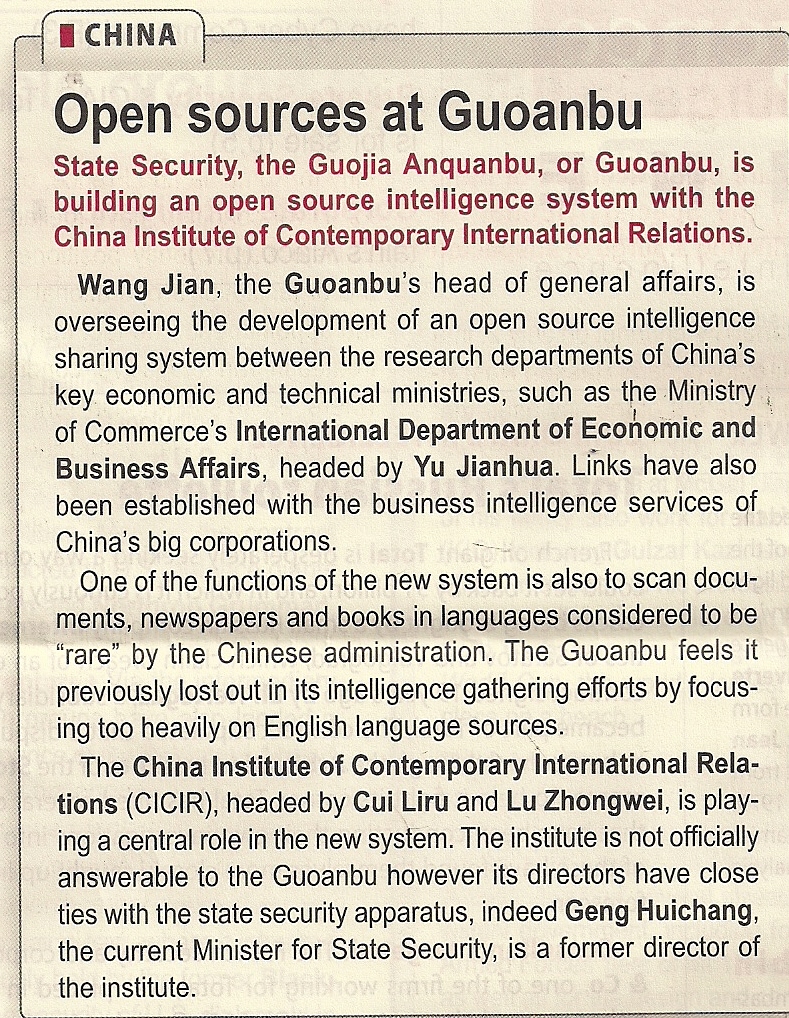
Phi Beta Iota:Intelligence Online is the one subscription we cannot live without. See their other offerings as well. Reading between the lines, it would appear the Chinese no longer feel “behind” the English-language world, and are doing what the English-language world should have been doing since 1988: focusing on reality as it is depicted in all other languages.
I don't usually present another organization's fundraiser in the middle of our Co-Intelligence Institute fundraiser, but this is an exception I feel strongly about.
Generating real wisdom together – not just knowledge and resources (as valuable as these are) – requires talking together. Furthermore, vast domains of our humanity flourish and deepen through conversation. And in both cases, the QUALITY of conversation makes all the difference in the world.
Collectively humanity now knows a lot about how to make powerful, enjoyable, meaningful conversations. A large and rapidly growing field of study and practice stewards these deeply human technologies and explores how to develop them further and use them better for broader benefit. These people bring to life a fundamental co-intelligence precept – accessing the wisdom of the whole on behalf of the whole.
Some of the most dedicated and creative people among those professionals are members of the National Coalition for Dialogue and Deliberation. It is a home base, a learning community, an unparalleled resource – and it could be more. In my opinion, tNCDD nurtures one of the most important networks for the future of the planet. I consider its thrival essential. Furthermore, I have the highest respect for its co-founder and director, Sandy Heierbacher, a grounded, heartful, effective change agent. Her contribution to us all awes me.
NCDD's resource center alone is a priceless gift to each and every one of us. See, in particular, their Beginner's Guide and their “Best of the Best” page .
It goes without saying that I value any support you can give the Co-Intelligence Institute, But I want to urge you here to lend your support to NCDD, whether or not you donate to CII. As I tighten my own belt, I have given NCDD $100. Please read the note below that Sandy sent to me and other NCDD members and consider what you can do.
As part of its expanding counterterrorism program in Somalia, the CIA also uses a secret prison buried in the basement of Somalia’s National Security Agency (NSA) headquarters, where prisoners suspected of being Shabab members or of having links to the group are held. Some of the prisoners have been snatched off the streets of Kenya and rendered by plane to Mogadishu. While the underground prison is officially run by the Somali NSA, US intelligence personnel pay the salaries of intelligence agents and also directly interrogate prisoners. The existence of both facilities and the CIA role was uncovered by The Nation during an extensive on-the-ground investigation in Mogadishu.
Hacking murdered children's phones, paying off police, destroying evidence of crimes, threatening politicians — UK leaders say Rupert Murdoch's empire has “entered the criminal underworld”. For decades, Murdoch has ruled with impunity — making and breaking governments with his vast media holdings and scaring opponents into silence, but we're fighting back, and winning!
Murdoch's reign of fear is breaking down, and many are on the edge of speaking out against his tactics. The dam is about to break in the US, Australia and elsewhere, but we need to give it an urgent push by investigating Murdoch further, organising high profile opposition, and making sure that our politicians pass laws that will clean up our media for good. Let's make it happen together:
Our community kept campaigning on this issue when almost everyone else in the UK gave up hope. Because we're people-powered, we don't have the same fear of Murdoch that almost everyone else does. It's part of the promise that people power has for change in the world. Today, hope is breaking out in the UK — let's take it global.
Does anyone still remember the GOP of the chowder and marching society, Jell-O salads, Buicks, and cloth coats? Is it conceivable that a Republican could have written the following? —
“Should any political party attempt to abolish social security, unemployment insurance, and eliminate labor laws and farm programs, you would not hear of that party again in our political history. There is a tiny splinter group, of course, that believes you can do these things. Among them are H. L. Hunt (you possibly know his background), a few other Texas oil millionaires, and an occasional politician or business man from other areas. Their number is negligible and they are stupid.”
That was President Eisenhower, writing to his brother Edgar in 1954.
But the Republican Party of 2011 is not your grandfather's GOP, not by a long shot. To be sure, the party always had its share of crackpots, like Robert K. Dornan or William E. Dannemeyer. But the crackpot outliers of two decades ago have become the vital center today: Steve King! Michele Bachman (now a leading presidential candidate as well)! Paul Broun! Patrick McHenry! Virginia Foxx! Louie Gohmert! The Congressional Directory now reads like a casebook of lunacy.
The Republican Party of 2011 believes in three principal tenets (the rest of their platform is essentially window dressing):
1. They solely and exclusively care about their rich contributors, and have built a whole catechism on the protection and further enrichment of America's plutocracy. Their caterwauling about deficit and debt is so much eyewash, intended to con the booboisie. Whatever else President Obama has accomplished (and many of his purported accomplishments are highly suspect), his $4-trillion deficit reduction package did perform the useful service of smoking out Republican hypocrisy. The GOP could not abide so much as a one-tenth of one percent increase on the tax rates of the Walton family (net worth: $86 billion) or the Koch brothers, much less a repeal of the carried interest rule that permits billionaire hedge fund managers to pay income tax at a lower effective rate than cops or nurses.
2. They worship at the altar of Mars. While the me-too Democrats have set a horrible example of keeping up with the Joneses with respect to waging war, they can never match GOP stalwarts such John McCain or Lindsey Graham in their sheer, libidinous enthusiasm for invading other countries. McCain wanted to mix it up with Russia — a nuclear-armed state — during the latter's conflict with Georgia in 2008 (remember? — “we are all Georgians now,” a slogan that did not, fortunately, catch on), while Graham has been persistently agitating for attacks on Iran and intervention in Syria. And these are not fringe elements of the party; they are the leading “defense experts” who always get tapped for the Sunday talk shows. If we are to believe Eric Cantor, a majority of House Republicans will not vote to raise the debt ceiling; yet these are the same people who just passed a defense appropriations bill that increases spending by $17 billion over the prior year's defense appropriation. To borrow Chris Hedges' formulation, war is the force that gives meaning to their lives.
3. Gimme that old time religion. Pandering to religious nuts is a full-time vocation in the GOP. Beginning in the 1970s, religious cranks ceased simply to be a minor public nuisance and grew into the major element of the Republican rank and file. Pat Robertson's strong showing in the 1988 Iowa Caucus signaled the gradual merger of politics and religion in the party. The results are all around us: if the American people poll more like Iranians or Nigerians than Europeans or Canadians on questions of evolution versus creationism, scriptural inerrancy, the existence of angels and demons, and so forth, that result is due to the rise of the Religious Right, its insertion into the public sphere by the Republican Party, and the consequent normalizing of formerly reactionary or quaint beliefs. The Constitution to the contrary notwithstanding, there is now a de facto religious test for the presidency: major candidates are encouraged (or coerced) to “share their feelings” about their “faith” in a revelatory speech; or, some televangelist like Rick Warren dragoons the candidates (as he did with Obama and McCain in 2008) to debate the finer points of Christology, with Warren himself, of course, as the arbiter. Politicized religion is also the sheet anchor of the culture wars. But how did this toxic stew of beliefs come completely to displace Eisenhower Republicanism?
Indeed, if there is one sentiment that unites the crises in Europe and America it is a powerful sense of “baby boomers behaving badly” — a powerful sense that the generation that came of age in the last 50 years, my generation, will be remembered most for the incredible bounty and freedom it received from its parents and the incredible debt burden and constraints it left on its kids.
. . . . . . .
I was struck by one big similarity between what I heard in Tahrir Square in Cairo in February and what one hears in Syntagma Square today. It’s the word “justice.” You hear it more than “freedom.” That is because there is a deep sense of theft in both countries, a sense that the way capitalism played out in Egypt and Greece in the last decade was in its most crony-esque, rigged and corrupt deformation, letting some people get fantastically rich simply because of their proximity to power. So there is a hunger not just for freedom, but for justice. Or, as Rothkopf puts it, “not just for accounting, but for accountability.”
I think of consciousness from two perspectives. Both may seem plodding. I don’t think of it in terms of evolution, understood as involving some novel emergence, like growing a new organ. An improvement of consciousness occurs within the kind of physical and social makeup and potential that humans have had for a very long time and will be stuck with for a very long time.
One perspective is individual development. I’m reading Bernard Lonergan right now, so I will use his terms. He uses lists and says there are five degrees of “self-transcendence.” (Don’t go looking for any long explanation. I’m working off his Reader, and an excerpt from a 1980 article called “A Post-Hegelian Philosophy of Religion.”) “The fourth is the discovery of a truth.. the grasp in a manifold of data of the sufficiency of the evidence for our affirmation or negation. The fifth is the successive negotiation of the stages of morality and/or identity till we reach the point where we discover that it is up to ourselves to decide for ourselves what we are to make of ourselves, where we decisively meet the challenge of that discovery, where we set ourselves apart from the drifters. …becomes a successful way of life ..when we fall in love, whether the love be the domestic love.. or the love of our fellows whose well-being we promote and defend, or the love of God above all in whom we love our neighbor as ourselves.”
This seems to fit with what struck me in Robert Kegan’s book, Immunity to Change: How to Overcome it and Unlock the Potential in Yourself and Your Organization. He has a nice little progression on “mental capability”, going from socialized mind, self-authoring mind, and self-transforming mind. The self-authoring mind is a very clever fellow who figures out how to get things done and apply concepts. They are the leaders today but a few percent get beyond it. Kegan even seems to have some tests that can detect this. And I saw his deceptively simple unlocking workshop really make a difference for several people.
The other perspective is culture. Lonergan points to a first enlightenment, with Newton, that swept away feudalism. We are well into a second enlightenment that relativizes it all. “Just as the first enlightenment had its carrier in the transition from feudal to bourgeois society, so the second may find a role and task in offering hope and providing leadership to the masses alienated by large establishments under bureaucratic management.” (From a 1975 paper in the Third Collection, p56-65.)
While all this sounds plodding, it can also get very sophisticated (in explaining our degraded culture and recapturing lost insight) without at the same time being taken in by some new age or guru, an impulse that has confused and derailed us. (My other guide on this is Eric Voegelin, who understood the errors of gnosticism.)