John Robb: US Legal Rot in Soviet-Style Collapse

09 Justice, Blog Wisdom, Commercial Intelligence, Corruption, Cultural Intelligence, Government, IO Impotency, Law Enforcement
John Robb

JOURNAL: Legal Decay in a Soviet Style Collapse

Here's a question I got recently:  What happens to the legal system when the US suffers a Soviet style collapse?  Answer:  It will rapidly decay.

Here's a simple formula for this (it works for both legal systems and government bureaucracies):

Low legitimacy + slashed operating budgets = rampant corruption

Regardless of any decay in the legal system, business will still be conducted.  Small disputes will be resolved through the existing system, with graft tipping the scales or speeding the outcome.  Large disputes involving substantial wealth transfer will be something else entirely.  These disputes will be resolved through the ability of one party or the other to apply the threat of (or actual) violence to the negotiation process.

These pressures won't only be the result of counterparties that have access or control the large mafias/gangs/militias (or corporate militaries) that will spring up during economic collapse (far larger than we've seen the US to date).  Threats will also be mounted by government/defense/security officials that use their government sanctioned command of violence (police, SWAT, military units, etc.) as a means to personal enrichement.

This has pretty intersting implications for those GG readers that have large amounts of wealth in the current system.  You might not be able to retain it or move it or transact with it in a collapse scenario w/o putting your life (and those around you) at mortal risk.

NOTE:  We've already seen a taste of what's to come with the financial crisis of 2008.  In sum: it was the biggest financial crisis to date, full of fraud and deception across the board, and almost nobody was punished for it.  In fact, most were rewarded for their malfeasence with generous government bailouts and huge bonuses.

DefDog: Swift Elusive Sword vs. Dinosaur

10 Security, Advanced Cyber/IO, Government, Methods & Process, Military, Officers Call, Peace Intelligence
DefDog Recommends....

From 2003, making the rounds now among the earnest.

Product Description

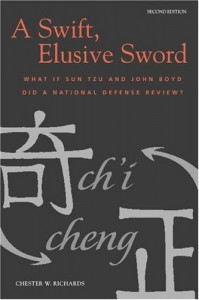
A study of national security and military strategy by Col. Chester Richards (USAF Ret.), suggests that ancient strategic wisdom may help solve the dilemma confronting the U.S. military: spending on defense exceeds that of any combination of potential adversaries, but the services still face cancellation of weapon systems and lack of funds for training, spares, and care and feeding of the troops. Richards suggests U.S. military leaders can break out of the “dollars equals defense” mindset, and create more effective forces. The second edition contains a new forward written in response to the effects that the September 11, 2001 terrorist attacks against the United States have engendered in the U.S. military.
Free Online

From the Inside Flap

The author would like to thank General Charles Krulak, U.S.M.C. (Ret.), former Commandant of the Marine Corps, General Pat Garvey, NYNM, Charles A. Leader, Franklin C. Spinney, Major Don Vandergriff, U.S.A., Colonel Michael Wyly, U.S.M.C. (Ret.), and Major Chris Yunker, U.S.M.C. (Ret.) for their invaluable contributions and input. The views in the final product are those of the author.

John Steiner: Banks Not Lending–Blame the Fed!

03 Economy, 07 Other Atrocities, 11 Society, Budgets & Funding, Commerce, Commercial Intelligence, Corruption, Government
John Steiner

Thanks to: Jack Kaplan.

Why Banks Aren’t Lending: The Silent Liquidity Squeeze

by Ellen Brown

Global Research, July 15, 2011

EXTRACT

Paying interest on reserves was intended to prevent “inflation,” but it is having the opposite effect, contracting the money and credit that are the lifeblood of a functioning economy.  The whole economic model is wrong.  The fear of price inflation has prevented governments from using their sovereign power to create money and credit to serve the needs of their national economies.  Instead, they must cater to the interests of a private banking industry that profits from its monopoly power over those essential economic tools.

Whether by accident or design, federal policymakers still have not got it right.

Read full article…

Marcus Aurelius: Global Phone-Tracking Blown Big Time….

10 Security, 11 Society, Advanced Cyber/IO, Commerce, Commercial Intelligence, Geospatial, Government, Law Enforcement, Military, Mobile, Real Time
Marcus Aurelius

I recall that Viet-Nam era secret writing was blown by an Admiral in his memoirs, causing all future terrorists and secret police to photocopy incoming and outgoing mail.  This appears to be publicity we could have done without.

Meet the ‘Keyzer Soze’ of Global Phone-Tracking

Spencer Ackerman

WIRED, July 18, 2011

‘The capability of doing mass tracking is possible.’

EXTRACT

Around the world, TruePosition markets something it calls “location intelligence,” or LOCINT, to intelligence and law enforcement agencies. As a homeland security tool, it’s enticing. Imagine an “invisible barrier around sensitive sites like critical infrastructure,” such as oil refineries or power plants, TruePosition’s director of marketing, Brian Varano, tells Danger Room. The barrier contains a list of known phones belonging to people who work there, allowing them to pass freely through the covered radius. “If any phone enters that is not on the authorized list, [authorities] are immediately notified.”

Read full article…

Michael Ostrolenk: Public Voting on Federal Budget

Advanced Cyber/IO, Budgets & Funding, Civil Society, Collective Intelligence, Corruption, Earth Intelligence, Ethics, Government, Office of Management and Budget, Policies, Threats
Michael Ostrolenk Recommends...

Two public voting  options have emerged.  Their results will be ignored, but it is a start.

FEDERAL BUDGET
PREFERENCE POLL

Let your voice be heard
in the federal budget debate!

Click here to vote.

And here the same idea but different network….

Let your voice be heard in the federal budget debate!

Three very different federal budget choices are being proposed for fiscal year 2012:

  • President Obama's Budget Framework
  • The “People's Budget” proposed by the Congressional Progressive Caucus (CPC)
  • The GOP Budget proposed by House Budget Committee Chair Paul Ryan (R-WI)

Click here to vote.

Chuck Spinney: From Bad to Worse in Afghanistan

03 Economy, 04 Inter-State Conflict, 05 Civil War, 07 Other Atrocities, 08 Wild Cards, 10 Security, 11 Society, Corruption, Government, IO Impotency, Military, Peace Intelligence
Chuck Spinney

From bad to worse in Afghanistan

Peter Eichstaedt

McClatchy News – 20/07/11

KABUL, AFGHANISTAN The assassination of President Hamid Karzai’s half brother, Ahmed Wali Karzai, along with the recent attack on the Intercontinental Hotel in the heart of the capital in Kabul, underscore the increasingly fragile security situation in Afghanistan.

Both events occurred soon after U.S. President Barack Obama announced his intention to begin withdrawing 30,000 “surge” troops beginning this month, with a goal of removing all American forces by the end of 2014.

With the death of Osama bin Laden and claims that his terror network had been crippled in Afghanistan, the president suggested the United States and its international partners had done all they could in the country.

Afghans would have to assume responsibility for security in Afghanistan, the president said.

The hotel attack, however, immediately raised questions about the Afghan military’s capabilities, with eight terrorists successfully overwhelming one of the most secure places in the capital. It was only after NATO helicopters were called in after an all-night firefight that the siege was brought to an end.

While many complain the assault laid bare the weakness of Afghanistan’s security forces, with some guards reportedly fleeing after the first shots were fired, others note that their response was about as good as could have been expected, given the Afghan forces’ level of equipment and training.

What the attack on the hotel did show was the pervasive presence of the Taliban and their growing alliance with other anti-government forces all across the country.

These insurgents in recent months have steadily ratcheted up the size, frequency and effectiveness of these attacks, while showing an alarming ability to penetrate seemingly impenetrable places.

Recent events included the wholesale escape of nearly 500 Talban captives from a prison in the southern province of Kandahar; the dramatic attack on the defence ministry headquarters in Kabul; and the suicide attack on a high-level military meeting in the northern Takhar province that killed one of Afghanistan’s best commanders and injured a NATO general.

Indeed, the list seems to grow daily.

Read full article….

Koko: List of Toxic US States

03 Environmental Degradation, 05 Energy, 07 Health, 07 Other Atrocities, Analysis, Commerce, Corporations, Corruption, Government, IO Impotency, Media Reports
Koko the Reflexive

FOR IMMEDIATE RELEASE

Press contact: Suzanne Struglinski, NRDC, 202-289-2387 or sstruglinski@nrdc.org

If you are not a member of the press, please write to us at nrdcinfo@nrdc.org or see our contact page

Ohio, Pennsylvania and Florida Lead List of “Toxic 20” States with Most Toxic Air Pollution from Power Plants

Worst States: OH, PA, FL, KY, MD, IN, MI, WV, GA, NC, SC, AL, TX, VA, TN, MO, IL, WI, NH, IA
WASHINGTON (July 20, 2011) — Residents of Ohio, Pennsylvania and Florida live in states with the most toxic air pollution from coal- and oil-fired power plants, according to an analysis by the Natural Resources Defense Council.

The study used publicly-available data in the Environmental Protection Agency’s Toxics Release Inventory (TRI). The analysis, entitled “Toxic Power: How Power Plants Contaminate Our Air and States” was jointly released today by NRDC and Physicians for Social Responsibility (PSR).

Among the key findings:

  • Nearly half of all the toxic air pollution reported from industrial sources in the United States comes from coal- and oil-fired power plants.
  • Power plants are the single largest industrial source of toxic air pollution in 28 states and the District of Columbia.

Read full statement….

Koko Observes (in American Sign Language):  The above is an excellent example of isolated concern that is going nowhere–never mind the blatant corruption of Congress.  If it were combined with a 360 degree toxicity survey showing food poisoning, toxic chemicals in everyday materials, and so on, this would be a great deal more useful.  If all of that were integrated into a true cost global game (or in this case, national game), there would be a compellingly useful basis for public outrage one district at a time.