Berto Jongman: US in 5-134 Wars (Right Now)

Government, Idiocy, Military, Peace Intelligence
Berto Jongman
Berto Jongman

The US is now involved in 134 wars or none, depending on your definition of ‘war'

The White House spent much of last week trying to figure out if the word “war” was the right one to describe its military actions against the Islamic State.

US Secretary of State John Kerry was at first reluctant:

“We're engaged in a major counterterrorism operation,” he told CBS News on Sept. 11. “I think war is the wrong terminology and analogy but the fact is that we are engaged in a very significant global effort to curb terrorist activity… I don't think people need to get into war fever on this. I think they have to view it as a heightened level of counter terrorist activity.”

Kerry said similarly hedgy things during interviews on CNN and ABC.

By the next day, the Obama administration appeared more comfortable with the word war, yet hardly offered any more clarity. White House Press Secretary Josh Earnest told reporters, “The United States is at war with ISIL in the same way we are at war with Al Qaeda and its affiliates.”

The problem is that our traditional definition of “war” is outdated, and so is our imagination of what war means.

Read full article.

Chuck Spinney: Uri Avnery on the Obsolescence of the Nation-State

Cultural Intelligence, Government, Peace Intelligence
Chuck Spinney
Chuck Spinney

Scotland on the Euphrates

The Obsolescence of the Nation-State

by URI AVNERY

Counterpunch, WEEKEND EDITION SEPTEMBER 19-21, 2014

[This essay originally appeared at http://www.avnery-news.co.il/english/index.html ]

TWO COUNTRIES competed this week for first place in news programs all over the world: Scotland and the Islamic State in Iraq and Syria.

There could not be a greater difference than between these two countries. Scotland is damp and cold, Iraq is hot and dry. Scotland is called after its whisky (or the other way round), while for ISIS fighters, drinking alcohol is the mark of unbelievers, who should lose their head (literally).

However, there is one common denominator of both crises: they mark the approaching demise of the nation-state.

Continue reading “Chuck Spinney: Uri Avnery on the Obsolescence of the Nation-State”

Electronic Frontier Foundation: Human Rights Require a Secure Internet

Advanced Cyber/IO, Civil Society

effHuman Rights Require a Secure Internet

Between 15th-19th of September, in the week leading up the first year anniversary of the 13 Necessary and Proportionate Principles, EFF and the coalition behind the Principles will be conducting a Week of Action explaining some of the key guiding principles for surveillance law reform. Every day, we'll take on a different part of the principles, exploring what’s at stake and what we need to do to bring intelligence agencies and the police back under the rule of law. You can read the complete set of posts online. The Principles were first launched at the 24th Session of the United Nations Human Rights Council in Geneva on 20 September 2013. Let's send a message to Member States at the United Nations and wherever else folks are tackling surveillance law reform: surveillance law can no longer ignore our human rights. Follow our discussion on twitter with the hashtag: #privacyisaright

Human Rights Require a Secure Internet

The ease by which mass surveillance can be conducted is not a feature of digital networks; it's a bug in our current infrastructure caused by a lack of pervasive encryption. It's a bug we have to fix. Having the data of our lives sent across the world in such a way that distant strangers can (inexpensively and undetectably) collect, inspect and interfere with it, undermines the trust any of us can have in any of our communications. It breaks our faith not only with the organizations that carry that data for us, but the trust we have with each other. On a spied-upon network, we hold back from speaking, reading, trading and organizing together. The more we learn about the level of surveillance institutions like the NSA impose on the Net, the more we lose trust in the technology, protocols, institutions and opportunities of the Net.

Read full article.

2014 The National Intelligence Strategy of the USA — 3 Strikes and Out

Corruption, Director of National Intelligence et al (IC), Government, Ineptitude, IO Impotency
Click on Image to Enlarge

(U) 2014 US National Intelligence Strategy

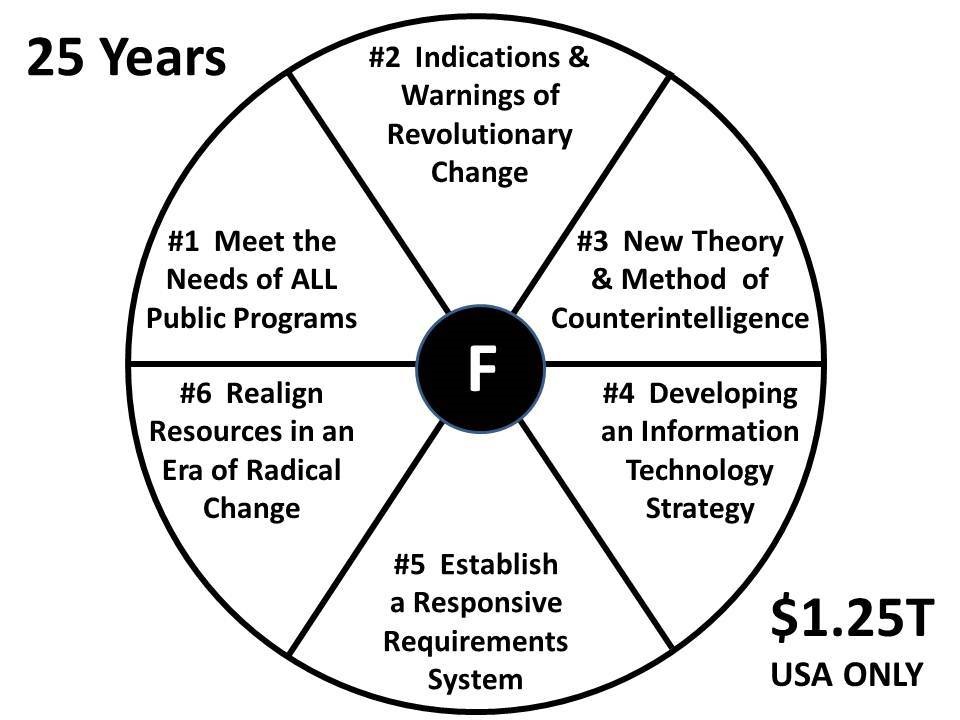
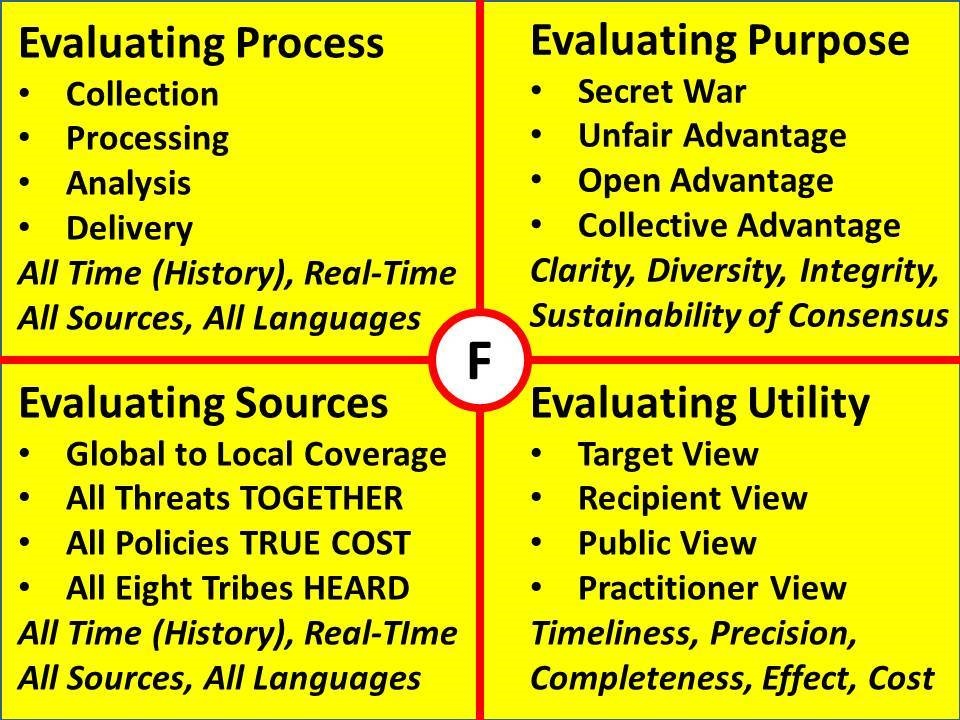
STRIKE ONE: Refuses counterintelligence on domestic enemies.

STRIKE TWO: Refuses Whole of Government.

STRIKE THREE: Refuses Acquisition.

The six sucking chest wounds identified in 1990 continue. HUMINT/CI are dead in the water, followed by OSINT and mature holistic analytics integrating true cost economics. We continue to process 1% of what we collect by technical means, while being so far removed from human-centric ground truth about everything as to cause one to wonder, just who is the US IC supposed to be helping?

Keep the money moving, rah rah rah.

Click on Image to Enlarge

See Especially:

1989 Al Gray (US) on Global Intelligence Challenges

1990 Intelligence in the 1990′s – Six Challenges

See Also:

1989+ Intelligence Reform

1976+ Intelligence Models 2.1

1957+ Decision Support Story

Books By and With Robert Steele (includes Amazon links and free online links)

Worth a Look: Book Reviews on Intelligence (Most)


SchwartzReport: 25% US Citizens Support Secession & Break-Up of USA + Meta-RECAP

03 Economy, 07 Other Atrocities, 09 Justice, 11 Society, Corruption, Government, Idiocy, Ineptitude
Stephan A. Schwartz
Stephan A. Schwartz

Twenty five per cent of Americans are open to secession and the break up of the United States. To this add that better than 3 out of 4 Americans are unhappy. And that 64 per cent can't even name the three branches of government. This is a country in crisis.

Angry With Washington, 1 in 4 Americans Open to Secession
Reuters/The Raw Story

The failed Scottish vote to pull out from the United Kingdom stirred secessionist hopes for some in the United States, where almost a quarter of people are open to their states leaving the union, a new Reuters/Ipsos poll found.

Some 23.9 percent of Americans polled from Aug. 23 through Sept. 16 said they strongly supported or tended to support the idea of their state breaking away, while 53.3 percent of the 8,952 respondents strongly opposed or tended to oppose the notion.

The urge to sever ties with Washington cuts across party lines and regions, though Republicans and residents of rural Western states are generally warmer to the idea than Democrats and Northeasterners, according to the poll.

Continue reading “SchwartzReport: 25% US Citizens Support Secession & Break-Up of USA + Meta-RECAP”

Stephen E. Arnold: Palantir Funding + PBI Comment – Not Matched by Vision, Engineering, or Utility

Commerce, Ineptitude, IO Impotency
Stephen E. Arnold
Stephen E. Arnold

Palantir and Its Funding

I read “Palantir May Have Raised More Than We Thought, Perhaps $165 million.” The article presented a revisionist view of how much money is in the Palantir piggy bank. Here’s the number I circled: $165 million since February 2014. I also marked this paragraph:

The Palo Alto company led by CEO Alex Karp disclosed in a Securities and Exchange Commission filing on Friday that it had raised more than $440 million in a funding round that began last November.

The numbers add up. The write up asserted:

The company co-founded by Karp, Peter Thiel, Joe Lonsdale and others in 2004 has raised a total of about $1 billion, with some of that funding coming from In-Q-Tel, the venture arm of U.S. intelligence agencies.

This works out to a $9 billion valuation.

The question now becomes, “How long will it take Palantir to generate sufficient revenue to pay back the investors and turn a profit?” The reason I ask is that IBM is chasing this market along with a legion of other firms.

Continue reading “Stephen E. Arnold: Palantir Funding + PBI Comment – Not Matched by Vision, Engineering, or Utility”

SchwartzReport: 64% of US Citizens are Utterly Stupid About Their Own Government

04 Education, Civil Society, Cultural Intelligence, Ineptitude
Stephan A. Schwartz
Stephan A. Schwartz

What is one to think about a country and a time in which 64 per cent of the population cannot identify the three major branches of government? Not the individuals, just the basic system. Nearly two out of three. This may be the most depressing statistic I have ever published.

Only 36 Percent of Americans Can Name the Three Branches of Government
REID WILSON – The Washington Post

Wednesday marked national Constitution Day, the 227th anniversary of the signing of the U.S. Constitution. But only 36 percent of Americans can actually name the three branches of government the Constitution created.

noble gold