Jolted by Hezbollah's Entry Into Civil War and Chemical Weapons, Administration Chose to Arm Rebels
Adam Entous
Wall Street Journal, 14 June 2013
EXTRACT:
In one sobering moment in late April, Jordan's King Abdullah II presented President Barack Obama and aides with a bleak scenario for Syria—showing them a map of how the country could split into warring, sectarian fiefdoms, with a tract of desert dominated by al Qaeda and its allies, U.S. officials said.
. . . .
In meetings with officials from the White House and other departments, King Abdullah told policy makers that Syria would become similar to the Federally Administered Tribal Areas of Pakistan, or FATA, where al Qaeda has long been based.
“Syria is going to become the new FATA, the breeding ground from where they launch attacks,” the king said, according to a person in the meetings.
If your daily routine took you from one homegrown organic garden to another, bypassing vast fields choked with pesticides, you might feel pretty good about the current state of agriculture. If your daily routine takes you from one noncommercial progressive website to another, you might feel pretty good about the current state of the Internet. But while mass media have supplied endless raptures about a digital revolution, corporate power has seized the Internet—and the anti-democratic grip is tightening every day.
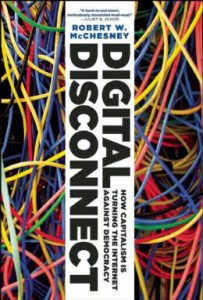
“Most assessments of the Internet fail to ground it in political economy; they fail to understand the importance of capitalism in shaping and, for lack of a better term, domesticating the Internet,” says Robert W. McChesney in his illuminating new book, Digital Disconnect.
Amazon Page
Plenty of commentators loudly celebrate the Internet. Some are vocal skeptics. “Both camps, with a few exceptions, have a single, deep, and often fatal flaw that severely compromises the value of their work,” McChesney writes. “That flaw, simply put, is ignorance about really existing capitalism and an underappreciation of how capitalism dominates social life. . . . Both camps miss the way capitalism defines our times and sets the terms for understanding not only the Internet, but most everything else of a social nature, including politics, in our society.”
And he adds: “The profit motive, commercialism, public relations, marketing, and advertising — all defining features of contemporary corporate capitalism — are foundational to any assessment of how the Internet has developed and is likely to develop.”
Concerns about the online world often fixate on cutting-edge digital tech. But, as McChesney points out, “the criticism of out-of-control technology is in large part a critique of out-of-control commercialism. The loneliness, alienation, and unhappiness sometimes ascribed to the Internet are also associated with a marketplace gone wild.”
Discourse about the Internet often proceeds as if digital technology has some kind of mind or will of its own. It does not.
For the most part, what has gone terribly wrong in digital realms is not about the technology. I often think of what Herbert Marcuse wrote in his 1964 book One-Dimensional Man: “The traditional notion of the ‘neutrality’ of technology can no longer be maintained. Technology as such cannot be isolated from the use to which it is put; the technological society is a system of domination which operates already in the concept and construction of techniques.”
I have been asked by my superiors to give a brief demonstration of the surprising effectiveness of even the simplest techniques of the new-fangled Social Networke Analysis in the pursuit of those who would seek to undermine the liberty enjoyed by His Majesty’s subjects. This is in connection with the discussion of the role of “metadata” in certain recent events and the assurances of various respectable parties that the government was merely “sifting through this so-called metadata” and that the “information acquired does not include the content of any communications”. I will show how we can use this “metadata” to find key persons involved in terrorist groups operating within the Colonies at the present time. I shall also endeavour to show how these methods work in what might be called a relational manner.
A new lawsuit brought by a current CIA officer hints at the existence of a secret overseas paramilitary operation that triggered war crimes allegations, The Cable has learned.
On Friday, “John Doe,” an undercover paramilitary officer will file suit against the CIA for “unreasonable delay” of an Inspector General investigation into “alleged war crimes committed in an overseas location.” (The operation remains highly classified; details about when and where it occurred remain secret.)
According to his lawyer Mark Zaid, Doe was engaged in “offensive operations against individuals designated or viewed as enemies of the United States.” His client believes he did nothing wrong, according to Zaid, but witnessed events that “concerned him.” Zaid declined to outline what those concerning events might be.
The CIA's paramilitary activities have come under heavy scrutiny in recent months. With the ascension of John Brennan to the top of agency, there have been renewed calls in Congress to rein in the CIA's drone strikes and return Langley to traditional mission of gathering human intelligence. President Obama even took the unusual step in late May of publicly defending the agency's targeted killing operations — while pledging to subject them to new constraints. Brennan himself has expressed his desire to scale back some of the agency's traditional military activities. “While the CIA needs to maintain a paramilitary capability,” Brennan said in February, “the CIA should not be used, in my view, to carry out traditional military activities.”
. . . . . . .
“You couldn't tell the difference between CIA officers, Special Forces guys and contractors,” a senior U.S. official who toured through Afghanistan told The Post. “They're all three blended together. All under the command of the CIA.” As a result of the overlapping roles, congressional committees covering intelligence and armed services often get an incomplete view of CIA paramilitary operations.
In any case, Zaid's suit opens a small crack into the type of covert missions that rarely see the light of day. Whether more will be uncovered about this specific operation is yet to be seen. Below is a copy of the suit Zaid plans to file tomorrow:
Attorney Inder Comar is maintaining a website at http://witnessiraq.com which describes the lawsuit:
Witness Iraq has brought a lawsuit against key members of the Bush Administration: George W. Bush, Richard B. Cheney, Donald H. Rumsfeld, Condoleezza Rice, Colin Powell and Paul Wolfowitz.
In Saleh v. Bush, plaintiff Sundus Shaker Saleh alleges that the Iraq War was a premeditated war against the Iraqi people, the planning of which started in 1998. The war was not conducted in self-defense, did not have the appropriate authorization by the United Nations, and under international law constituted a “crime of aggression” — a crime first set down at the Nuremberg Trials after World War II.
The results of this survey by Gallup reveal the present state of the Congress. It should be obvious how corrosive this is the a healthy democracy, and that it is a measure of how corrupted this central institution of our government has become. Only voting will change this.