The article titled Boardroom Priorities in 2015: Can IT Deliver on ZDNet discusses a recent survey of 200 CXOs on boardroom concerns for 2015 from Constellation Research. Digital transformation was at the top of many lists, and the article posits that there is a fear among many companies that a “Digital Darwinism” will take down corporations that have not invested in digital strategies. The article states,
Owl has previously suggested first 65% and most recently 80% probability of the Paris 12 being a false flag event. With the revelation of the Zionist ownership of the “victim” organization, and the video of a fake head shot with no splatter (as well as blank dust-off ), we now take our estimate to 90%.
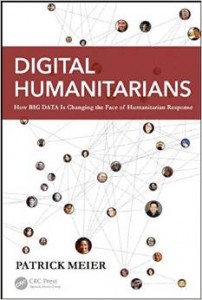
In January 2014, I wrote this blog post announcing my intention to write a book on Digital Humanitarians. Well, it's done! And launches this week. The book has already been endorsed by scholars at Harvard, MIT, Stanford, Oxford, etc; by practitioners at the United Nations, World Bank, Red Cross, USAID, DfID, etc; and by others including Twitter and National Geographic. These and many more endorsements are available here. Brief summaries of each book chapter are available here; and the short video below provides an excellent overview of the topics covered in the book.
Amazon Page
Together, these overviews make it clear that this book is directly relevant to many other fields including journalism, human rights, activism, business management, computing, ethics, social science, data science, etc. In short, the lessons that digital humanitarians have learned (often the hard way) over the years and the important insights they have gained are directly applicable to fields well beyond the humanitarian space. To this end, Digital Humanitarians is written in a “narrative and conversational style” rather than with dense, technical language. The story of digital humanitarians is a multifaceted one. Read more.
Stephen Hawking thinks computers may surpass human intelligence and take over the world. We won't ever be silicon slaves, insists an AI expert
Mark Bishop in NewScientist
It is not often that you are obliged to proclaim a much-loved genius wrong, but in his alarming prediction on artificial intelligence and the future of humankind, I believe Stephen Hawking has erred. To be precise, and in keeping with physics – in an echo of Schrödinger's cat – he is simultaneously wrong and right.
The following essay looks to present a theory of false flag terrorism in relation to evidence and motives present for the case of the Charlie Hebdo shootings in Paris, France.
I really am tired of the baloney surrounding Google, which calls itself an “artificial intelligence” company. There is no question that its computational mathematics are out of this world — they are also unregulated (the US Government is incompetent in this domain) and divorced from the humanities — people working for Google do not “compute” words like Consilience. Below is an article full of hype that manages to avoid the reality that Google indexes less than 4% of the digital web (their number, mine is 2%) while failing to date to provide any tools for analytics (shared calendars and spreadsheets are nice — like colorful napkins). Never mind that less than 1% of big data is processable; that it takes three years to move a petabyte across the crappy infrastructure the US Government has failed to elevate, or that there are five billion humans out there, each of whom has a brain vastly more able than any computer NSA or Google (NSA Lite) might have in hand. Never mind that Google has no clue when it comes to the intersection of holistic analytics, true cost economics, and open source everything engineering. Google is — like most of the secret intelligence community and most of Wall Street banking — a Ponzi scheme. Keep the money moving. Never mind striving for ethical evidence-based decision-support or serving the public interest.