Howard Rheingold: If Then Online RSS Tool

IO Tools
Howard Rheingold
Howard Rheingold

IFTTT to Evernote can be a powerful team infotention tool (Diigo groups is good for circumstances in which you want to attach comment threads to bookmarked material, add sticky notes, etc.

IF THEN ONLINE RSS ALERT TOOL

The debate team at my school began using Evernote last year for collaborative research.  As students find sources, they dump them into a shared Evernote folder that everyone on the team has access to.  Our effort is multiplied, as students collaborate on finding and writing up evidence.



Click on Image to Enlarge

This year I’ve discovered a tool that makes Evernote even more powerful.  If This, Then That (or IFTTT) is a service that allows users to link any number of websites and web-based services: from widely-used services like email, SMS, Dropbox, Facebook, and Google drive, to lesser known services like Svpply, Pocket, or ffffound!  Using a clean and easy-to-use interface, IFTTT guides users step by step in creating “recipes” to link services.  If you’re looking for inspiration, you can browse through the hundreds of public recipes created by IFTTT users.  The recipes include everything from “download emailed Paypal receipts into Evernote” to “automatically change my Twitter profile picture when I change by Facebook profile picture.”  You can even have IFTTT text you when it’s going to rain.


IFTTT can be combined with Evernote to make a powerful collaborative research tool, because it allows you to combine the collaboration and cloud-access of Evernote with the easy access to information offered by RSS feeds.

Here’s an example:

Continue reading “Howard Rheingold: If Then Online RSS Tool”

Jean Lievens: Robot Can Print House in 24 Hours

Advanced Cyber/IO, Design, Innovation, Manufacturing, Materials

The world’s largest concentrations of slums exist in the “global south:” Africa, Asia, and Latin America; places where urbanization has not led to economic development, and are characterized by poor sanitation, crowded living conditions, low quality structures, and populations vulnerable to disease and natural disasters.

Robot Printing House in 24 Hours

Click on Image to Enlarge

Nik Peachey: Interactive Presentation Tool

IO Tools
Nik Peachey
Nik Peachey

This looks like a great free tool for creating interactive presentations and recording and publishing them. Just downloading it myself.

With SlideIdea, presentations are no longer a one-man show. SlideIdea gives presenters the tools to engage their audience through their audience’s smart phones, laptops, and tablets. Each SlideIdea presentation is provided a unique URL (i.e, www.sld.im/12345 ). Regardless of the location, an audience can simply input the URL into their internet browser and then immediately follow along with slides, participate in polls, ask questions, or even network.

Berto Jongman: Mind Control in the 21st Century – Overview of the State of the Art and Future Prospects

Advanced Cyber/IO, IO Deeds of War
Berto Jongman
Berto Jongman

Mind Control in the 21st Century-Science Fiction & Beyond

Pravda, 05.02.2014  By Steven DiBasio

***Part One*** Conspiracy Theory?

“Mind control” is a topic commonly perceived as “conspiracy theory” or “X-Files” fare. That is, it is seen as possibly not “real,” and certainly not something about which one should be “overly” concerned. This attitude at least partially arises from the widespread belief or assumption that the human brain is so complicated-(“the most complex entity in the universe” is a common formulation)-that it has not, and perhaps cannot, be comprehended in any depth.

One writer, for example, describes the brain as of “perhaps infinite” complexity, while another, David Brooks of the New York Times, writes that it is “probably impossible” that “a map of brain activity” could reveal mental states such as emotions and desires. Similarly, Andrew Sullivan, blogger and former editor of The New Republic, opines that neuroscience is still in its “infancy,” and that we have only begun “scratching the surface” of the human brain, and links to a New Yorker piece in support of that position.

And the cover story for the October 2004 issue of Discovery Magazine entitled “The Myth Of Mind Control” advises the reader that while mind control is a “familiar science-fiction” staple, there is little reason for real concern, because actually deciphering the “neural code” would be akin to figuring out other “great scientific mysteries” such as the “origin of the universe and of life on Earth,” and is therefore hardly likely. According to the article, as the brain is “the most significant mystery in science” and quite possibly “the hardest to solve,” mind control remains at worst a distant concern.

The underlying idea seems to be that sophisticated mind control is unlikely without understanding the brain; and we do not understand the brain.

Understanding the “Neural Code”

Continue reading “Berto Jongman: Mind Control in the 21st Century – Overview of the State of the Art and Future Prospects”

Arnold: Topology and Big Data Making Shapes

IO Sense-Making
Stephen E. Arnold
Stephen E. Arnold

Topology and Big Data Making Shapes

The article titled Lawrence Livermore Explores the Shape of Data, Expanding Query-Free Analytics on GCN delves into the work of the Livermore National Laboratory in partnership with Ayasdi Inc. Using homegrown technology, the lab tackles big data to analyze various areas of research such as climate change, national security and biological defense. Recently their work has begun to incorporate topology, the study of shapes. The article explains the connection,

““The fundamental idea is that topological methods act as a geometric approach to pattern or shape recognition within data,” says a September 2013 article in the journal Science co-authored by Ayasdi CEO Gurjeet Singh. It allows “exploration of the data, without first having to formulate a query or hypothesis.” That is, researchers can find things they did not know they were looking for. For instance, in a database of billions upon billions of phone records scientists could make sense of who was talking to whom.”

Continue reading “Arnold: Topology and Big Data Making Shapes”

NIGHTWATCH: Foolish US Statements on Syria

04 Inter-State Conflict, 07 Other Atrocities, 08 Proliferation, 08 Wild Cards, Ethics, Government, IO Deeds of War, Military, Peace Intelligence

Syria: Special comment. The Ba'athist government in Damascus appears to be holding its own. The best indication of increased stability is that the focus of most combat reports is the city of Aleppo, most of which has been under opposition control. This means the government and its allies are taking the fight to the anti-government fighting groups.

The security situation generated [foolish] comments by two senior US officials.

Continue reading “NIGHTWATCH: Foolish US Statements on Syria”

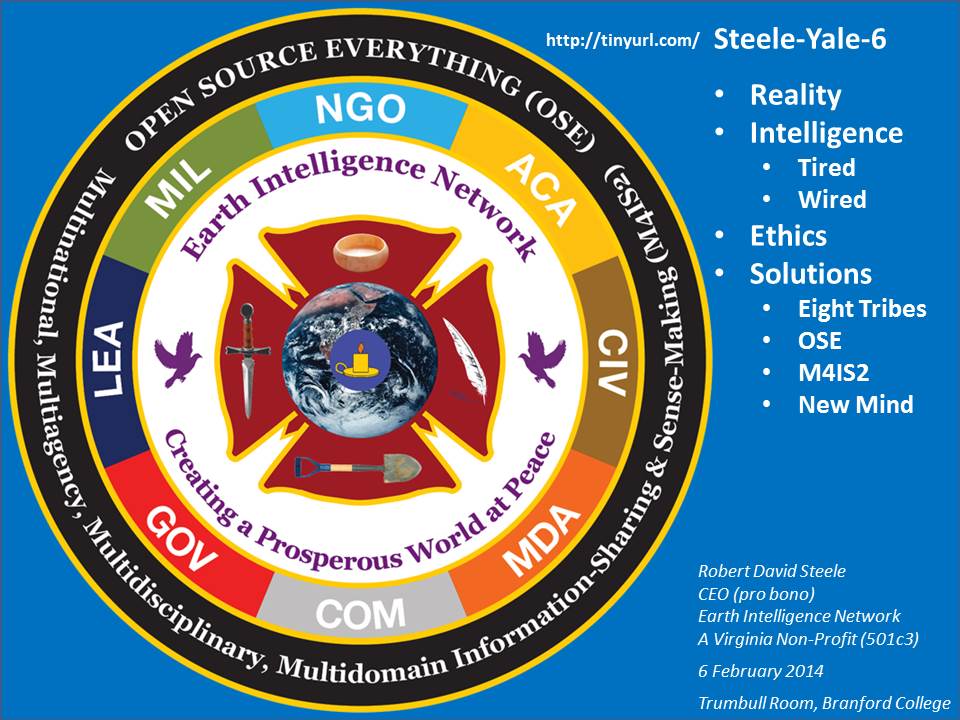
Steele on Reality, Intelligence, Ethics, & Solutions [Yale, 6 February 2014]

#Events, Advanced Cyber/IO, Communities of Practice, Ethics
Click on Image to Enlarge

SHORT URL: http://tinyurl.com/Steele-Yale-6

On Thursday 6 February 2014 from 1800-1930, Robert Steele will address a group of undergraduates convened by Yale Politic. The event is free, open to the public without RSVP required, and the media has been invited.

Yale University, Branford College
Trumbull Room
74 High Street
New Haven, CT 06511

Downloadable PPT (30 Pages): Steele @ Yale

YouTube as Presented (Verbatim, Slides Not Really Visible)

Briefing as Planned Below the Line in Full Text

See Also:

YALE The Politic Interviews Robert Steele

2014 Intelligence Reform (Robert Steele)

Continue reading “Steele on Reality, Intelligence, Ethics, & Solutions [Yale, 6 February 2014]”

noble gold