Berto Jongman: Paul Krugman on Saving the Planet “For Free” PLUS New Book List

Earth Intelligence
Berto Jongman
Berto Jongman

Paul Krugman: Saving The Planet ‘Might Be Free’

Economist and columnist for The New York Times Paul Krugman says he’s been reading “two new reports on the economics of fighting climate change” that prove saving the planet could be “cheaper and easier than almost anyone imagines.”

Here’s a sampling of the evidence that suggests to him that the “economics of climate protection look even better now than they did a few years ago”:

On one side, there has been dramatic progress in renewable energy technology, with the costs of solar power, in particular, plunging, down by half just since 2010. Renewables have their limitations — basically, the sun doesn’t always shine, and the wind doesn’t always blow — but if you think that an economy getting a lot of its power from wind farms and solar panels is a hippie fantasy, you’re the one out of touch with reality.

On the other side, it turns out that putting a price on carbon would have large “co-benefits” — positive effects over and above the reduction in climate risks — and that these benefits would come fairly quickly. The most important of these co-benefits, according to the I.M.F. paper, would involve public health: burning coal causes many respiratory ailments, which drive up medical costs and reduce productivity.

Of course, the wrench in the machine of Krugman’s last point is the utter lack of evidence that leaders in government and business run their cost-benefit analyses with entire societies in mind. Rather, they limit their concerns to their locales, social classes and enterprises—and sometimes, as in cases of control fraud, to themselves alone.

Continue reading “Berto Jongman: Paul Krugman on Saving the Planet “For Free” PLUS New Book List”
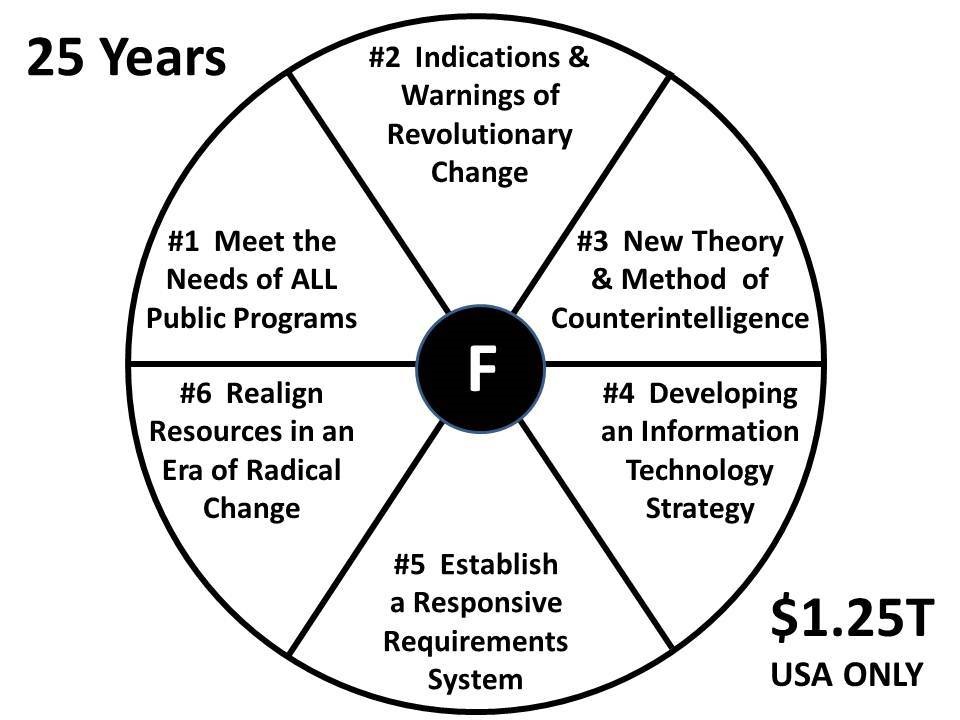
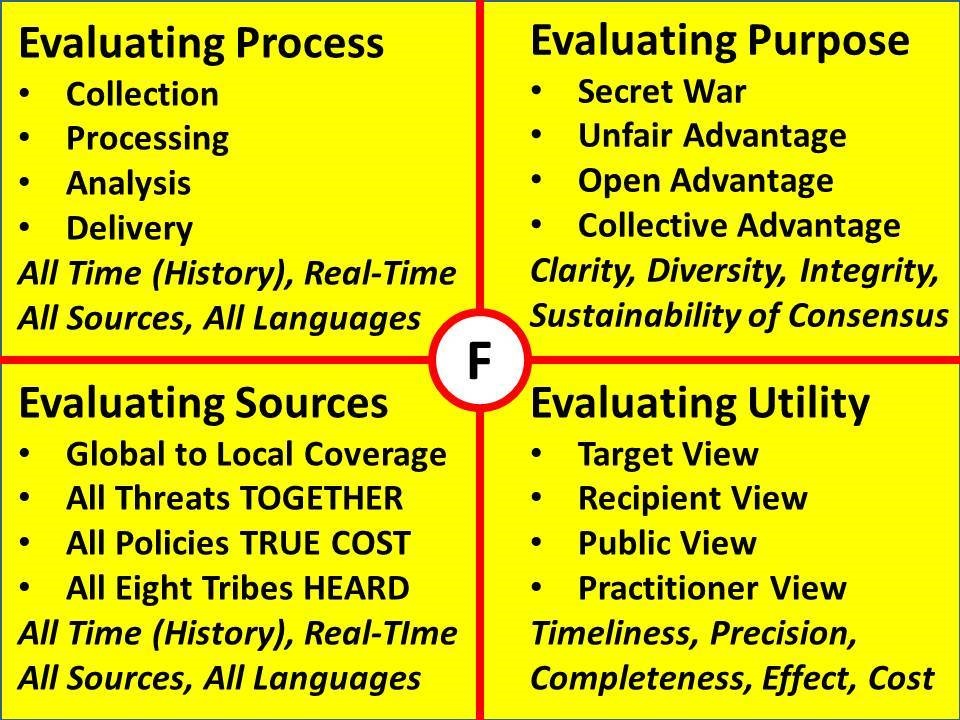
2014 The National Intelligence Strategy of the USA — 3 Strikes and Out

Corruption, Director of National Intelligence et al (IC), Government, Ineptitude, IO Impotency
Click on Image to Enlarge

(U) 2014 US National Intelligence Strategy

STRIKE ONE: Refuses counterintelligence on domestic enemies.

STRIKE TWO: Refuses Whole of Government.

STRIKE THREE: Refuses Acquisition.

The six sucking chest wounds identified in 1990 continue. HUMINT/CI are dead in the water, followed by OSINT and mature holistic analytics integrating true cost economics. We continue to process 1% of what we collect by technical means, while being so far removed from human-centric ground truth about everything as to cause one to wonder, just who is the US IC supposed to be helping?

Keep the money moving, rah rah rah.

Click on Image to Enlarge

See Especially:

1989 Al Gray (US) on Global Intelligence Challenges

1990 Intelligence in the 1990′s – Six Challenges

See Also:

1989+ Intelligence Reform

1976+ Intelligence Models 2.1

1957+ Decision Support Story

Books By and With Robert Steele (includes Amazon links and free online links)

Worth a Look: Book Reviews on Intelligence (Most)


Stephen E. Arnold: Google as Architect of Cities?

IO Impotency
Stephen E. Arnold
Stephen E. Arnold

Google and Its Possible Really, Really Big Ambitions

I read “Looking Past the Search Results: Google 2.0 Will Build Airports and Cities Says Report.” The “report” appears to be the work of an outfit doing business as “The Information.” The founder of The Information is Jessica E. Lessin. She was a Wall Street Journal reporter. She morphed into a “reportrepreneur.” (See About the Information for more about the company.)

The “report” costs money. The Independent’s summary of the main idea reveals:

Larry Page has set up a ‘company within a company’ dubbed ‘Google 2.0’ that will look at the tech giant’s long-term future – presumably for when advertising revenue from search traffic (inevitably) dries up.

The “report” suggests that Google may build airports and cities. I assume these will complement the Loon, Glass, Death, and other moon shot projects.

Continue reading “Stephen E. Arnold: Google as Architect of Cities?”

SchwartzReport: 25% US Citizens Support Secession & Break-Up of USA + Meta-RECAP

03 Economy, 07 Other Atrocities, 09 Justice, 11 Society, Corruption, Government, Idiocy, Ineptitude
Stephan A. Schwartz
Stephan A. Schwartz

Twenty five per cent of Americans are open to secession and the break up of the United States. To this add that better than 3 out of 4 Americans are unhappy. And that 64 per cent can't even name the three branches of government. This is a country in crisis.

Angry With Washington, 1 in 4 Americans Open to Secession
Reuters/The Raw Story

The failed Scottish vote to pull out from the United Kingdom stirred secessionist hopes for some in the United States, where almost a quarter of people are open to their states leaving the union, a new Reuters/Ipsos poll found.

Some 23.9 percent of Americans polled from Aug. 23 through Sept. 16 said they strongly supported or tended to support the idea of their state breaking away, while 53.3 percent of the 8,952 respondents strongly opposed or tended to oppose the notion.

The urge to sever ties with Washington cuts across party lines and regions, though Republicans and residents of rural Western states are generally warmer to the idea than Democrats and Northeasterners, according to the poll.

Continue reading “SchwartzReport: 25% US Citizens Support Secession & Break-Up of USA + Meta-RECAP”

Stephen E. Arnold: Palantir Funding + PBI Comment – Not Matched by Vision, Engineering, or Utility

Commerce, Ineptitude, IO Impotency
Stephen E. Arnold
Stephen E. Arnold

Palantir and Its Funding

I read “Palantir May Have Raised More Than We Thought, Perhaps $165 million.” The article presented a revisionist view of how much money is in the Palantir piggy bank. Here’s the number I circled: $165 million since February 2014. I also marked this paragraph:

The Palo Alto company led by CEO Alex Karp disclosed in a Securities and Exchange Commission filing on Friday that it had raised more than $440 million in a funding round that began last November.

The numbers add up. The write up asserted:

The company co-founded by Karp, Peter Thiel, Joe Lonsdale and others in 2004 has raised a total of about $1 billion, with some of that funding coming from In-Q-Tel, the venture arm of U.S. intelligence agencies.

This works out to a $9 billion valuation.

The question now becomes, “How long will it take Palantir to generate sufficient revenue to pay back the investors and turn a profit?” The reason I ask is that IBM is chasing this market along with a legion of other firms.

Continue reading “Stephen E. Arnold: Palantir Funding + PBI Comment – Not Matched by Vision, Engineering, or Utility”

Yoda: Big Data Potential — and Ignorance

IO Impotency
Got Crowd? BE the Force!

Baby steps…

What Big Data Can Mean for Sustainability

The first Industrial Revolution showed the world how much machines could accomplish. What GE calls the “Next Industrial Revolution” is now showing how much machines can accomplish when they communicate with each other. And just as steam — and later electricity — powered the first industrial revolution, Big Data is powering the second. Machine-to-machine communication (M2M) gave birth to the age of Big Data and advances in big data are expanding our sense of what the Internet of Things can accomplish in the coming years.

It’s too soon to know whether or not the promise of Big Data is being overstated. Google Trends shows that the number of news references for “Big Data” has increased ten-fold since 2011. Comparing that with the Gartner Hype Cycle suggests that the concept may be nearing its “Peak of Inflated Expectations” and will soon be sliding into a “Trough of Disillusionment” [see accompanying graph]. Still, if the Hype Cycle is an accurate forecast of the future, it seems reasonable to expect great things from Big Data once it reaches the “Plateau of Productivity.”

The Four V’s of Big Data

According to Wayne Balta, vice president of corporate environmental affairs and product safety at IBM, Big Data is defined by the four V’s: volume, velocity, variety and veracity.

Continue reading “Yoda: Big Data Potential — and Ignorance”

SchwartzReport: 64% of US Citizens are Utterly Stupid About Their Own Government

04 Education, Civil Society, Cultural Intelligence, Ineptitude
Stephan A. Schwartz
Stephan A. Schwartz

What is one to think about a country and a time in which 64 per cent of the population cannot identify the three major branches of government? Not the individuals, just the basic system. Nearly two out of three. This may be the most depressing statistic I have ever published.

Only 36 Percent of Americans Can Name the Three Branches of Government
REID WILSON – The Washington Post

Wednesday marked national Constitution Day, the 227th anniversary of the signing of the U.S. Constitution. But only 36 percent of Americans can actually name the three branches of government the Constitution created.

noble gold