
SHOCKING Video Of Crashed Drone Hit With Rocks By Afghan Villagers – My New Video
Go here to turn the video into an MP3: http://us.
Keep fighting,
Lee

The truth at any cost lowers all other costs — curated by former US spy Robert David Steele.
Go here to turn the video into an MP3: http://us.
Keep fighting,
Lee

Revolving Door Syndrome in the Military-Industrial-
The Best Government Money Can Buy
by FRANKLIN C. SPINNEY, COUNTERPUNCH, FEBRUARY 11, 2014
Those of you who think it is incorrect to attach “Congressional” onto the the end of Military – Industrial – Congressional Complex (MICC) would be well advised to read “Lawmaker holds stock in defense contractor he champions” (by Donovan Slack, USA Today, 8 Feb 2014) to see one reason why I always include the reference to Congress.
Slack describes the ethically-challenged influence peddling capers of Congressman Tom Petri (R-Wisconsin), a Harvard educated lawyer and one of longest serving and wealthiest members of Congress. Petri used his position in Congress to enhance his political career (and power) as well as his personal wealth by promoting a controversial $3 billion dollar armored truck procurement contract to Oshkosh corporation that pushed dollars, jobs, and profits into his home district as well as wealth into his own stock portfolio. Slack describes how Petri intervened to (1) fend off Oshkosh’s competitors, especially Texas based BAE corp, who had protested the contract award, accusing Oshkosh of low-balling its cost estimates and (2) how he worked to neutralize the rescue efforts by BAE’s friendly congressmen. The story is complex, and I urge you to read Slack’s report at the link above.
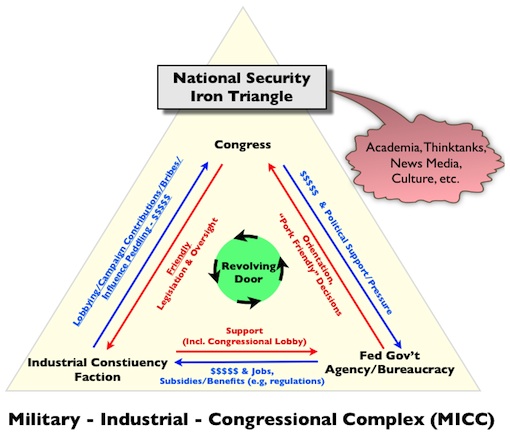
Petri’s hijinks are old as our democracy (see this hilarious example of how the Navy’s Ship of the Line program was funded in the years after the War of 1812), but the intricacies of his maneuvers illustrate the subtle and deep-seated general nature of corruption and influence peddling now pervading our nation’s defense policy making machinery. The threads of this influence peddling network are now woven deeply, almost invisibly, throughout the entire fabric of the contemporary American political economy.
Some political scientists use the metaphor Iron Triangle as a short hand for describing the structural aspects of this web of influence relationships. The attached diagram depicts the triangle’s basic features for the MICC. Note its principle idea: the two mutually-reinforcing circulations: (1) a counter-clockwise circulation of influence peddling fueling (2) a concomitant clockwise circulation of money.
Continue reading “Chuck Spinney: Corruption in Congress – The Iron Triangle”
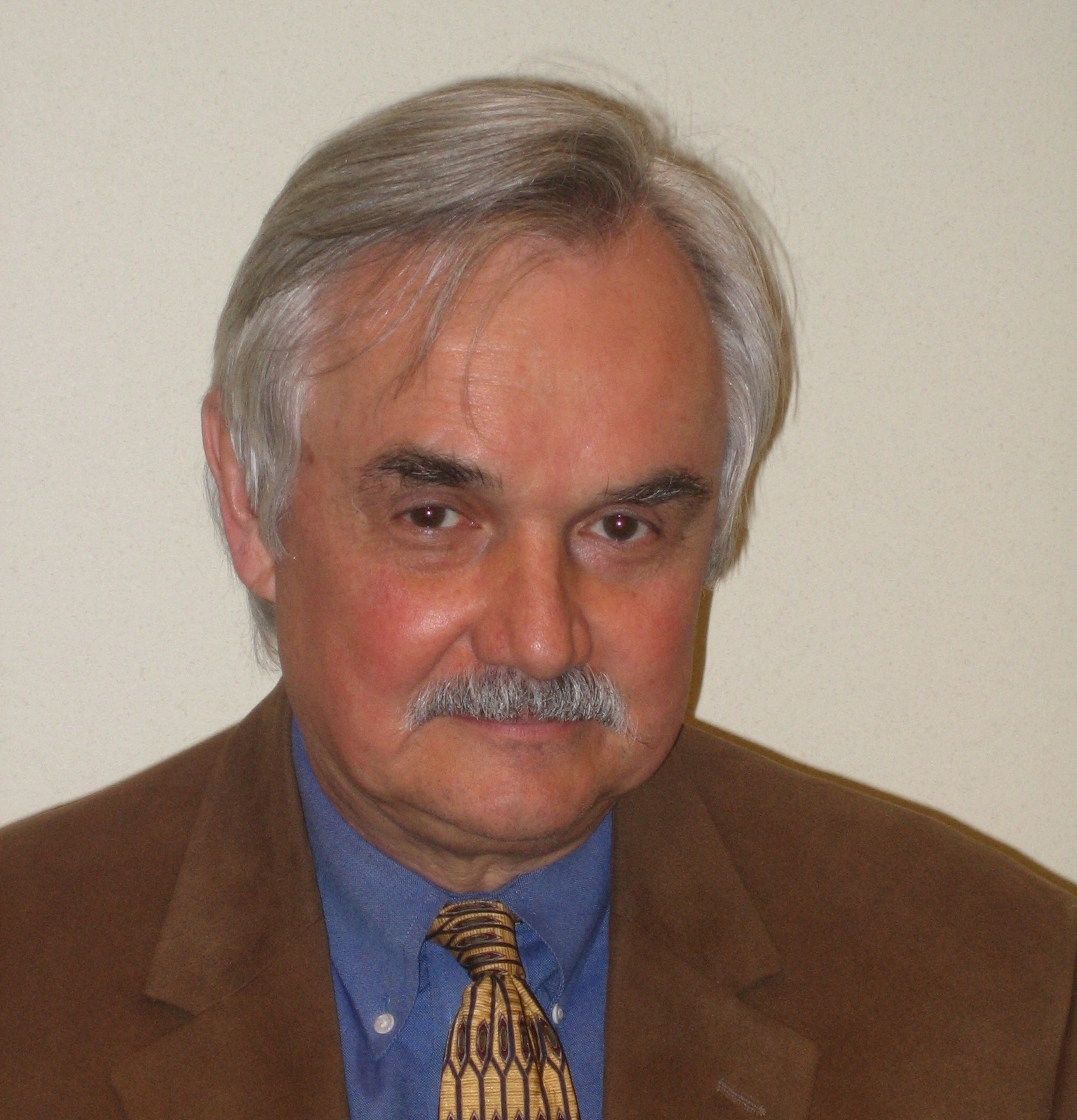
The defense trade press and even some major media have recently produced reports about ethical problems in the US military officer corps. Bill Hartung writes at Huffington Post that “Military Ethics Reform Should Start at the Top,” advocating a reduction in our astoundingly–even historically–high officer bloat. Lt. Col. Danny Davis writes in Armed Forces Journal that our officers are “Seduced by Success” by winning, but only at the minor tactical level, against literally incompetent, almost unarmed enemies.
These are important articles, and I urge you to read them, but retired Army Major Don Vandergriff (who has written about officer education, how our over-officered military means an ineffective military, and more) brought to my attention an article that puts the disconnected media reports about individual examples of officer ethics problems into a broader and far more important perspective. This article, “A Crisis in Command and the Roots of the Problem” explains-at least to me-the fundamental origin of the problem and its solution. Written Jorg Muth (who has also written about the differences between German and American officer training before World War Two-a difference that hardly puts us in a good light), the “Crisis in Command” article explains how today's ethical problems started on the first day that West Point cadets showed up on that campus and how those problems will not go away until American military officers start listening to those they think they outrank–intellectually and morally as well as physically.
Indeed, if you are interested in ending the military sexual harassment now so widely reported in the press and debated in Congress, if you want to eliminate “toxic” and financially corrupt military officers, and if you want to get rid of those who tolerate or just fail to report them all, understand that those behaviors are more likely reinforced, than eliminated, by most of the changes being advocated in the press and Congress. The Jorg Muth article explains why I say this and what can be done to change the course our officer corps is on. Be warned, however, as important as reducing the bloated size of our officer corps is, the solution to our problems is not just to have a smaller number of ethics-crippled officers; it is not to give them a new set of judicially independent ethics enforcers, and it is not to tell them to go to an ethics training course. Muth explains; it is short but informative reading, I believe.
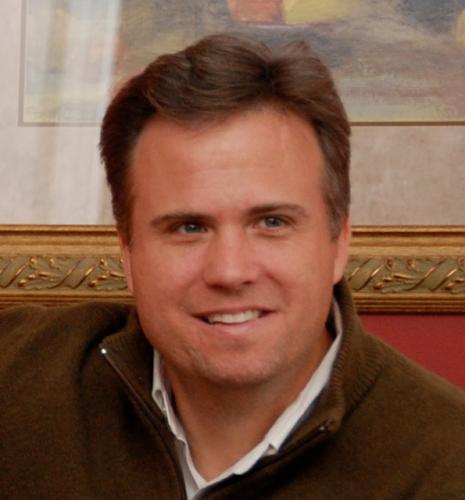
A People’s Movement to End All War
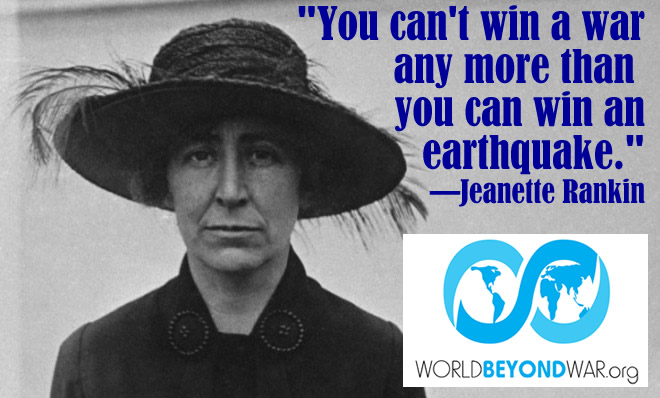
When people sign the declaration of peace at WorldBeyondWar.org they have the opportunity to type in a brief statement in their own words. Thousands have done so, including those pasted below. (And a few great quotes from the past have been added here in graphic form.)
“I support this proposal and agree with this great and important initiative to abolish militarism and war. I will continue to speak out for an end to the institution of militarism and war and for institutions built on international law and human rights and nonviolent conflict resolution.” — Mairead Maguire, Nobel Peace Laureate
“As a 29 year veteran of the US Army/Army Reserves, retiring as a Colonel and having served as a U.S. diplomat for 16 years and resigning in 2003 in opposition to the Iraq war, I firmly believe war does not resolve political issues. We must work diligently to force the governments of our nations to use diplomacy, not weapons.” —Ann Wright
“Everybody’s worried about stopping terrorism. Well, there’s a really easy way: stop participating in it.” — Noam Chomsky
 “It is so inspiring to see a new group coming together not to focus on a particular war or weapons system, but on all war–everywhere. And it’s great to have such beautifully crafted arguments about why war is not inevitable and how war contributes to so many other global ills. This coalition is worthy of Martin Luther King’s call to end violence and instead put our energies and resources into ‘life-affirming activities.’ Bravo!” —Medea Benjamin
“We must work to end all war because: 1. In war there are no winners, only losers. 2. To thrive, humans need peace, which cannot be created by war. 3. We need all our ingenuity, creativity, technology and will to find a solution to runaway climate change. We cannot afford the military-industrial complex.” — Sally Reynolds, Abingdon Peace Group
“The abolition of war is an idea whose time has come. We are at a transformative moment in history. Our Mother Earth is under siege from destructive global warming and industrialization. It is essential that we mobilize to save our planet. War is a cruel and untenable distraction, draining trillions of dollars and incalculable losses of intellectual firepower away from the essential work that needs to be done to create a livable future for humanity.” — Alice Slater, Global Council of Abolition 2000
Continue reading “David Swanson: A People's Movement to End All War”


ECUADOR INITIATIVE: Transition Proposals Toward a Commons-Oriented Economy and Society
Sponsored by the National Institute of Advanced Studies of Ecuador, carried out by the Free/Libre Open Knowledge (FLOK) Society.
Marc Gauvin is actively engaged in the Ecuador endeavor. Establlishing true value is as important as establishing true cost — the first is social value, the second ecological value.
B.I.B.O. is an acronym referring to “Bounded Input Bounded Output” The sine-qua-non requirement for stability in the types of systems that include any money system. Passivity refers to a particular case of BIBO where output never exceeds input or in the case of currency, debt is always less or equal to prices i.e. money is not a negotiable object as explained in this document).
BIBO precisely defines stability in Control Systems Engineering. Understanding BIBO as applied to money systems is crucial as it provides a powerful basis for logically dispelling the current false money paradigm. It explains why almost everything we have been conditioned to believe about money is logically and mathematically inconsistent and the exact opposite of what is scientiically required to bring stability to money. The conclusion of having applied Control Systems and Stability theory to money can be best summarised by the following theorem:
Continue reading “Ecuador Initiative: Passive BIBO Currency – Stable Liquidity for the 21st Century”

Beyond Connecting the Dots is a new kind of book on Systems Thinking and Modeling. Rather than being constrained by the printed page, it runs digitally on your computer or your tablet. Because of this it can provide you an exciting experience that goes beyond the printed word. The models in the book are truly interactive and you can directly experiment with them within the book as you read about them. Beyond Connecting the Dots is more than a book; it is a truly interactive learning environment that lets you play with ideas rather than just read them.
Models in Beyond Connecting the Dots are living. You can interact with them and experiment with them right in the book. Each model contains a guided tour that you can sit back and watch. Alternatively, you can jump in and take the reins adjusting the model on-the-fly to see the results. You can change all the model's parameters or adjust its structure, all right within the book! If you want, you can even load up the models in Insight Maker, a powerful on-line modeling platform, to extend the models with your own ideas and share them with others.
Beyond Connecting the Dots covers all aspects of Systems Thinking and Modeling. It starts on a very basic conceptual level and assumes you do not have a modeling or mathematical background. As the book progresses it becomes increasingly advanced providing you expert knowledge that will be both challenging and rewarding. Whatever your skill level, Beyond Connecting the Dots has something for you. Read the next section to see the full list of subject matter in the book.
Book Home Page, Including Chapter Reviews
See Also:
