Jim Dean: CNN & Amanpour – Lacking Integrity?

Corruption, Media
Jim W. Dean
Jim W. Dean

Did CNN Knowingly Hype an Intel Psyop Atrocity Report?

Geneva II – CNN  throws  a  Curveball  Just  before  Summit

… by  Seth Ferris,  … with  New Eastern Outlook,  Moscow

[ Editor's note:  Corporpate media earned some new stripes in the past week for being in the bag 0f someone's  intelligence agency when they want to herd the rest of us like lemmings to the sea.

The attempt to tag Assad with an anonymous single source mega-atrocity is being laughed at worldwide.

Intelligence people are wondering how could CNN have been suckered into to this when they had to know that the story was just unbelievable.

Continue reading “Jim Dean: CNN & Amanpour – Lacking Integrity?”

Protocol Over Politics – Restoring Agency to the Public with Open Source Liquid Democracy

Advanced Cyber/IO, Civil Society, Ethics, YouTube

NOTES:

Industrial era institutions have failed — need a new way of organizing.

Liquid demoracy, liquid feedback delegates trust.

Politics about decision-making but no software captures how decisions are made and carried forward.

AGENCY is the deinstituionalization (disintermediation) os as to move agency back to the people.

Institutions cannot currently interact with networks (e.g. “outreach” stinks)

GOAL is to replace institutions with P2P protocols.

Chuck Spinney: Should US Leave Afghanistan? Is BBC Out of Its Mind? Robert Steele Comments

02 China, 03 India, 05 Iran, 06 Russia, 08 Wild Cards, IO Impotency, Peace Intelligence
Chuck Spinney
Chuck Spinney

The attached BBC report/video by John Simpson describing Afghan attitudes toward the US/UK exit struck me as bizarre.  The weight of Simpson's gist is that most Afghans do not want us to leave.  But the report based most of its information on interviews in Kabul and only a short part (the wobbly part) on the countryside where the vast majority of Afghans live — i.e., Helmand.  Simpson did not mention of Taliban strongholds in Kandahar and the border areas with Pakistan,nor did he mention the western areas like Herat, or the Northern areas.  So I asked an Afghan friend who follows events in Afghanistan closely for his take on this report.  Attached below the video link is my friend's reaction and a NYT piece with yellow highlights.

http://www.bbc.co.uk/news/uk-25864611

(BBC) The BBC's world affairs editor John Simpson visited Kabul, a city he knows well, to discover what shape Afghan government forces are in and whether the Taliban could take over after UK and American troops leave.
 
———–
Email from Mr. X 
(a highly educated Afghan — ethnic Pashtun — an expat living in Europe)

Berto Jongman: How to Hide From Surveillance

07 Health, 09 Justice, 11 Society
Berto Jongman
Berto Jongman

‘How to hide from surveillance'

BBC, 27 January 2014

Is Big Brother watching us? Every day, street cameras monitor our movements and phones give our location and other information about us away.

New York artist Adam Harvey is working with surveillance, fashion and privacy, with a view to using fashion to help keep our lives more private.

He demonstrates how make-up can prevent facial recognition systems from seeing us, how clothes can foil a heat sensor looking for body heat and how a smart holder for your phone can prevent it giving away information about you.

Includes Video. Visit original.

Phi Beta Iota: The extremely wealth who are also extremely well informed appear to be investing in clothing including scarves and hats, all with high content of special metals to block harmful electromagnetic radiation.

See Also:

General Search: wifi dangers

4th Media: John Walsh on Prosperous China Implications for the USA

Cultural Intelligence, Peace Intelligence

4th media croppedA Prosperous China vs An Imperial US

JOHN V. WALSH | Tuesday, January 28, 2014, 11:31 Beijing

China has stated its goals quite unambiguously. “A moderately prosperous society by 2020” is the first goal and “a strong socialist nation by 2049” as the second. But this may be simplified: China’s leadership wants its people to have a standard of living equal to that of the developed nations of the West.

And that, along with restoring and preserving sovereignty, has been the main part of the Chinese program since 1949 – at least. China’s great historical achievement is to lift hundreds of millions out of poverty, accounting for most of the eradication of poverty in the recent past. This achievement is rarely mentioned in the West.

Consider the simple consequences of that fact. China has a population of 1.36 billion and the United States has a population of 320 million. So if China is to have a per capita GDP equal to that of the United States, its total GDP must be more than four times the size of the US economy. Four times.

As we have known at least since Thucydides military power flows from economic power. That is also true of “soft” power, scientific discovery and technological achievement and capacity. (This week USA Today carries a story on the rapid growth of new and original patents in China., alarming the Pentagon.) Growth in China’s economic power therefore closes the door on US global hegemony.

Continue reading “4th Media: John Walsh on Prosperous China Implications for the USA”

Mini-Me: Is Google Stupid? Here’s The Plan — and the Phi Beta Iota Alternative

Commerce, Corruption, Idiocy, IO Impotency
Who?  Mini-Me?
Who? Mini-Me?

Huh?

Google’s Grand Plan to Make Your Brain Irrelevant

Google is on a shopping spree, buying startup after startup to push its business into the future. But these companies don’t run web services or sell ads or build smartphone software or dabble in other things that Google is best known for. The web’s most powerful company is filling its shopping cart with artificial intelligence algorithms, robots, and smart gadgets for the home. It’s on a mission to build an enormous digital brain that operates as much like the human mind as possible — and, in many ways, even better.

Continue reading “Mini-Me: Is Google Stupid? Here's The Plan — and the Phi Beta Iota Alternative”

Last Mile Mobile Solutions (LMMS)

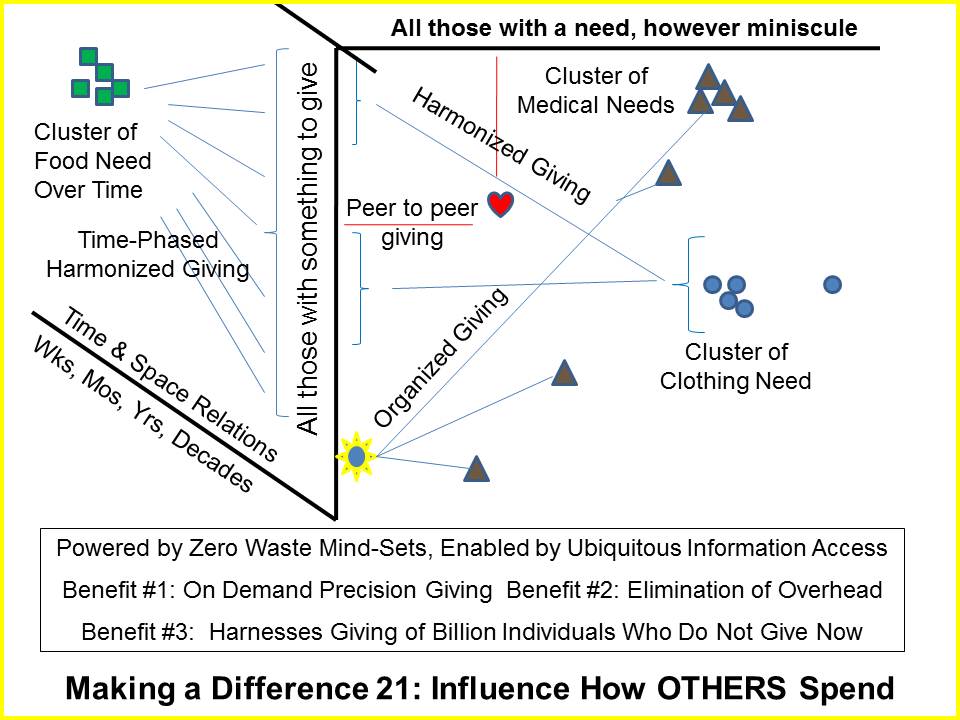
Gift Intelligence
Click on Image to Enlarge

Last Mile Mobile Solutions Program Streamlines Food and Aid Distribution in Real Time

ThoughtWorks, a global technology company, in partnership with the Christian humanitarian agency World Vision Canada, announced that over 137,000 people affected by Typhoon Haiyan have received supplies, including rice and cash distributions via World Vision’s Last Mile Mobile Solutions (LMMS) system. The mobile program empowers mobile users to register recipient information electronically and ultimately produce a bar-coded photo card. When swiped on the same hand-held device, this card produces the information needed to determine and distribute food and non-food items.

Generating reports through LMMS takes just seconds and the time associated with planning and distribution of relief supplies has been significantly reduced. This allows aid agencies to reach more distressed communities in the Philippines with the same human and financial resources. To date, more than 27,500 households in the areas affected by Typhoon Haiyan have been registered through LMMS World Vision staff in the Philippines.  In addition, global humanitarian agencies, such as Oxfam, are being trained to implement the use of LMMS in their own relief efforts for Typhoon Haiyan.

Read full article.

noble gold