Decision Makers Needs Workshop Report
Inevitable Transhumanism? How Emerging Strategic Technologies will affect the Future of Humanity

The truth at any cost lowers all other costs — curated by former US spy Robert David Steele.

According to Harold Jarche, knowledge is an emergent property of all sense-making activities.
Curation and PKM (personal knowledge management) have the same objective: helping oneself and others gain more understanding about whatever we are interested in. The only difference between the two is that curation devotes itself to satisfy the knowledge needs of an audience while the second addresses these at a personal level.
But what are sense-making activites about?
Harold Jarche draws on Ross Dawson's five ways of adding value to information as well as on Nancy Dixon examination Rob Cross and Lee Sproull examination of tacit knowledge sharing practices inside large organizations to identify at least eight individual approaches to sense-making or adding more value to existing information.
These include:
It is indeed around identifying and becoming aware of these specific aspects of our sense-making activities that we can improve and augment our capability to learn and to effectively curate information for others.
Thoughtful. Inspiring. 8/10
Original post: http://www.jarche.com/2013/10/pushing-and-pulling-tacit-knowledge/
Posted: 28 Oct 2013 01:56 PM PDT

Boyd's Theorem
Leaving Afghanistan: Not With a Bang, But a Whimper
Stephen M. Walt, Foreign Policy, 28/10/13

PDF (1 Page): (U) CSA Interview (Defense News, 28Oct13)-1
Interview
GEN. RAY ODIERNO
US Army Chief of Staff
Defense News 10/28/2013

At last week’s Association of the United States Army annual meeting and exposition in Washington, thousands gathered to hear senior leaders explain where the service is headed in this era of austerity. And the message from Gen. Ray Odierno, Army chief of staff, was one of frustration with uncertain budgets and automatic and inflexible defense cuts that are gutting readiness, with only two of his brigades ready for combat. The Army has been cutting personnel at a breakneck pace to save as much money as possible, given additional budget cuts are likely.
The Army is headed from a force of 570,000 soldiers, just a few years ago, down to 490,000. That number could get smaller, given sequestration is likely to continue and deeper reductions are expected over the coming months as part of a broader debt and spending deal.
Q. What is the real impact of past and future budget cuts on the force? Why are you so alarmed? And what is the way out of it?
 This is the latest on Fukushima and the impact it is making on the U.S. West Coast. This directly affects me, as well as tens of millions of other Americans, and there doesn't seem to be a thing we can do about it.
28 Signs That The West Coast Is Being Absolutely Fried With Nuclear Radiation From Fukushima
MICHAEL SNYDER – Global Research – Centre for Research and Globilization
The map below comes from the Nuclear Emergency Tracking Center. It shows that radiation levels at radiation monitoring stations all over the country are elevated. As you will notice, this is particularly true along the west coast of the United States.
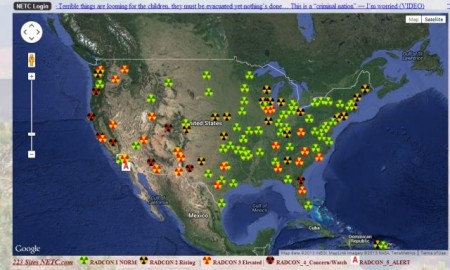
Every single day, 300 tons of radioactive water from Fukushima enters the Pacific Ocean. That means that the total amouont of radioactive material released from Fukushima is constantly increasing, and it is steadily building up in our food chain. Ultimately, all of this nuclear radiation will outlive all of us by a very wide margin. They are saying that it could take up to 40 years to clean up the Fukushima disaster, and meanwhile countless innocent people will develop cancer and other health problems as a result of exposure to high levels of nuclear radiation. We are talking about a nuclear disaster that is absolutely unprecedented, and it is constantly getting worse. The following are 28 signs that the west coast of North America is being absolutely fried with nuclear radiation from Fukushima.
Pakistan: Pakistan is backing Saudi Arabia's rejection of its non-permanent seat on the UN Security Council and supports Riyadh's calls for UN reforms, the Pakistani Foreign Ministry said on 26 October. Pakistan fully understands the imperatives and compulsions that led to the Saudi decision, according to a foreign ministry statement.
Comment: The Pakistani statement appears to be unsolicited. That suggests its timing serves two important purposes. One is to curry favor with the Saudis with whom Pakistan has a longstanding security relationship.
The second is to identify Pakistan's troubles with US foreign policy with those of Saudi Arabia. Despite the recent release of more than $1 billion in US aid to Pakistan, Prime Minister Sharif's visit to Washington, D.C., last week did not go well. Sharif has now let the US know.