NIGHTWATCH: Middle Class Youth Turn Violent — Government Remains Corrupt and Ignorant

01 Brazil, Civil Society, Collective Intelligence, Cultural Intelligence, Ethics, Government
Click on Image to Enlarge

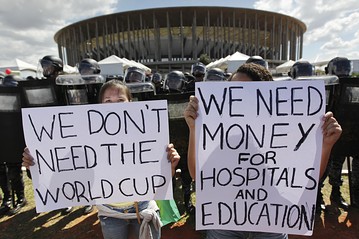
Brazil: The demonstrations are starting to turn violent. The day after the government revoked the transportation fare increases the demonstrations swelled again and engaged in more aggressive clashes with police.

President Dilma Rousseff decided to call off a visit to Japan that was planned for next week. The forthcoming visit by Pope Francis might also have to be rescheduled if the demonstrations continue.

In Rio de Janeiro riot police fired tear gas and rubber bullets at groups of masked young men trying to approach the City Hall late on Thursday. At least 29 people were reported to be injured in the clashes.

Some reports suggest about 300,000 people were taking part in an anti-government rally in the city. One news service reported more than 800,000 people participated in demonstrations in the major Brazilian cities

Comment: The polling agency, Datafolha, published its findings from a poll of the demonstrators in Sao Paulo yesterday. More than half of the demonstrators are under 25. Seventy-seven percent have higher education. Eighty-four percent back no political party, suggesting they do not vote.

The dominant issue for more than half was the fare increase which has been withdrawn. Corruption, a better transportation system, against all politicians and against violence and repression were distant other issues.

What the poll and anecdotal reports indicate is that the beneficiaries of Brazilian prosperity are protesting. The poll found no poor or disadvantaged people and few unemployed among the protestors. Brazil has low unemployment even for workers under age 25. The protestors have no organization or leadership. They gather by cell-phone notification. Expect the demonstrations to expand this weekend and become more violent.

Continue reading “NIGHTWATCH: Middle Class Youth Turn Violent — Government Remains Corrupt and Ignorant”

NIGHTWATCH: US Kicked Out of Kyrgyzstan, Taliban Declares Victory

Ethics, Government
Click on Image to Enlarge

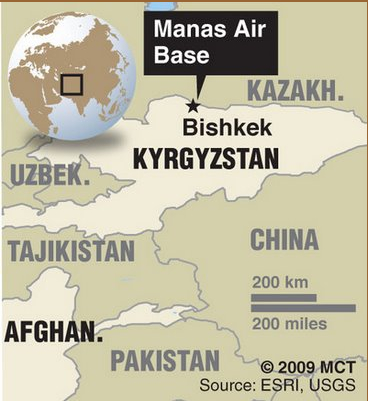
Kyrgyzstan-US: On Thursday, 20 June, the Kyrgyz parliament voted 91 to 5 in favor of ending the lease agreement with the US for use of Manas air base when it expires in 2014. The bill will take effect after being signed by the Kyrgyz president. The US has been given notice to vacate the premises by July 2014 when the lease expires.

Comment: The vote is no surprise, though the US had hoped to keep using Manas after 2014. President Atambayev campaigned in 2011 to end the lease agreement with the US and to establish closer ties with Russia. Last year, Kyrgyzstan extended for 15 years the Russian lease to use Kant air base, which is not far from Manas.

The transit center at Manas has been critical in military personnel movements to and from Afghanistan, but the lease agreement has been a longstanding source of controversy among Kyrgyzstan, Russia and the US. The significance of a firm end date is that it takes away any easy option and capability for an emergency surge or bailout, to help save the Karzai government after mid-2014. It also means the final phase of the withdrawal must transit Pakistan or use Russian bases.

Like South Asia, Central Asia is a half-continent too far for the US to sustain deep engagement in defiance of Russia or China.

Afghanistan: For the record. In web postings today, the Taliban gloated about their political victory over the US.

Continue reading “NIGHTWATCH: US Kicked Out of Kyrgyzstan, Taliban Declares Victory”

John Robb: Canada Makes It Illegal to Wear Masks — Reflections on the Loss of Government Legitimacy (and Sanity) — Beards May Be Next…

Cultural Intelligence, Government, Idiocy, Law Enforcement
John Robb
John Robb

Canada Makes the Automation of Tyranny Easier

Here's a sign of the times.  Canada has made wearing a mask at a protest a crime.

Why did they do this?   It makes it easier for police to ID people using CCTV and social media photos after a protest occurs.

It also makes it easier to assemble a database of facial portraits, that can be run through rapidly improving facial recognition software, so everyone involved in the protest can be IDed and the information stored in a database, for use in the future.

For me, it's another sign that the big, cumbersome nation-state is in decline.

Decline?

First of all, don't confuse decline with collapse.  The decline of the nation-state doesn't mean it's going away entirely.

Like the feudal system before it, it's got a long life ahead of it (much of it at our expense).

The nation-state's rise to power and innevitable decline reads like a Greek tragedy. The nation-state became globally ubiquitous due to its ability to militarily crush all competitive forms of governance.  That competition was eventually won in the last century, and nuclear weapons seal the peace.  Large scale conventional conflict is now something for the history books (despite the occasional sideshows like Iraq).

However, this success means that the nation-state has lost its raison d'etre, its reason for being.  There aren't any external competitors for the nation-state left to crush, despite a voracious desire to do so.

This loss of legitimacy and an creeping economic impotence (in almost all cases in developed world, they haven't delivered prosperity to most citizens in decades) has led to a gnawing fear within political and bureaucratic elites.  A fear that they are losing control.  A paranoia that turns every citizen into a potential enemy of a nation-state that requires enemies in order to justify its existence.

Continue reading “John Robb: Canada Makes It Illegal to Wear Masks — Reflections on the Loss of Government Legitimacy (and Sanity) — Beards May Be Next…”

Gordon Duff: Modern Cars As Murder Weapons — Just Attach A Transceiver to the On Board Computer, and Assume Control — Works on Aircraft as Well

07 Other Atrocities, Corruption, Government, Military
Gordon Duff
Gordon Duff

“We Got The Message…”

Hastings “Boston Brakes” Killing a Warning?

Imagine a new “E Class” Mercedes exploding in flames, burning to a cinder.  220 km/hr crashes on the Autobahn are often survived, certainly without a fire.

There is a reason to own a Mercedes, in normal circumstances the chances of dying in one are quite remote unless you are Lady Di or heir to the presidency of Syria or, just perhaps, wrote a scathing expose that dismembered part of one of the greatest drug empires of all time.

“Yes, you got Michael Hastings.  We are warned.  Lots of journalists are killed each year.  Veterans Today loses its share, perhaps a bit more. ”

For those who didn’t watch the entire video, go back. Catch the last few seconds. I was flabbergasted.

Those of us who have “been there and done that,” and come back with more than the T Shirt say goodbye to one of ours.

RIP Michael from “g” and the gang at “VT”

Continue reading “Gordon Duff: Modern Cars As Murder Weapons — Just Attach A Transceiver to the On Board Computer, and Assume Control — Works on Aircraft as Well”

Berto Jongman: Data visualisation aims to change view of global health

Advanced Cyber/IO
Berto Jongman
Berto Jongman

Data visualisation aims to change view of global health

By creating a new and innovative way to look at massive amounts of patient data worldwide, one man hopes he can change the way public health crises are managed, as Cynthia Graber reports.

Imagine you are a foreign aid worker trying to persuade a senior politician in a developing world country to introduce a pneumococcus vaccination programme. It’s not just a case of stressing how the bacterium causes diseases including pneumonia, meningitis, and sinusitis, and kills over a million children under the age of five every year worldwide. The politician has to decide how to allocate scant resources. How does the death toll compare with malaria and AIDS? Aren't road traffic accidents a bigger problem? Has vaccination been a success in neighbouring countries?

These statistics exist, but you don't have the relevant reports and academic papers to hand. And even when you do have the information, a list of numbers may not the best way to express the strength of your case.

By creating new and innovative visual displays out of oceans of data, Christopher Murray hopes his tool can change this situation for the better. Called GBD Compare, users can rapidly determine which diseases are most harmful to children in Africa, or view how the developing and developed worlds compare in terms of heart disease, all with a few clicks of a computer mouse.

The data viz tool processes data from the Global Burden of Disease (GBD) report, which compiles statistics, charts and graphs on causes of death and disease. “The thing that’s really neat about the visualisations is they allow people to see the problem in context – in the context of all the other problems, how it’s changing over time, how it compares to other countries,” says Murray, director of the Institute for Health Metrics Evaluation (IMHE), based in Seattle.

When Murray shows this tool to people outside the academic world of public health, Murray says, they immediately get it. “That just totally changes who you can engage in a thoughtful discussion about what are the key health problems and where they’re going,” he says.

The new tool has the enthusiastic backing of no less an advocate than Bill Gates, and, just three months after its launch, it's already leading to changes in health policies.

Read full article (2 more screens).

Berto Jongman: Millimeter Waves May be the Future of 5G Phones

Advanced Cyber/IO
Berto Jongman
Berto Jongman

Millimeter Waves May Be the Future of 5G Phones

Samsung’s millimeter-wave transceiver technology could enable ultrafast mobile broadband by 2020

By Ariel Bleicher

IEEE Spectrum, 13 Jun 2013

Clothes, cars, trains, tractors, body sensors, and tracking tags. By the end of this decade, analysts say, 50 billion things such as these will connect to mobile networks. They’ll consume 1000 times as much data as today’s mobile gadgets, at rates 10 to 100 times as fast as existing networks can support. So as carriers rush to roll out 4G equipment, engineers are already beginning to define a fifth generation of wireless standards.

What will these “5G” technologies look like? It’s too early to know for sure, but engineers at Samsung and at New York University say they’re onto a promising solution. The South Korea–based electronics giant generated some buzz when it announced a new 5G beam-forming antenna that could send and receive mobile data faster than 1 gigabit per second over distances as great as 2 kilometers. Although the 5G label is premature, the technology could help pave the road to more-advanced mobile applications and faster data transfers.

Continue reading “Berto Jongman: Millimeter Waves May be the Future of 5G Phones”