Jim Dean: Boston Bombing — DHS Out-Sourced Red Cell Attack to Israel?

07 Other Atrocities, 09 Terrorism, Corruption, Government, IO Deeds of War, Law Enforcement
Jim W. Dean
Jim W. Dean

Jim Dean comes from an old military family dating back to the American Revolution. Dozens of Confederate ancestors fought the Yankees in our Civil War. Uncles fought in WWII and Korea. His father as a WWII P-40 and later P-51 Mustang fighter pilot. Vietnam found several uncles serving, a cousin, and brother Wendell as a young Ranger officer.

Boston Bombing – DHS Contracted Security out to Israelis

Veterans Today, 24 April 2013

The dust has settled on Boston, America’s newest example and scene of national insecurity.

As Kevin Barrett’s hugely successful Press TV article pointed out yesterday we witnessed corporate media suggesting a major domestic terror attack might have been done by our own security people. Military Intelligence agrees.

. . . . . . . . .

Many in the Intel and national security business have watched all this happen just totally aghast not only at the brazenness involved to orchestrate such sting operations, but the general acceptance by a public that seems almost brain dead to the internal threat represented. There is much blame to go around.

. . . . . . .

What we quickly observed was security breach after security breach, like all the doors had been left open. We saw Israeli operational profiles all over the place, many with ear buds getting feeds from higher up spotters who were watching where the cops and bomb dogs were, and where they were not.

. . . . . . .

What we have here once again is a profile of a security stand down. Could it be incompetence? No, not when you outsource to one of the biggest terrorist operations in the world… the one called Israel.

. . . . . . .

Let me repeat in closing. There was no way that two kettle bombs could have been walked in, placed, and then the bombers get away, without a security penetration letting them do it.
Read full article with photos..

Neal Rauhauser: On Intelligence & Foreign Policy Analysis — Looking Forward, Looking Behind

Advanced Cyber/IO, Ethics, Government
Neal Rauhauser
Neal Rauhauser

Looking Forward, Looking Behind

The Democratic Study Group was a 150 staff member legislative service organization(LSO) that had as customers all of the Democratic members of Congress and a good number of Republicans. This internal think tank analyzed policy proposals, serving as an in-house ‘brain’ for Congress. The “Republican Revolution” of 1994 would lead to the defunding of this entity in 1995, functionally turning over control of domestic policy making to the likes of the Heritage Foundation and the American Enterprise Institute. This has result, in my opinion, in an unmitigated policy making disaster that has ended the American empire and that endangers the stability of our nation. The construction of Progressive Congress News was a halting attempt to reverse this trend.

Click on Image to Enlarge

Our intelligence community was more resilient, due to their structure and duties. The outing of Valerie Plame, a twenty year CIA veteran and the head of our counter-proliferation operation, for failure to support the Bush administration’s desire for an adventure in Iraq, ought to have resulted in the prosecution of Dick Cheney and Karl Rove. Instead we limp forward with this crime unpunished, lugging a variety of other attendant baggage of our decay.

Having seen the problems at the domestic level and having a good idea of how they’ll be resolved, I decided I would turn my attention to foreign policy issues. I have gone through the Quadrennial Diplomacy & Development Review, the State Department’s companion to the Defense Department’s Quadrennial Defense Review, I spent the first three months of the year surveying the foreign policy discussion space, and I have my own short list of openings in the area.

Read full post.

Continue reading “Neal Rauhauser: On Intelligence & Foreign Policy Analysis — Looking Forward, Looking Behind”

Berto Jongman: YouTube (1:52) Jeremy Scahill on Significance of Wikileaks as Source on US Dirty Wars and Department of State Being Over-Ruled

04 Inter-State Conflict, 05 Civil War, 07 Other Atrocities, 09 Terrorism, Corruption, Ethics, Government, Military, Peace Intelligence, YouTube
Berto Jongman
Berto Jongman

Published on Apr 24, 2013

Watch the full interview with Jeremy Scahill on Democracy Now! at http://owl.li/knEmh. Jeremy Scahill, author of the new book, Dirty Wars: The World Is A Battlefield, has spent years covering secret U.S. warfare through drone strikes, targeted killings, and enlisting foreign militias in countries from Somalia to Pakistan. Speaking to Democracy Now!, Scahill says U.S. diplomatic cables released WikiLeaks were instrumental in researching the book. “In terms of understanding how the covert apparatus works, WikiLeaks was indispensable,” he says. “We're going to look back decades from now and realize that because of the release of those documents, there was a huge shift in how we understand some of the more hidden aspects of U.S. policy.”

Watch the 50-minute Part 1 of our interview with Jeremy Scahill at http://owl.li/klnWN.

Democracy Now! is an independent global news hour that airs weekdays on 1,100+ TV and radio stations Monday through Friday. Check out our vast news archive and stream live 8-9am ET at http://www.democracynow.org.

Michael S. Kearns: Frederick Nietzsche on Truth and Lies in a Nonmoral Sense

Cultural Intelligence, Ethics
Michael S. Kearns
Michael S. Kearns

On Truth and Lies in a Nonmoral Sense

Über Wahrheit und Lüge im außermoralischen Sinn (in English: “On Truth and Lies in a Nonmoral Sense“, also called “On Truth and Lie in an Extra-Moral Sense[1]) is an (initially) unpublished work of Friedrich Nietzsche written in 1873, one year after The Birth of Tragedy.[2] It deals largely with epistemological questions of truth and language, including the formation of concepts.

Wikipedia / On Truth and Lies in a Nonmoral Sense

2013-04-23 Nietzsche on Truth and Lies in Nonmoral Sense

Berto Jongman: Existential Risk to Humanity

Collective Intelligence, Commercial Intelligence, Cultural Intelligence, Ethics
Berto Jongman
Berto Jongman

How are humans going to become extinct?

By Sean Coughlan

EXTRACT

Dr Bostrom believes we've entered a new kind of technological era with the capacity to threaten our future as never before. These are “threats we have no track record of surviving”.

Lack of control

Likening it to a dangerous weapon in the hands of a child, he says the advance of technology has overtaken our capacity to control the possible consequences.

Experiments in areas such as synthetic biology, nanotechnology and machine intelligence are hurtling forward into the territory of the unintended and unpredictable.

Synthetic biology, where biology meets engineering, promises great medical benefits. But Dr Bostrom is concerned about unforeseen consequences in manipulating the boundaries of human biology.

Nanotechnology, working at a molecular or atomic level, could also become highly destructive if used for warfare, he argues. He has written that future governments will have a major challenge to control and restrict misuses.

There are also fears about how artificial or machine intelligence interact with the external world.

Such computer-driven “intelligence” might be a powerful tool in industry, medicine, agriculture or managing the economy.

But it also can be completely indifferent to any incidental damage.

Continue reading “Berto Jongman: Existential Risk to Humanity”

Sepp Hasslberger: Artificial Leaf Self Heals Produces Energy from Dirty Water

05 Energy, 12 Water
Sepp Hasslberger
Sepp Hasslberger

Producing hydrogen from water, sunlight and some catalyst-coated chips of silicon – we are getting closer to doable home electricity for the technically challenged…

‘Artificial leaf’ gains the ability to self-heal damage and produce energy from dirty water

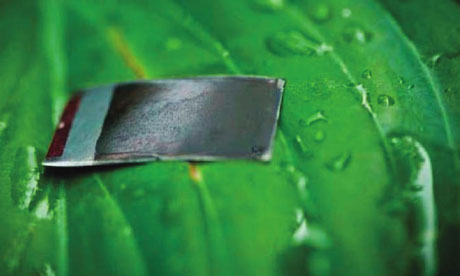
Another innovative feature has been added to the world’s first practical “artificial leaf,” making the device even more suitable for providing people in developing countries and remote areas with electricity, scientists reported here today. It gives the leaf the ability to self-heal damage that occurs during production of energy.

Daniel G. Nocera, Ph.D., described the advance during the “Kavli Foundation Innovations in Chemistry Lecture” at the 245th National Meeting & Exposition of the American Chemical Society.

Click on Image to Enlarge

Nocera, leader of the research team, explained that the “leaf” mimics the ability of real leaves to produce energy from sunlight and water. The device, however, actually is a simple catalyst-coated wafer of silicon, rather than a complicated reproduction of the photosynthesis mechanism in real leaves. Dropped into a jar of water and exposed to sunlight, catalysts in the device break water down into its components, hydrogen and oxygen. Those gases bubble up and can be collected and used as fuel to produce electricity in fuel cells.

“Surprisingly, some of the catalysts we’ve developed for use in the artificial leaf device actually heal themselves,” Nocera said. “They are a kind of ‘living catalyst.’ This is an important innovation that eases one of the concerns about initial use of the leaf in developing countries and other remote areas.”

Nocera, who is the Patterson Rockwood Professor of Energy at Harvard University, explained that the artificial leaf likely would find its first uses in providing “personalized” electricity to individual homes in areas that lack traditional electric power generating stations and electric transmission lines. Less than one quart of drinking water, for instance, would be enough to provide about 100 watts of electricity 24 hours a day. Earlier versions of the leaf required pure water, because bacteria eventually formed biofilms on the leaf’s surface, shutting down production.

“Self-healing enables the artificial leaf to run on the impure, bacteria-contaminated water found in nature,” Nocera said. “We figured out a way to tweak the conditions so that part of the catalyst falls apart, denying bacteria the smooth surface needed to form a biofilm. Then the catalyst can heal and re-assemble.” …

via ‘Artificial leaf’ gains the ability to self-heal damage and produce energy from dirty water.

noble gold