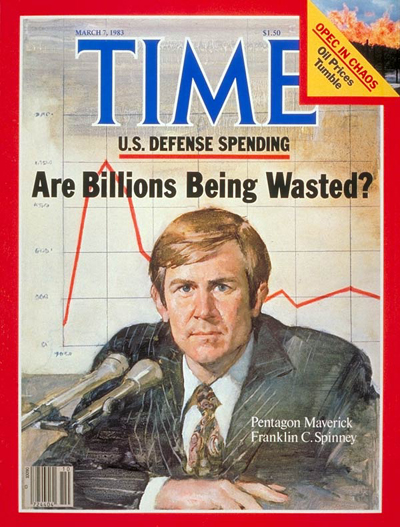
The joint-service F-35 strike fighter is the Pentagon's largest program. In fact, it is the most expensive procurement program in the Pentagon's history. It is also an unfolding disaster that is well documented, but of almost unimaginable proportions. And yet, the F-35 is impervious to budget cutbacks in sequesterland. Not surprisingly, among the cognoscenti of gold-plated boondoggles, the F-35 is not only a source of cynical humor, it is rapidly becoming the mother of all case studies of the pathologies that fuel the Pentagon's gold-plated boondoggles.
Perhaps the most egregious of these pathologies is the practice of concurrent engineering and production, a practice from which all bad things flow.
Concurrency refers to the practice of placing a complex hi-tech weapon system into production, before it is completely designed. Known in the Pentagon as “buy before you fly.” It is the opposite of commonsens engineering, yet concurrency has been business as usual in the Military – Industrial – Congressional Complex for many years, the problem-plagued F-111 and C-5 in the 60s, and more recently the V-22 tilt rotor and the F-22 fighter being cases in point.
Why do we repeat a madness that both robs the taxpayer and puts defective weapons in the hands of soldiers year after year?
DARPA is working on an embryonic project that would store your every verbal conversation on an Internet server, creating a searchable chat database that would represent the ultimate privacy killer.
Having failed to establish its infamous Total Information Awareness system, although the project was continued under numerous different guises, DARPA is attempting to create a world in which your every utterance is stored in perpetuity.
But don’t worry, the servers on which your conversations are stored will be owned by the individual or their employer, and the government promises to never access the information using their vast new $2 billion dollar spying hub in the middle of the Utah desert. Honest.
This is the latest on an important downward trend: the collapse of American media. A healthy Fourth Estate is essential to the running of a healthy democracy. I have written about this a number of times in the past, but this trend is gaining momentum, and should be of concern to every citizen.
This is the best assessment of the distorted behavior of Washington corporate media I have seen in some time. It explains why it is almost impossible, when you turn on the television, or open your paper, to get serious substantive news from American reporters, particularly those within the Beltway of Washington. And why I get so many of the reports I use in SR from overseas sources.
Forbes, Feb. 20, 2013: […] Last week one of the authors of the study from last year, Daniel J. Madigan from Stanford University’s Hopkins Marine Station—along with five other scientists— published a new follow-up study. The main question that this new study wanted to answer: Would the migratory Bluefin tuna show up again a year later off the coast of California carrying radiation from Fukushima? The answer was yes. That means, ultimately, that there is still a high level of radiation in the waters near the Fukushima plant most likely because, as marine chemist, Ken Buessler, asserts, the plant is still leaking radiation into the ocean nearly two years later. […]
After the North American governments refused to fund testing, oceanographer Ken Buesseler, a senior scientist at the non-profit Woods Hole Oceanographic Institution in Woods Hole, Mass, along with Nicholas Fisher, a marine sciences professor at the State University of New York at Stony Brook, and other concerned scientists, managed to secure private funding for a Pacific research voyage. The results?
Cesium levels in the Pacific had initially gone up an astonishing 45 million times above pre-accident levels. The levels then declined rapidly for a while, but after that, they unexpectedly levelled off.
In July, cesium levels stopped declining and remained stuck at 10,000 times above pre-accident levels.
This means the ocean isn’t diluting the radiation as expected. If it had been, cesium levels would have kept falling.
The finding suggests that radiation is still being released into the ocean long after the accident in March, 2011.
The tale of what is going on in Syria reads something like this: an insurgency active since March 2011 has been funded and armed by Saudi Arabia and Qatar and allowed to operate out of Turkey with the sometimes active, but more often passive, connivance of a number of Western powers, including Britain, France, Germany, and the United States. The intention was to overthrow the admittedly dictatorial Bashar al-Assad quickly and replace him with a more representative government composed largely of Syrians-in-exile drawn from the expat communities in Europe and the United States. The largely ad hoc political organization that was the counterpart to the Free Syrian Army ultimately evolved into the National Coalition for Syrian Revolutionary and Opposition Forces (Syrian National Coalition) in November 2012, somewhat reminiscent of Ahmad Chalabi and the ill-starred Iraqi National Congress. As in the lead-up to regime change in Iraq, the exiles successfully exploited anti-Syrian sentiment among leading politicians in Washington and Europe while skillfully manipulating the media narrative to suggest that the al-Assad regime was engaging in widespread atrocities and threatening to destabilize its neighbors, most notably Lebanon. As in the case of Iraq, Syria’s possession of weapons of mass destruction was introduced into the indictment of al-Assad and cited as a regional threat.
If there was a model for what was planned for Syria it must have been the invasion of Iraq in 2003 or possibly the United Nations-endorsed armed intervention in Libya in 2010, both of which intended to replace dictatorial regimes with Western-style governments that would at least provide a simulacrum of accountable popular rule. But the planners must have anticipated a better outcome. Both Libya and Iraq have become more destabilized than they were under their autocrats, a fact that appears to have escaped everyone’s notice. It did not take long for the wheels to fall off the bus in Syria as well. As in Iraq, the Syrian exiles had no real constituency within their homeland, which meant that the already somewhat organized resistance to al-Assad, consisting of the well-established Muslim Brotherhood and associated groups, came to the fore. Al-Assad, who somewhat credibly has described[1] the rebels as terrorists supported by foreign governments, did not throw in the towel and leave. The Turkish people, meanwhile, began to turn sour[2] on a war which seemed endless, was creating a huge refugee and security problem as Kurdish terrorists mixed in with the refugees, and was increasingly taking on the shape of a new jihad as foreign volunteers began to assume responsibility for most of the fighting.
From: “Bill McKibben
Reply-To: <organizers@350.org>
Date: Fri, 01 Mar 2013
Subject: Breaking news on Keystone XL
Friends,
Yesterday Time Magazine declared that Keystone had become the Stonewall and the Selma of the climate movement — and today we got a reminder of just how tough those fights were, and how tough this one will be.
On a Friday afternoon, with Secretary of State John Kerry half a world away and D.C. focused on the budget fight, the State Department released a new environmental impact statement for the pipeline. Like the last such report, it found that approving a 800,000 barrel-a-day fuse to one of the planet¹s biggest carbon bombs was ³unlikely to have a substantial impact² on the tar sands or the climate.
That, in a word, is nonsense — some of our most important climate scientists in the U.S. have written the State Department to explain exactly how dangerous Keystone is. Just yesterday Europe¹s top climate diplomat
pointed out that it would send a truly terrible signal to the rest of the world.