NIGHTWATCH: Chinese Using Senkaku Islands Dispute to Experiment with Managing “Total War” Across All Domains

02 China, 03 Economy, 04 Inter-State Conflict, 10 Security, 11 Society, IO Sense-Making

Japan-China: Bloomberg has published an excellent report that describes the economic consequences of Japan's dispute with China over ownership of the Senkaku Islands. No other news outlet has published a comparably insightful and detailed account.

The first point the journalists made is that trade relations between China and Japan multiply the costs of a territorial dispute. Japan's trade with China is valued at more than $300 billion per year, which is potentially at risk.

A Chinese boycott of Japanese imports would hurt China but might already have resulted in a reduction of GDP, according to Bloomberg citing JPMorgan Chase, because of reduced Chinese purchases of Japanese goods.

Ripple effects in China from boycotts of Japanese manufactures put at risk the jobs of millions of Chinese who work in Japanese industries in China. Japanese auto sales declined. Air travel cancellations increased in both countries. One Japanese department store retailer closed 60 of 169 stores because of anti-Japanese vandalism and threats.

Comment: The key point is that global economic integration magnifies the consequences of international disputes. Interdependency means both sides seriously suffer economically, although security incidents result in no casualties. Japan might have sustained a .5 per cent decline in GDP in the last quarter of 2012, essentially because of Chinese hostile, nationalistic responses to the islands dispute.

Both sides got hurt, but China can absorb the consequences more than Japan.

Another key point is that the dispute shows how the Chinese fight in every kind of battle space – at sea, in the air, on the land, in cyber space, in international political space and in economic space. Total warfare means total to the Chinese. They are experimenting with that in the Senkakus dispute.

Continue reading “NIGHTWATCH: Chinese Using Senkaku Islands Dispute to Experiment with Managing “Total War” Across All Domains”

Berto Jongman: Maplecroft Global Terrorism Risk Map 2013

09 Terrorism
Berto Jongman
Berto Jongman

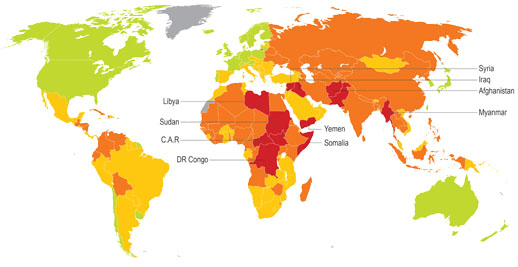
The spread of violence and instability from Syria and Libya; increasing terrorism across key growth economies; the heightened risk of social unrest driving regime change; and resource nationalism will be the drivers of political risk for 2013, according to the fifth annual Political Risk Atlas, released by Maplecroft.

Maplecroft’s Political Risk Atlas 2013 (PRA) includes 50 risk indices and interactive maps developed to enable companies and investors to monitor the key political issues and trends affecting the business environments of 197 countries. The Atlas includes dynamic short-term risks, such as rule of law, political violence including terrorism, the macroeconomic environment, expropriation, resource nationalism and regime stability, as well as structural long-term risks, such as economic diversification, resource security, infrastructure readiness, and human rights. Indeed, changing patterns of human rights risk on the ground are considered leading indicators of political risk by Maplecroft.

Click on Image to Enlarge

Phi Beta Iota: There is still a need for a map that integrates the ten high level threats to humanity and performance across all organizations on the twelve core policies.

See Also:

2002 Jongman (NL) World Conflict & Human Rights Map 2001/2002

Reflections on the Next Four Years — Eradicate “Distortions,” Get the Truth on the Table, and Focus on Free Energy

#OSE Open Source Everything, Advanced Cyber/IO, All Reflections & Story Boards, Cultural Intelligence
Robert David STEELE Vivas

Joseph Stiglitz, an economist I admire and would trust as one of several advisers has written a provocative essay, “The Post-Crisis Crisis” (Project Syndicate, 9 January 2013).  Here is his opening:

NEW YORK – In the shadow of the euro crisis and America’s fiscal cliff, it is easy to ignore the global economy’s long-term problems. But, while we focus on immediate concerns, they continue to fester, and we overlook them at our peril.  The most serious is global warming. While the global economy’s weak performance has led to a corresponding slowdown in the increase in carbon emissions, it amounts to only a short respite. And we are far behind the curve: Because we have been so slow to respond to climate change, achieving the targeted limit of a two-degree (centigrade) rise in global temperature, will require sharp reductions in emissions in the future.  Some suggest that, given the economic slowdown, we should put global warming on the backburner. On the contrary, retrofitting the global economy for climate change would help to restore aggregate demand and growth.  Read full article.

Joseph is well-intentioned in his focus on global warming and the need to create resilient localities and nations that ut people to work creating green infrastructure, but this is — with all humility — like painting the Titanic before driving it into the iceberg.  Cosmetic.

Continue reading “Reflections on the Next Four Years — Eradicate “Distortions,” Get the Truth on the Table, and Focus on Free Energy”

Marcus Aurelius: CIA’s Double Standard Exploitation of Secrecy — Use It to Hide Official Attrocities, While Screwing Iconoclasts + RECAP

07 Other Atrocities, 11 Society, Corruption, Director of National Intelligence et al (IC), Government
Marcus Aurelius
Marcus Aurelius

Secret Double Standard

By Ted Gup

New York Times, January 9, 2013

Cambridge, Mass. — IN the last week, the American public has been reminded of the Central Intelligence Agency’s contradictory attitude toward secrecy. In a critique of “Zero Dark Thirty,” published last Thursday in The Washington Post, a former deputy director of the C.I.A., Jose A. Rodriguez Jr., defended the use of waterboarding and said that operatives used small plastic bottles, not buckets as depicted in the film, to carry out this interrogation method on three notable terrorists. On Sunday, The New York Times reported on the Justice Department’s case against a former C.I.A. officer, John C. Kiriakou, a critic of waterboarding who faces 30 months in prison for sharing the name of a covert operative with a reporter, who never used the name in print.

The contrast points to the real threat to secrecy, which comes not from the likes of Mr. Kiriakou but from the agency itself. The C.I.A. invokes secrecy to serve its interests but abandons it to burnish its image and discredit critics.

Over the years, I have interviewed many active and retired C.I.A. personnel who were not authorized to speak with me; they included heads of the agency’s clandestine service, analysts and well over 100 case officers, including station chiefs. Five former directors of central intelligence have spoken to me, mostly “on background.” Not one of these interviewees, to my knowledge, was taken to the woodshed, though our discussions invariably touched on classified territory.

Somewhere along the way, the agency that clung to “neither confirm nor deny” had morphed into one that selectively enforces its edicts on secrecy, using different standards depending on rank, message, internal politics and whim.

I am no fan of excessive secrecy, or of prosecuting whistle-blowers or leakers whose actions cannot be shown to have damaged American security. The C.I.A. needs secrecy, as do those who place their lives in the agency’s hands, but the agency cannot have it both ways.

Read full article.


Continue reading “Marcus Aurelius: CIA's Double Standard Exploitation of Secrecy — Use It to Hide Official Attrocities, While Screwing Iconoclasts + RECAP”

Marcus Aurelius: The Four Business Gangs That Run (Loot) the US + 4 Books

Commerce, Corruption, Government, Military
Marcus Aurelius
Marcus Aurelius

The four business gangs that run the US

Ross Gittins

Sydney Herald, December 31, 2012

IF YOU'VE ever suspected politics is increasingly being run in the interests of big business, I have news: Jeffrey Sachs, a highly respected economist from Columbia University, agrees with you – at least in respect of the United States.

In his book, The Price of Civilisation, he says the US economy is caught in a feedback loop. ”Corporate wealth translates into political power through campaign financing, corporate lobbying and the revolving door of jobs between government and industry; and political power translates into further wealth through tax cuts, deregulation and sweetheart contracts between government and industry. Wealth begets power, and power begets wealth,” he says.

Sachs says four key sectors of US business exemplify this feedback loop and the takeover of political power in America by the ”corporatocracy”.

First is the well-known military-industrial complex. ”As [President] Eisenhower famously warned in his farewell address in January 1961, the linkage of the military and private industry created a political power so pervasive that America has been condemned to militarisation, useless wars and fiscal waste on a scale of many tens of trillions of dollars since then,” he says.

Second is the Wall Street-Washington complex, which has steered the financial system towards control by a few politically powerful Wall Street firms, notably Goldman Sachs, JPMorgan Chase, Citigroup, Morgan Stanley and a handful of other financial firms.

Continue reading “Marcus Aurelius: The Four Business Gangs That Run (Loot) the US + 4 Books”

Marcus Aurelius: Pentagon Plays the 800,000 Cuts Card, Dishonest to the Bone

Corruption, Military
Marcus Aurelius
Marcus Aurelius

Pentagon gets to work planning for severe cuts

Wants to be ready if sequestration occurs

Defense officials have begun “serious planning” for automatic spending cuts that could force the Pentagon to lay off hundreds of thousands of civilian workers as it reduces its budget by $500 billion over the next 10 years.

“We are doing some serious planning for sequestration,” Pentagon press secretary George Little told reporters Tuesday. “We need to be ready, and we’re working through those numbers right now.”

Known as sequestration, the across-the-board, automatic reductions are set to begin March 1, unless Congress reaches a deal on taxes and spending. Under sequestration, about $1 trillion is to be trimmed from the federal budget, with the Pentagon accounting for about half of that amount.

As many as 800,000 civilian employees in the Pentagon eventually could be laid off, defense officials say.

Read full article.
Continue reading “Marcus Aurelius: Pentagon Plays the 800,000 Cuts Card, Dishonest to the Bone”

Steve Aftergood: Intelligence System Acquisition

Director of National Intelligence et al (IC)
Steven Aftergood
Steven Aftergood

New Procedures for Intelligence System Acquisition

January 8th, 2013 by Steven Aftergood

The Director of National Intelligence issued a directive last month prescribing procedures for major system acquisitions by elements of the intelligence community.

The directive defines a multi-phase process for identifying critical needs, evaluating alternative paths to meet those needs, and so forth.

See Intelligence Community Directive 115, “Intelligence Community Capability Requirements Process,” December 21, 2012.

Phi Beta Iota:  A sad little document of no value what-so-ever.  This is a process for stove-piping that sets no standards for a) assuring that all collection can be processed; b) assuring that all processing collection can be shared; or c) assuring that the IC is moving as quickly as possible toward Open Source Everything (OSE) as well as M4IS2 (Multinational, Multiagency, Multidisciplinary, Multidomain Information-Shariing and Sense-Making).  The DNI and ODNI appear to be distracted, incoherent, largely ineffective, and long over-due for elimination.

See Also:

21st Century Intelligence Core References 2.8

noble gold