What is most striking to me, and to a few others I have spoken to recently, is the SECDEF quote early in the paper. If we follow its premise it puts anyone who opposes our projection of power in the cross hairs. It is this doctrinal fluff that we have touted for the last decade that must be tempered, otherwise 97% of the planet is and will our enemy. We will subsequently wrangle our ourselves into skirmishes and actions for nothing more than to save face and uphold flawed doctrine. We must bring to the forefront a sense of rationality about our defense and definition of national security. We must separate these from economic superiority debates and move policy decisions to the ones that truly matter. You have appropriately pointed out these yet again as the prevention of war and humanitarian crisis.
For the record, Keith Hall established the budget for the OSA when he was interviewed by Boyd Sutton — $10M a year for each of 150 topics not covered by an IC obsessed on a few hard targets and oblivious to all the rest ($1.5B). Congressman Simmons (then on the Homeland Security Committee) and I added $30M for each of the 50 states to create the bottom up “cop on the beat” and citizen “intelligence minuteman” 119 (auto repeat warning to 5 klik radius) and 114 (text or photo / text with geospatial grid to local fusion center) capabilities and the broader Smart Nation platform for eventually integrating education, intelligence, and research. And then he lost by 80 votes because his staff did not distribute 240 copies of THE SMART NATION ACT: Public Intelligence in the Public Interest, and two newspapers in his district turned against him because in the absence of the books, they had no idea he was a visionary as well as a patriot.
Put bluntly and directly, if a President were to direct D/OMB to create a Presidential initiative, IOC $125M, FOC $3B, or if a Secretary of Defense were to fund the Open Source Agency (OSA) out of hide, I could, within three to five years, not only provide 90% of the Whole of Government decision-support that is not provided today, but also assure both Whole of Government PPBS/E, and provide the President and Congress with a sufficiency of evidence justifying the reduction of the secret world's budget to below $20B per year, while helping DoD achieve a 450-ship Navy, a long-haul Air Force, and an air-liftable Army with half the flags and half the dollars they have today. This is not rocket science. Intelligence with integrity is the most powerful lever on the planet.
UPDATE 3 December 2012: Added links including DCI Preparing US Intelligence for the Information Age (STIC 93-001, January 1993). INSA is just now getting a partial and terribly flawed view of what the smart people were saying in 1992-1993.
UPDATE 2 December 2012: Richard Wright's comments on paper added at end of post followed by Steele endnote.
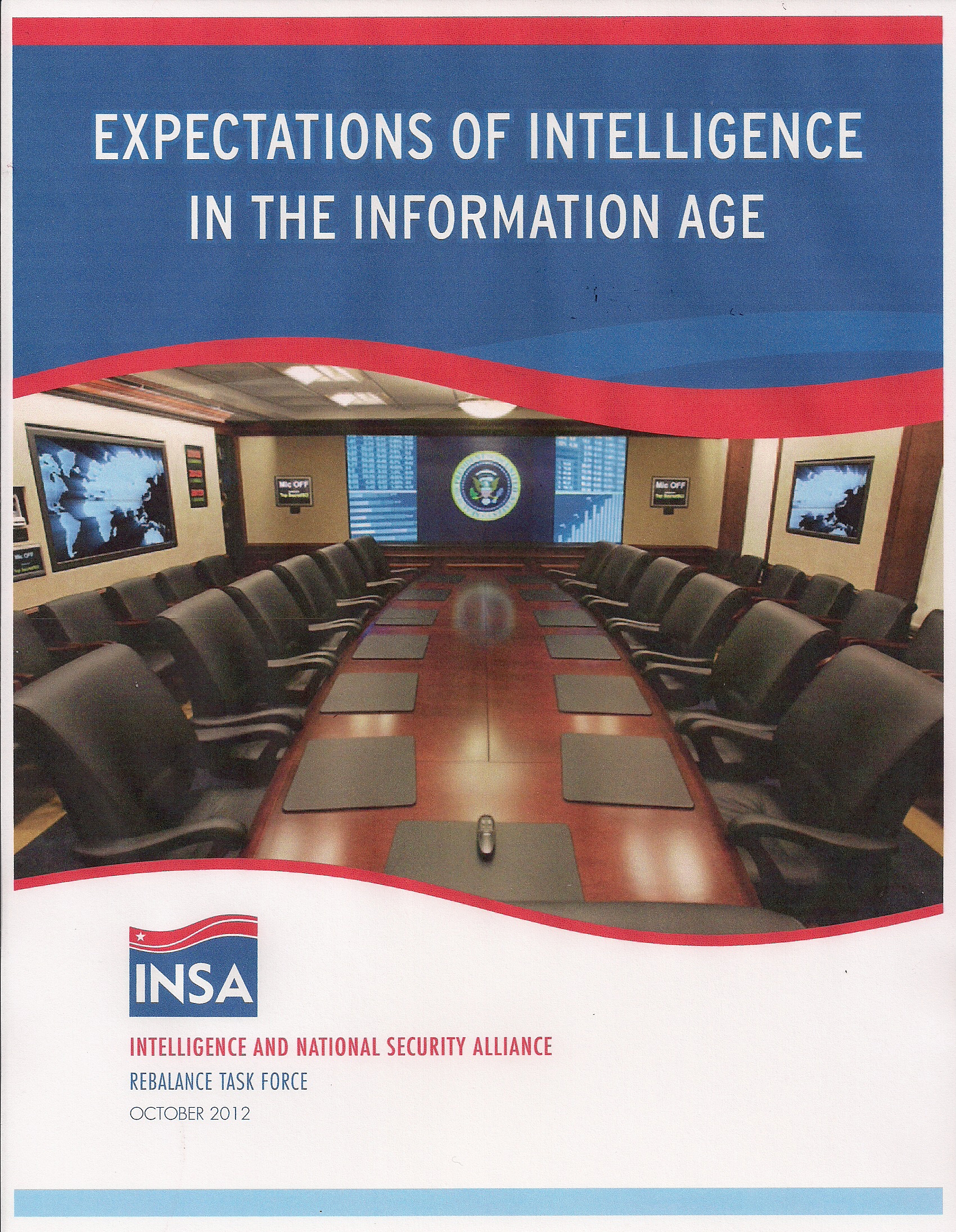
The INSA Rebalance Task Force concluded that although the IC developed world-class capabilities for intelligence-driven tactical operations in the last decade, the sources for developing global situational awareness and providing strategic warning are rapidly changing. The IC will need to develop authorized and appropriate techniques that improve its ability to leverage the growing platforms and vast amounts of information that are now openly available. To successfully leverage openly sourced information, the IC will need to develop capabilities to quickly validate and analyze that information, accurately integrate it with that gleaned from traditional collection sources, and present the resulting knowledge to policy makers addressing national security issues of an urgent and critical nature.
Dr. Stephen Cambone, former Undersecretary of Defense for Intelligence and INSA Rebalance Task Force Chair, said, “The challenge moving forward will be for the IC to enlarge its sphere of collection and the foundation for its analysis beyond the information gained through traditional methods. In the new era of global access to diverse and burgeoning sources of data and information, the Congress will need to authorize appropriate techniques for use by the IC to allow it to extract value and knowledge from open sources.”
The key proposals presented at the conclusion of the white paper are:
Policy makers should engage the IC to better understand the relative roles of open source and traditional intelligence in meeting the policy makers’ demand for knowledge of national security issues and events.
The executive and legislative branches should act to ensure that privacy and civil liberty rights impacted by open source collection are protected.
A coalition of knowledgeable experts should be formed to consider and recommend ways to resolve the practical issues associated with the collection, analysis, validation, integration and dissemination of openly sourced intelligence.
Executive Summary
The U.S. Intelligence Community (IC) is still living largely in the world of traditional secrets. In an era of global access to diverse and rich sources of data and information, the IC must embrace a new understanding of intelligence, knowledge, and rapidly evolving technology in order to sustain its relevance.
• The IC must become a curator of knowledge and information, translating secret and open information into useful knowledge for strategic warning, situational awareness and crisis management.
• In order to meet expectations from national security policy makers, the IC will need to monitor, measure, validate, analyze and distribute information collected in the open source world and across social networks.
• Traditional intelligence activities will retain their importance as the competitive advantage of the IC.
• Policy makers will want this melded knowledge in near real-time, not in days or hours.
• U.S. laws and practices must keep pace with this information revolution in a manner that respects privacy and civil liberties.
• Policy makers are likely to demand reports with knowledgeable insight into the trends that drive groups to form networks opposed to official government policy. Trends of interest include:
oo Shifting demographics
oo Competition for water, energy, food, medicine and other resources
oo Pandemics
oo Cyber threats
oo Global criminal networks
oo Continuing ethnic, sectarian and secular conflict
The white paper concludes with the following proposals:
• Policy makers of the incoming administration must engage the IC to better understand the relative roles of open source and traditional intelligence in meeting policy makers’ needs.
• The executive and legislative branches should propose and/or make policy, regulatory and statutory changes as appropriate and necessary to ensure that privacy and civil liberties are protected.
• A coalition of current and former decision makers and intelligence practitioners, as well as interested policy organizations, should be formed to recommend ways to resolve the practical issues
associated with the collection, analysis, validation, integration and dissemination of openly sourced intelligence.
THE REPORT ITSELF – REVIEW
Robert David STEELE Vivas Click Here to See Personal Page
ROBERT STEELE: The report has no bibliography, no footnotes, and no index. While it bears remarkable similarity to the concepts, doctrine, capabiltiies, and practices I have been calling for since 1988, there are only two people engaged in this report process that are likely to have read some of my work: Joe Mazzafro and Carmen Medina. This may well be an immaculate conception, in which case it is an excellent case study in time lags between agile minds and bureaucratic “no mind” — 20 years. The recommendations almost precisely mirror what Joe Markowitz and Paul Wallner, Tom Pedtke, and I (and a tiny handful of others) were working on in 1992. 20 years! The report is in many ways a perfect counter-foil to my own newest work, “The Craft of Intelligence,” forthcoming in Robert Dover, Michael Goodman, and Claudia Hillebrand (eds.). RoutledgeCompanion to Intelligence Studies (Oxford, UK: Routledge, 31 July 2013), a book I recommend in the strongest possible terms as among the first to really engage 21st Century intelligence challenges and possibilities.
Before my comments, let's start with what the report does not say. It does not say that the US is over-invested in technical collection that does not work as advertised and provides a tiny fraction of what is needed. It does not say that investments in processing have been neglected for fifty years, and that investments in inter-agency and all-source fusion processing have been cursory at best, treasonous at worst. It does not say that our clandestine service is a fraud, our analysts are mostly children, and the security mind-set of the IC is such that effective interaction with the real world, and particularly foreigners who know stuff, is next to impossible. It does not say that still today the National Counterterrorism Center (NCTC) is a very expensive trravesty, with over 80 different databases that have to be individually searched by someone experienced in the arcane search architecture and commands of that specific data base (i.e. a different person for each database), and if they lose their password, it will take days to reset it. And other stuff along those lines.
The following occur to me as I go through the actual 20 page document.
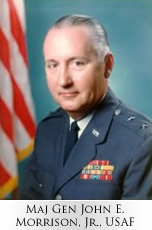
01 This report is 20 years late and out of focus — it is not really focused on all open source information that is mostly human in nature, or even the deep web, but rather on the fad of the day, social media. MajGen John Morrison, USAF (Ret) would keep inviting me to speak to this group in the 1990's, and toward the end I would demur, suggesting that they might be tired of listening to me, and he would say “Robert, you don't understand. They have not been listening in past years. This is the year I hope they will listen!” And so we would try again. I think we gave up on them around 1997.
Click on Image to Enlarge
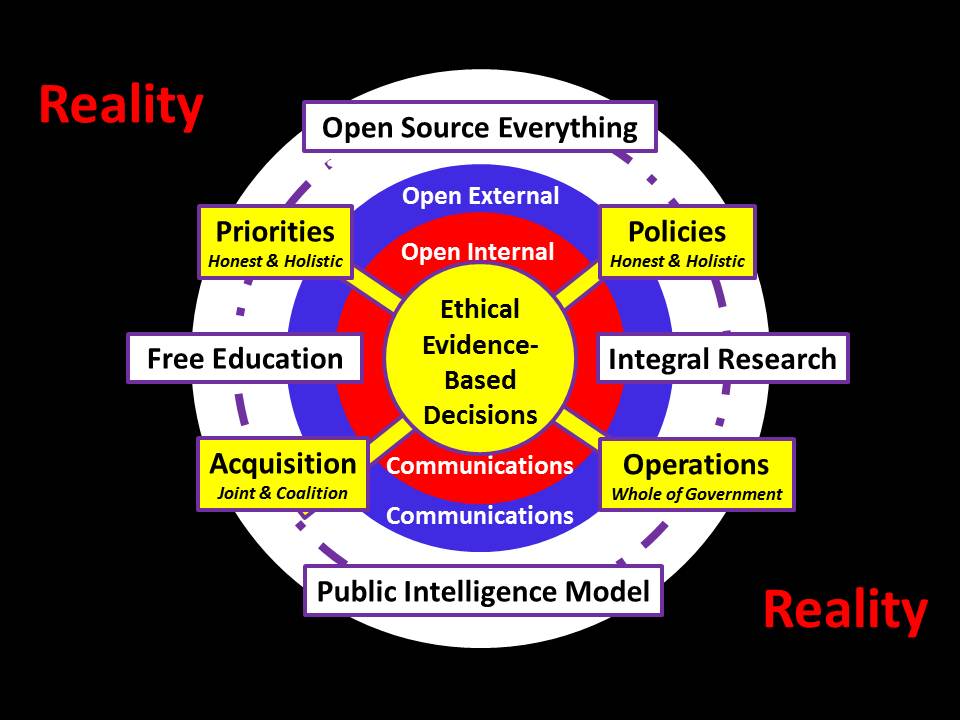
So they are 20 years late and still do not really have a grasp of what it means to have a strategy, to have a strategic analytic model, to have a requirements system, to do warning at three levels (near, mid, long), to do Whole of Government decision-support (at all levels from street and desk to Cabinet, across all mission areas), to take pride in ethical evidence-based decision-support, to actually impact constructively on national priorities, policies, acquisition, and operations — and they are completely lacking on Human Intelligence (HUMINT), multi-anything, and Open Source Everything (OSE).
02 Anyone who thinks that the current national and defense policies toward Asia are a) a strategic pivot and b) policies, does not understand strategy or policy. What we have right now is a massive case of strategic decrepitude, and an incoherent set of policies that are being mocked around the world. The President has just been politely kicked out of Asia, which is refusing the lunatic and predatory Trans-Asian Partnership (you give, we take), and instead going forward with the Regional Comprehensive Economic Partnership that excludes the USA. As with the Community of Latin American and Caribbean States (CELAC) that excludes the USA and Canada, and as with the emerging African, Central Asian and other communities of interest, it is now understood by most that the US Government (not to be confused with the Republic or the public inhabiting America the Beautiful) is toxic — all things being equal, following the USG is a certain heart-break and a probable bankruptcy.
Click on Image to Enlarge
03 This 20-pager fails at three levels.
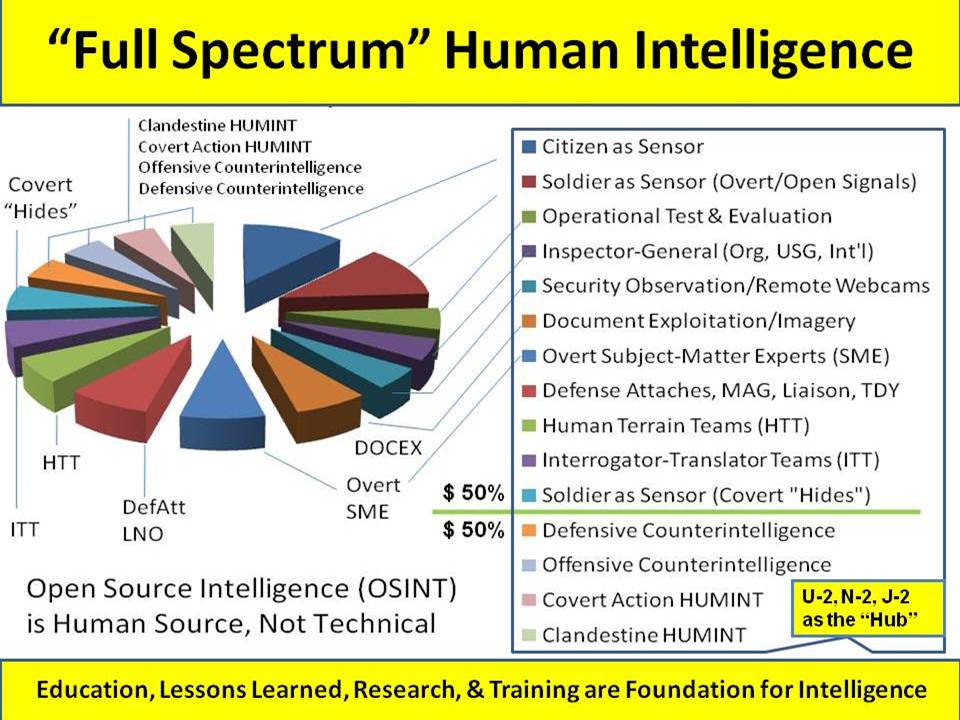
First: this is not a group that understands Human Intelligence (HUMINT) inclusive of offensive and defensive counter-intelligence (two of the fifteen slices of “full-spectrum HUMINT”).
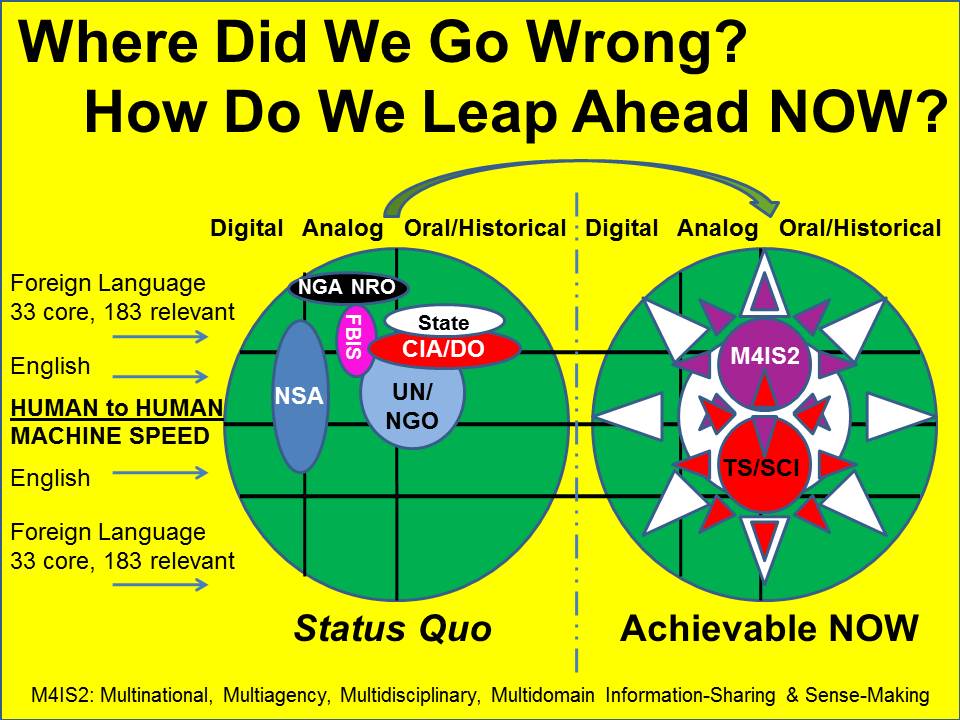
Second: this is not a group that understands World Brain, EarthGame, Smart Nation, or the eight tribes of information-sharing and sense-making. Certainly this is not a group that has a clue on Epoch B advanced information operations leveraging M4IS2 / OSE.
Third: this is not a group that is truly tuned in to near-real time multi-lingual (183 languages) geospatially-founded machine-speed all source data fusion or processing — they really truly believe in their hearts that “OSINT” is just another technical collection discipline, and processing and sense-making are someone else's problem. In other words, this is a group that has nothing to offer the policy, acquisition, and operations communities, which is ignoring them now anyway (they don't seem to realize that last bit). The focus on “social intelligence” is the indicator of how far off track these people are. With the possible exception of Carmen Medina, I doubt any one of these people knows what “citation analytics” means, or how to leverage it. They are certainly not tuned in to collective intelligence and cognitive surplus — their idea of “social intelligence” is twisted and far removed from the bazaars of humanity outside the USA.
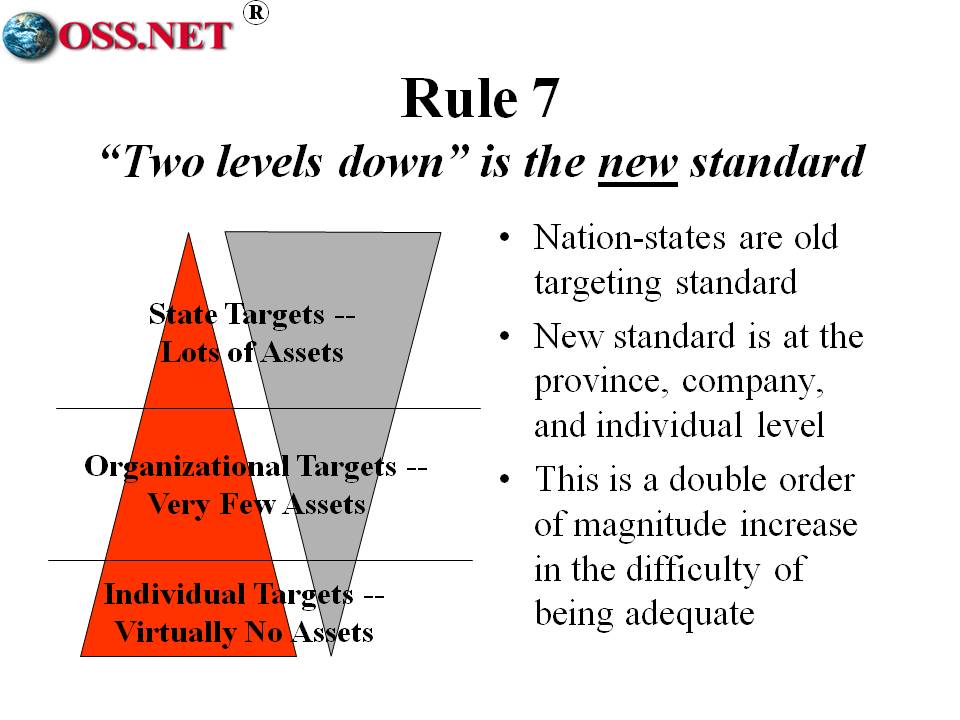
New Standard: Two Levels Down
04 “Strategic Warning” and “Demand Pull” are terms of art for “we don't have a clue.” The idea that strategic warning is some kind of connect the dots challenge for high speed high cost technical architectures is a clear sign that the individuals discussing this concept are totally divorced from reality and out of touch with the true craft of intelligence. Strategic Warning — as Michael Herman among others has documented so well — is a long game play, and is almost totally reliant on not just open sources but also Global Goverage (to which I would add Cambone's signal contribution in 2000, going two levels down, to universal neighborhood granularity). “Demand Pull” is an idiot's term for give me more money and I'll figure out something. David Cameron's little dashboard on his cell phone does absolutely nothing at all to help him — it reminds me of NewsEdge, the company that struggled in the 1990's to understand that humans would not value having to read a headline every 15 seconds. I already do strategic warning (I tell the truth), and I already do Demand Pull in a way this group cannot compute, precisely as I described it in Canada in 1994, by abandoning the linear paradigm and embracing the diamond paradigm. Just as when I soundly exposed the IC's debility with a few phone calls in the 1995 Aspin-Brown challenge match on Burundi, I know who knows and I can put a policy maker or acquisition manager or operator in touch with the person who knows in their head, who can create instant tailored answers that did not exist in analog or digital form before. Even if an IC analyst knows what I know, with the present deeply ingrained mind-sets of the aging security force, the IC will remain dysfunctional no matter how smart any one analyst might be.
Click on Image to Enlarge
05 “The sources, methods, tools, and products available in the private sector rival and, in many instances, surpass those of the IC.” I am reminded of John Perry Barlow's visit to CIA in the aftermath of their encountering him in 1992 at my first conference, and his famous 2002 description of CIA, in Forbes, as being the last vestige of the Soviet gulag and Soviet-era office style, equipment, and culture. There you have it, but the good news is that most corporations, non-profits, academics, civil society, etcetera, they don't have a clue either. Intelligence is not a profession today, it is a scam, and both practitioners and policy makers share the blame for letting secret intelligence get away with vaporware for the past 50 years. As I lectured NSA in Las Vegas in 2002, we are long overdue for focusing on the I in IT (and yes, Peter Drucker said this first in 1998, but the IC would not listen to him either).
Click on Image to Enlarge
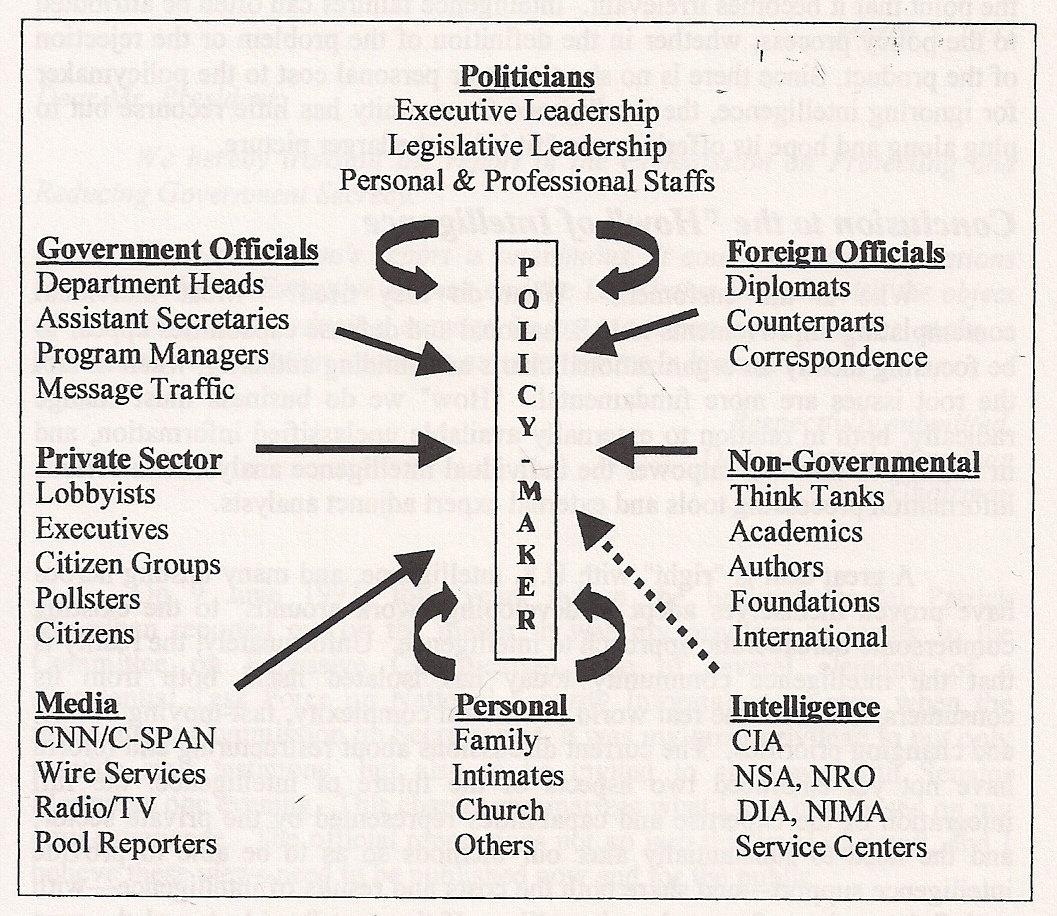
06 I enjoy their one graphic above, as it reminds me of my 1990's version — my latest from 2009 is here to the right — and makes as much sense. The problem the IC has is that it has refused to be serious about OSINT (or M4IS2) for 20 years, and at the same time been oblivious to the fact that when fiscal cliff time comes, those who do not work do not eat — the IC has not earned its way, and it is too late for most of those serving in leadership positions (really more like very senior administrative clerkships) to do anything other than plan for their retirement. They literally do not know what they need to know to be effective. It saddens me to reflect on how much I and Andy Shepard and a few otherss knew in 1992 — 20 years ago — and we did not stop learning. Today I know vastly more than any IC leader [or wanna-be] about the viable options, but absent a President or Secretary of Defense that actually wants to use intelligence to dramatically lower the cost of Whole of Governance while dramatically increasing benefits to the public, I see no way forward within the USG.
[NB: I held Full Scope for 30 years (1976-2006), and now have an OPM SSBI completed 12 March 2012. I am looking for just one IC or DoD senior with an open mind…I know precisely what is needed and how to do it and I have the only little black book of names, not just in NCA but world-wide, that is actually worth something to anyone who would like to build an IC that cannot be ignored or have its budget sacrificed to the fiscal cliff gods. Not only could I create an Open Source Agency overnight, but with USG access and validation, Sir Richard Branson and The Virgin Truth could be a public diplomacy triumph — a game changer. But I would be happy in any job, my SF-50 documents my departure as a Excepted Permanent Veteran at GS (previously GM) 14 step 5, and my SF-52 shows me recommended for rehire and promotion.]
CATALYST in the Cloud Click on Image to Enlarge
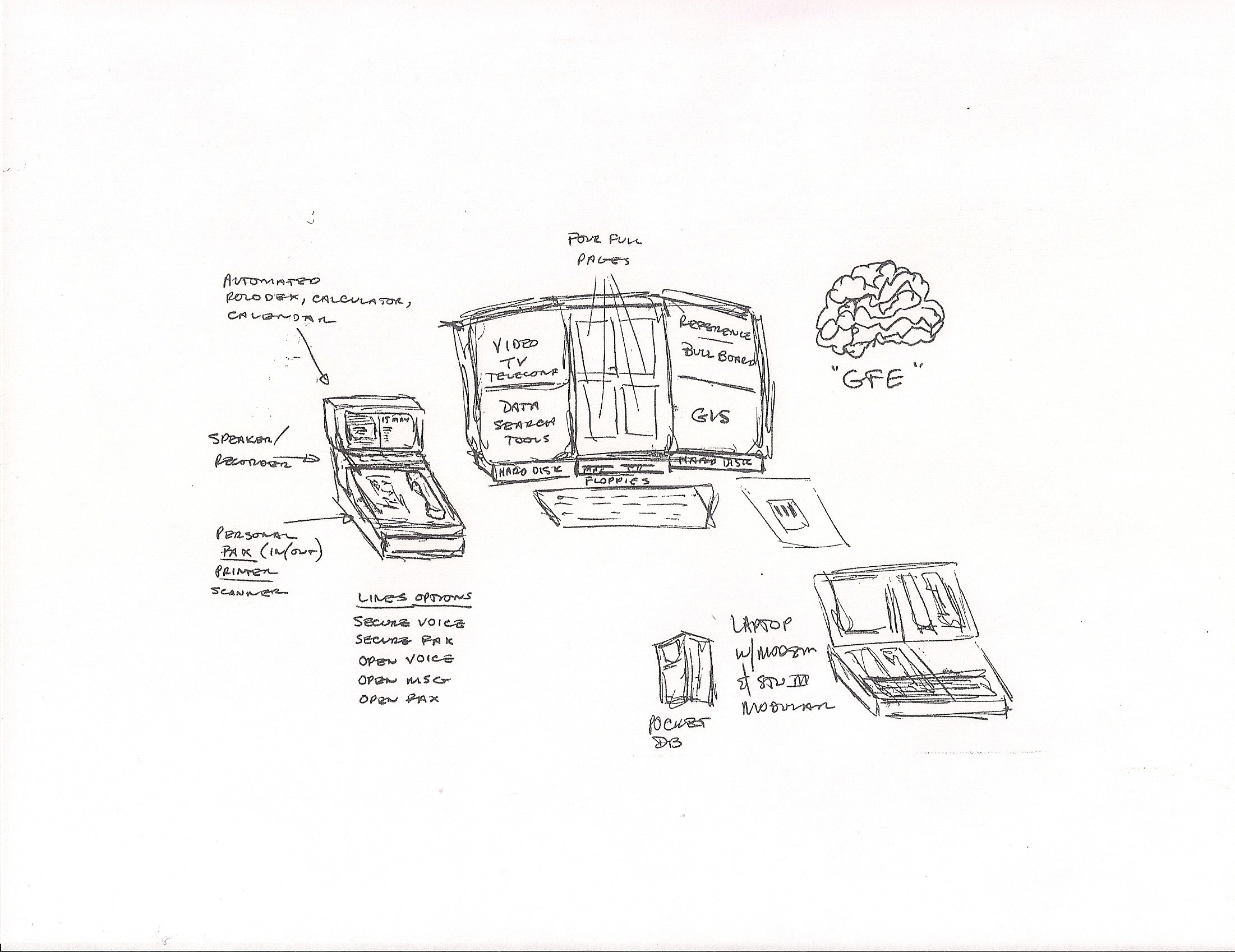
The US IC was told in 1985-1988 exactly what it needed to do in order to enter the 21st Century with some semblance of capacity, and each of the seniors then serving refused to be wise. Diane Webb and Dennis McCormick under Gordon Oehler were ignored and pushed out, or we would have CATALYST (Computer Aided Tools for the Analysis of S&T) today. Andy Shepard made it all the way to ADDNI/AP and finally retired without ever seeing his promising 1992 vision implemented. Tim Hendricks with GRANDVIEW at the National Ground Intelligence Center (NGIC) was starved out at the same time that the Army started falsifying databases to inflate the threat and justify heavier systems (never mind little things like bridge loading data). Later, a second generation innovator, Carol Dumaine sidelined at Energy and is now in a nunnery, while her brilliant idea, Global Futures Partnership was starved to death and eventually drop-kicked over to State where it appears to be buried. The list is long.
Click on Image to Enlarge
I particularly want to mention JNIDS IV. In 1989 the Marine Corps proposal, to build an all-source fusion work station, won. As I learned years later (too late to get the Commandant of the Marine Corps wound up), the Admiral nominally in charge of JNIDS overturned that win with the words “We are a Navy shop, we will do a Navy problem.” That is precisely the kind of corruption — a complete lack of professional integrity — that is pervasive in our Armed Forces, in our secret intelligence world, and across the US Government. ENOUGH!
Truth and integrity are back in style. Get with the program!
07 As I finish the conclusion, I am confirmed in my view that this paper is written for the purpose of justifying a whole new suite of technical collection investments — and some processing investments, but heaven forbid they actually coordinate with OMB about common solutions for producers and consumers of intelligence — or that they contemplate for one instant the M4IS2 / OSE concepts that can be implemented in tandem or in isolation. Their final headline:
The IC will become ineffective if it fails to assimilate these new and dynamic information technologies, capabilities, processes, and means of conveying
knowledge to policy makers.
Duh. This is not a serious effort, and if this is the best that INSA and the contributors — less Cambone, Medina, and Mazzafro can do — then they need to stay retired, they are still part of the problem.
As I go over the paper a second time, four big things keep coming back to me, all of them well-known to those of us that have labored for twenty years to get people to listen to common sense in the public interest:
Click on Image to Enlarge
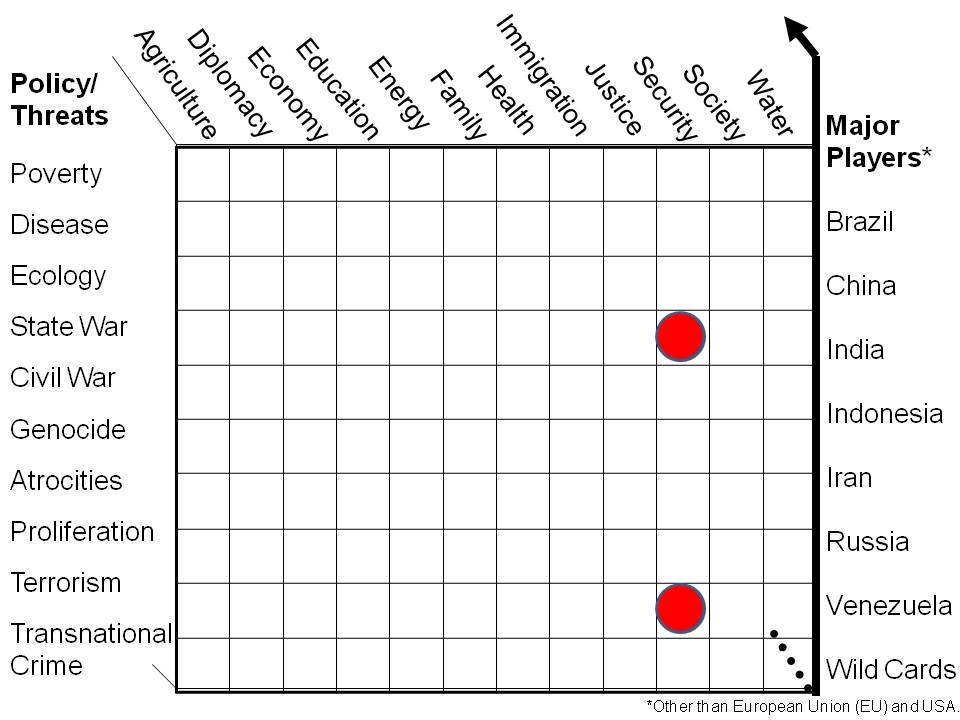
01 Strategic Analytic Model. These people have no idea that the ten high-level threats to humanity have already been identified and prioritized, and that the US Government is in willful ignorance of seven of the ten. At the same time there is no sense of how to address the cross-cutting policies, the true costs of goods and services, the whole system model, and so on. Or even – shudder — true cost economics across all Whole of Government mission areas.
02 Global Coverage. Boyd Sutton knows more about Global Coverage than this entire group. It may be time to bring him back. For the record, Keith Hall established the budget for the OSA when he was interviewed by Boyd Sutton — $10M a year for each of 150 topics not covered by an IC obsessed on a few hard targets and oblivious to all the rest ($1.5B). Congressman Simmons (then on the Homeland Security Committee) and I added $30M for each of the 50 states to create the bottom up “cop on the beat” and citizen “intelligence minuteman” 119 (auto repeat warning to 5 klik radius) and 114 (text or photo / text with geospatial grid to local fusion center) capabilities and the broader Smart Nation platform for eventually integrating education, intelligence, and research. And then he lost by 80 votes because his staff did not distribute 240 copies of THE SMART NATION ACT: Public Intelligence in the Public Interest, and two newspapers in his district turned against him because in the absence of the books, they had no idea he was a visionary as well as a patriot.
03 M4IS2. Joe and Carmen certainly understand my focus on the eight tribes of information-sharing and sense-making, within which government is the least important, generally the beneficiary rather than the benefactor. For this report to not have an semblance of understanding of what it takes to create a Smart Nation, is an indictment of INSA and its corporate membership.
Click on Image to Enlarge
04 OSE. Most in the IC are as ignorant of OSE as they still are of semantic processing, open hypertextdocument system and other innovations that are inevitable as the world by-passes the US Government — as John Perry Barlow said so famously, the Internet interprets censorship as an outage, and routes around it. Well, in a world of distributed intelligence, the Internet interprets stupidity as an outage, and routes around it.
I will be blunt, as is my wont when not serving another master [if someone were to hire me — I am not interested in corporate, only government — I would close down my public persona]: this report lacks intelligence and it lacks integrity. It is a vanilla justification for technical systems we do not need and cannot afford. It is devoid of understanding with respect to HUMINT, strategic analytic modeling, global coverage, all-source processing, M4IS2, and OSE. It certainly does not anything to enhance decision support to tactical combatants or policy makers and acquisition managers. I am glad I read it. These many years in the wilderness (20, actually), I have on occasion doubted my value. This report is as much validation as I am likely to get in the near term. For that I am thankful. St.
I read the entire INSA paper with considerable interest. It attempts to balance between the obvious need to take open source intelligence seriously in light of the so-called “Global Network*” and the need to protect the traditional institutional producers of secret intelligence. What is really needed is a recognition that the time has come for the U.S Government (I use the term advisedly) to recognize that your ideas on OSINT are absolutely relevant for the 21st Century.
As for your critique of this paper, you are absolutely dead on. With folks like General Hayden (USAF ret.) signing off on it you can bet it was designed precisely not to make waves. I am sure Charlie Allen was sent off to some make work research project to keep him out of everyone’s hair. The basic problem is that INSA is unwilling to commit to the concept of an independent OSINT Agency because it would make it clear that CIA has not done the job it was created for by the 1947 National Security Act: namely to collate and organize all source information to provide strategic and tactical warning intelligence of another Pearl Harbor and strategic intelligence to decision makers. This last capability disappeared with the dissolution of the CIA’s Office of National Estimates (ONE) by President Nixon. INSA is trying to give the illusion of bold proposals while still protecting the status quo. Still at least your ideas OSINT are gaining wider recognition, even if you as the real expert in OSINT are ignored.
* The Global Network is a rubric for an aggregate of independently owned and operated, but inter-connected and inter-operative telecommunication (carrier) networks. These networks incorporate both domestic and international carriers each of which consists of transmission lines (largely fiber optic or copper cable and satellite spot beams) coupled with relays, switching centers, earth stations, and various other sub-components. The content carried on these networks is obtained from public and private content providers. The public content providers include Internet Service Providers (ISPs) and Public Service Telephone Networks (PSTN). The private content providers include such entities as SWIFT and SITA. Inter-operability between the carrier networks and between the carriers and content providers is made possible by common sets of standards and procedures as established by international agreements through such agencies as the CCITT and ITU.
The INSA Paper is I hope only the first step towards real intelligence reform.
Richard
Robert David STEELE Vivas Click Here to See Personal Page
ROBERT STEELE: Richard's deep knowledge, with decades at both NSA and DIA, is a most helpful balance to my own. We are in agreement on the INSA paper, but I would stress that I am less satisfied with the INSA paper's cursory acknowledgement of “full spectrum” OSINT (they do not have a clue), that is focused exclusively on keeping the money moving toward corporate vapor-ware ostensibly capable of processing the entire Internet and particularly social media sites used by the one billion rich. The US secret intelligence mandarins (really more like super-empowered clerks) are not really devoted to the public interest, have not figured out that M4IS2 / OSE and the five billion poor are the center of gravity for future stabilization & reconstruction, and therefore they all continue doing the wrong things righter, certain that they will retire before anyone catches on to their ignorance, and equally certain that there are no retirement jobs for them in the world of OSINT, only in the world of make-believe, the world of corporate vapor-ware where no one is held accountable for failure. I am an intelligence professional and I take the craft of intelligence seriously. We have too many bureaucrats and clerk-leaders at the top of the intelligence hierarchy, and too many middle managers whose last original thought was twenty years ago (unlike the private sector, middle management is alive and well within the US Government, and particularly in the secret world where no manager is held accountable for outputs, decision-support, only for inputs — dollars spent, no questions asked).
Click on Image to Enlarge
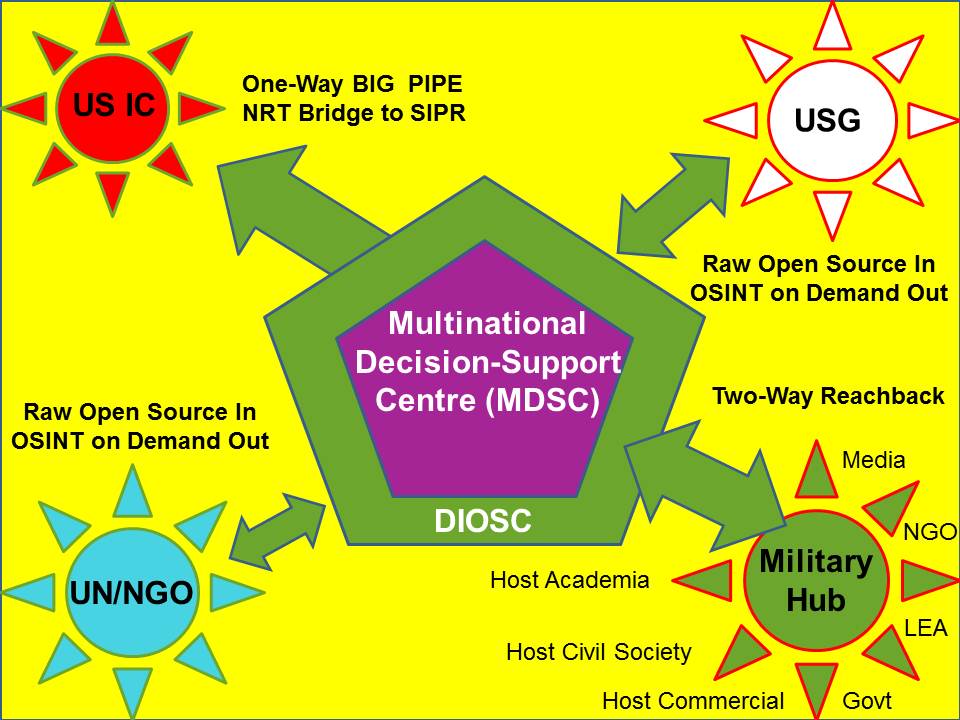
I have already reached the conclusion that in addition to the Open Source Agency [that would include General Tony Zinni, USMC (Ret) National Planning and Monitoring Center (NMPC) as a Whole of Government capability that works closely with the Office of Management and Budget (OMB) and all elements of the government, to do ethical evidence-based Planning, Programming, Budgeting, and Execution (PPBS/E); and my own long-recommended Multinational Decision-Support Centre (MDSC) [the hub for military-operated national centers in every country that signs the new Global Information-Sharing and Sense-Making Treaty, with the military organizing their countries other seven tribes for give and take] we also need to create a new national full-spectrum HUMINT capability that is virtually distributed, does not use official cover in any way whatsoever, is often multinationally-organized, region by region, and practices risk-based need to know security, avoiding the severe deficiencies of the current “system high US citizens only” HUMINT networks. Neither CIA nor DIA — and even less so SOCOM — are capable of executing that vision absent draconian mandated turn-over. The OSA, with an SCI/SAP appendage,is in my view the logical starting point, since 90% of the HUMINT is open, not secret.
Put bluntly and directly, if a President were to direct D/OMB to create a Presidential initiative, IOC $125M, FOC $3B, or if a Secretary of Defense were to fund the Open Source Agency (OSA) out of hide, I could, within three to five years, not only provide 90% of the Whole of Government decision-support that is not provided today, but also assure both Whole of Government PPBS/E, and provide the President and Congress with a sufficiency of evidence justifying the reduction of the secret world's budget to below $20B per year, while helping DoD achieve a 450-ship Navy, a long-haul Air Force, and an air-liftable Army with half the flags and half the dollars they have today. This is not rocket science. Intelligence with integrity is the most powerful lever on the planet.
There is also a very important role for the United Nations and perhaps NATO/PfP, but as things now stand I do not see the Cabinet level intelligence with integrity needed to allow me — or someone I advise — to put all these pieces together in a USG context favorable to the USA.
As I have noted elsewhere, I am far beyond OSINT. HUMINT is the center of gravity, OSINT is part of HUMINT, and M4IS2/OSE are the foundation for both multinational HUMINT/OSINT — 80% — and unilateral HUMINT/OSINT — 20%. HUMINT and OSINT — designed and executed with integrity — are the foundation for 21st Century intelligence. St.
UPDATE 2 Dec 2012: Wright update, Steele update, at end of original post.
As received: On the Linkedin Group, “Intelligence and Security”, a member started a discussion on open source intelligence using a quote from your [forthcoming chapter], “The Craft of Intelligence.” Davidson (a self proclaimed “former CIA Senior Intelligence Officer”) made such a wildly ignorant comment about you and open sources intelligence that I felt a response was in order.
NB: Open Source Intelligence (OSINT) is an umbrella term that encompasses Open Source Information (OSIF), Open Source Decision-Support (OSINT), and Validated OSINT (OSINT-V), the latter being the province of all-source analysts alone. Most OSINT is created by people who are not US citizens, do not have US clearances, and are completely invisible to the US secret world.
Michael R. Davidson Click for Biography
Michael R. Davidson • I just downloaded it. Steele has been around for a long time propounding the virtues of OSINT, something he learned about originally at CIA. In my view, his document has more to do with justifying Wikileaks than with what we might think of as intelligence. Perhaps that's too harsh. What he's really talking about already exists. It's called the media.
His quote of Steele from “The Craft of Intelligence” (version 3.1, 3.2 is latest), is in fact the opening sentence, conveniently dropping the four referencfes (Davis 1986, Garland 2012, Pillar 2011, Treverton 1986):
There is little desire in the developed intelligence nations to see the craft of intelligence evolve in line with the revolutions in information technology and globalization. Indeed, it can safely be said that most leaders with access to intelligence services do not value them—they are much more influenced by networks of influence and ideology that demand the status quo. Where intelligence is used at all it is generally to confirm pre-existing policy positions rather than what governing elites need to know.
Here is the complete opening of this seminal chapter that was commissioned specifically to Steele for the forthcoming in Robert Dover, Michael Goodman, and Claudia Hillebrand (eds.). RoutledgeCompanion to Intelligence Studies (Oxford, UK: Routledge, 31 July 2013), strongly recommended to all as one of the first full-spectrum 21st century collections for the professional (both practitioner and scholar).
There is little desire in the developed intelligence nations to see the craft of intelligence evolve in line with the revolutions in information technology and globalization. Indeed, it can safely be said that most leaders with access to intelligence services do not value them—they are much more influenced by networks of influence and ideology that demand the status quo. Where intelligence is used at all it is generally to confirm pre-existing policy positions rather than what governing elites need to know. (Davis 1986, Garland 2012, Pillar 2011, Treverton 1986).
Ada Bozeman has written: (There is a need) to recognize that just as the essence of knowledge is not as split up into academic disciplines as it is in our academic universe, so can intelligence not be set apart from statecraft and society, or subdivided into elements…such as analysis and estimates, counterintelligence, clandestine collection, covert action, and so forth. Rather … intelligence is a scheme of things entire. (Bozeman 1998: 177):[1]
What can be observed within both the closed intelligence communities and open academic, civil society, commerce, government at all levels, law enforcement, media, military, and non-governmental/non-profit (hereafter the “eight communities”) is a failure to comprehend the shift in the nature and reliability of their unwittingly shared sources and methods; the Earth (reality), and the mix of humanity, culture and technology.
Intelligence—the art of forecasting, warning, and holistic evaluation of cause and effect—has generally focused in the past on the identification and evaluation of grave threats and in supporting the judgment of executive agencies and political leaders with respect to those threats (Iraq and Afghanistan are two such recent incidents, and Iran is likely to become the next incident of its type).
Since 1988 I have sought to generate a paradigmatic shift in the understanding of intelligence so as to refocus it on holistic analytics and opportunities as well as the expansion of the craft of intelligence to embrace all human minds, all information in all languages, all the time. This approach – which treats the social world as an ecology – is the only one capable to dealing with the complexity present in a fluid international system typified by revolutions in the production and dissemination of knowledge, and in the character and dynamics of social relations as well as all attendant technologies.
The secret intelligence community (and the accompanying political apparatus) as one of the eight information-processing communities is – as a result of the failure to understand and adapt to these changes – so isolated that on its own terms it has become an irrelevance. More worryingly, it has become an expensive and unethical irrelevance that is undermining the craft of intelligence as a whole. I wish to restore the relevance of what I term the secret world—in the USA it now provides less than 4% of what national-level leaders need—but only in the context of a renaissance of intelligence that creates a Smart Nation and a World Brain focused on creating a prosperous world at peace by eradicating corruption, fraud, waste, and abuse. [2]
Intelligence should be an inherent responsibility of and benefit for all citizens, not just of leaders—80% of whom do not get intelligence support now.[3]We must migrate from secrets for the few to public intelligence for all.
Robert David STEELE Vivas Click on Image for Bio Page
ROBERT STEELE: Let's begin with the obvious: the opening sentence, while out of context, has nothing to do with OSINT and everything to do with the refusal of policy makers to be serious about demanding and integrating intelligence — decision-support from all possible sources both secret and open — into their deliberations. Paul Pillar has documented this better than anyone I know, in his recent book, Intelligence and U.S. Foreign Policy: Iraq, 9/11, and Misguided Reform (Columbia University Press, 2011). My summary review of Paul's work is the first review visible on the book's Amazon page. That is the discussion one would think Mr. Davidson intended to pursue. Right now the secret world is a minor pork trough for Congress, nothing more.
Next up is his claim that I learned about OSINT at CIA. That not correct. My experience at CIA was in three back-to-back clandestine tours in Latin America, followed by three headquarters tours: one doing two full time jobs for the clandestine Central American Task Force (CATF); a second hand-picked by D/DA Bill Donnelly to lead the experimental application of advanced information technologies to both clandestine operations and all-source analytics; and the third, after Bill Casey died and all forward momentum was lost, in the Holy of Holies, the DCI's Advanced Program and Evaluation Group (APEG) under Boyd Sutton, which [APEG] was responsible for monitoring all external technical programs (NRO, NSA, others) and advising the DCI in his capacity as Director of Central Intelligence, with respect to the planning, programming, budgeting, and execution of those other agencies.
I learned about OSINT after I resigned from the CIA to accept a Marine Corps invitation to be the senior civilian founder of the new Marine Corps Intelligence Center, spending $20 million on a system-high network and advanced workstations that were the best in the US Intelligence Community at the time (1988), and after getting all the approvals needed to channel everything on the high side to our SPINTCOM, including NSA traffic, for which a waiver was required, Quantico then being outside the beltway. We had one PC in isolation, connected to the Internet, which at the time was mostly “The Source.” Within two weeks the analysts were abandoning their high-end systems with access to “everything” and standing in line for the PC. When I asked why, they said, essentially, “there is nothing in the classified system about our shit-holes — Burundi, Haiti, Somalia, etcetera.” It was at that moment that the modern OSINT movement was born, with due credit to those who came before me, such as Jan Herring and George Marling in the 1970's. What we accomplished using only open sources, is noteworthy and has never been replicated — today the Marine Corps Intelligence Command is another expensive bureaucracy — money really does corrupt intelligence.
His observation that OSINT is the media — the media is OSINT — is both deeply ignorant, and deeply representative of the CIA mind-set, remembering that no one at CIA is retiring, and those that did have returned as geriatric annuitants, as the USG is the only source of jobs in an economy where the real unemployment rate is 22.4%, and for the recently graduated as well as the Social Security eligible, closer to 40%.
ON INTELLIGENCE (p. 53) Credit to Treverton (1986) Click on Image to Enlarge
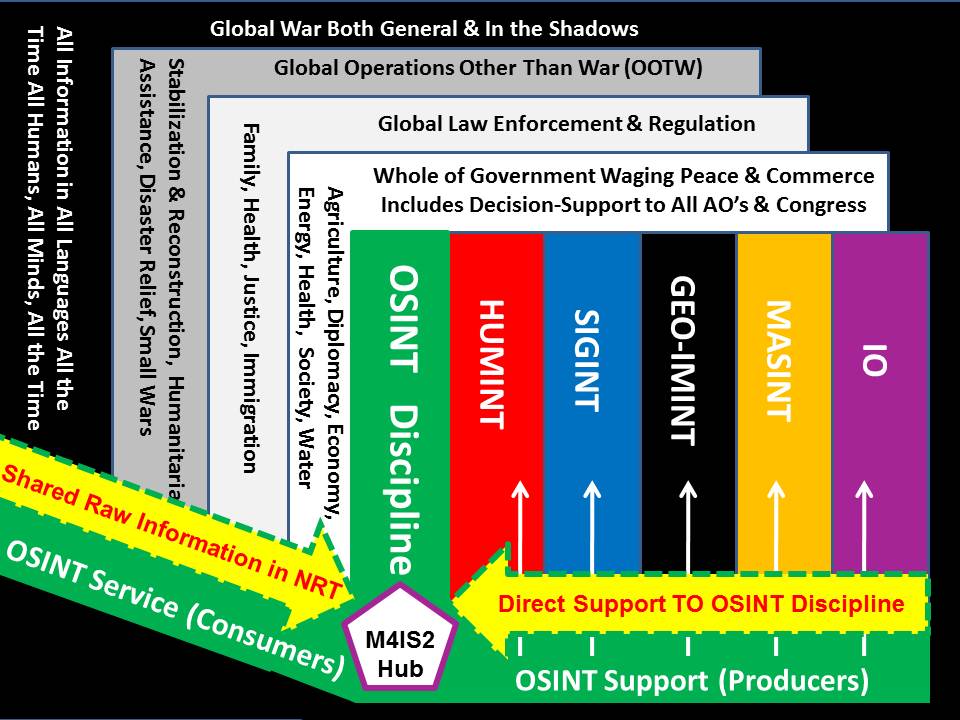
Put in the simplest possible terms, open sources of information (not decision support–decision support demands the application of the intelligence process that is not secret, not expensive, and generally not done by the US secret world) are all those sources that are open, i.e. not secret, confidential, proprietary, or otherwise encumbered that are unpublished (i.e. in human memory banks), of local provenance (“gray literature”), analog, and digital, with the latter only showing 10% or so to search engines, the rest being “deep web” (C drives, emails, local private networks, etcetera). Media, both print and digital, both niche and corporate, is certainly included. It is also the least important. On one side of media are all those with eyes on the target and ears to the ground, one fifth of them, no more, twittering away, as General Mike Flynn recently observed in relation to Uganda; and on the other are all the notes, documents, gray literature, movies, tape recordings, hand held photographs and on and on and one (CIA's Open Source Center still has no human access, just 100 T-1 lines disappearing into the ground). Here above is a depiction of the eight tribes showing the relative unimportance of intelligence as a “source” for policy makers — I use this graphic instead of one itemizing open source information types for two reasons that neither CIA nor DoD understand: OSINT is a HUMINT discipline, not a technical discipline; and everything not secret is open, and more often than not in the head — unpublished — of exactly the right person in the right place at the right time. “Knowing who knows” as Stefan Dedijer announced at OOS '92, is the acme of skill for the truly professional intelligence all-source analyst — NOT cutting and pasting from 80 secret databases full of noise. Whatever the reasons, one can only weep at the persistent lack of intelligence (an outcome) and integrity (the enabler) across the US secret world.
I will not belabor Mr. Davidson's ignorance with respect to OSINT further, and will simply point to the 30,000 pages on OSINT as an emerging discipline as produced by over 800 international practioners, none of whom, I speculate, Mr. Davidson has ever met. Together we trained over 7,500 mid-career officers from across 66+ countries [I lost my clearances to DOHA over this despite the fact that I was OPCON to J-23 at SOCOM the whole time], and wrote the OSINT handbooks for DIA, SOF, NATO, and multiple countries — handbooks I am quite certain Mr. Davidson has no idea even exist. Cf. Handbooks / OSINT Generic (17); Historic Contributions (268); Awards 1992-2006 (2); and Phi Beta Iota the Public Intelligence Blog generally (portal to both OSS and EIN content from 1988 onwards).
Mr. Davidson renders a public service in displaying so publicly the level of retardation characteristic of the CIA's over-promoted and under-educated “Senior Intelligence Service.” Whatever his accomplishments as a Russian-speaking case officer, he reminds me all too sadly of Sandra Cruzman, my former Reviewing Officer as head of the Collection Requirements and Evaluations Staff, who after reading my first truly public offering, 1992 E3i: Ethics, Ecology, Evolution, & intelligence, told Dr. Ross Stapleton-Gray “This confirms Steele's place on the lunatic fringe.” Today of course, twenty years later almost to the month, the intelligence industrial mafia organization, Intelligence and National Security Alliance (INSA, formerly SASA), is scurrying to state the obvious and missing the point completely. Their paper, “Expectations of Intelligence in the Information Age,” is well-intentioned–I particularly like the fingerprints of Cambone and Medina–but dangerously counterproductive for reasons that I outline at the separate post where both the one-page summary and the document itself can be downloaded, and my detailed review of that document examined.
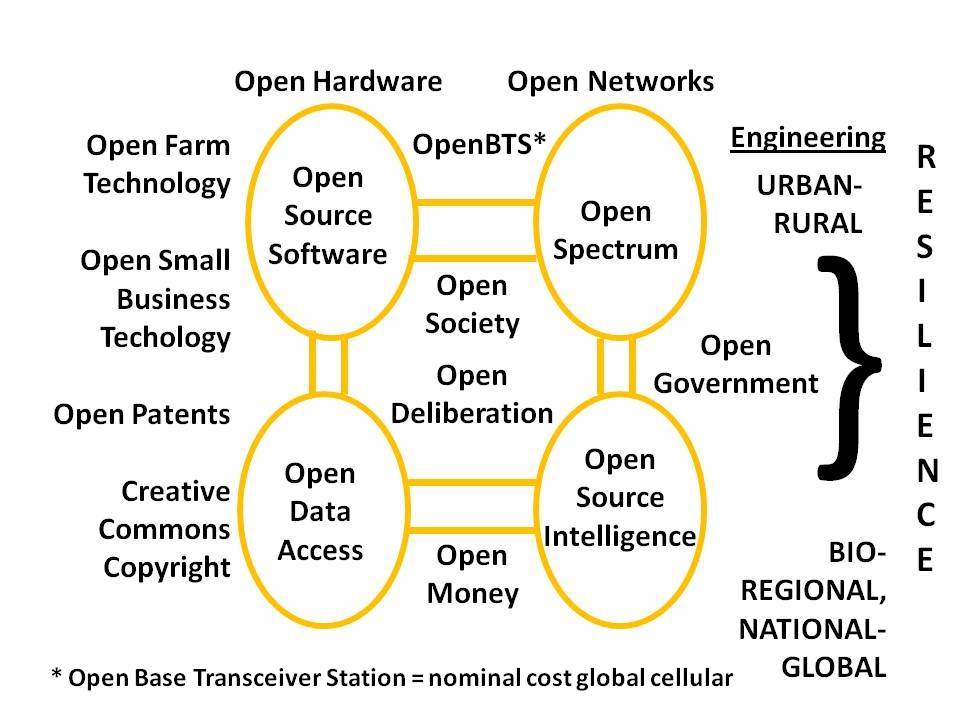
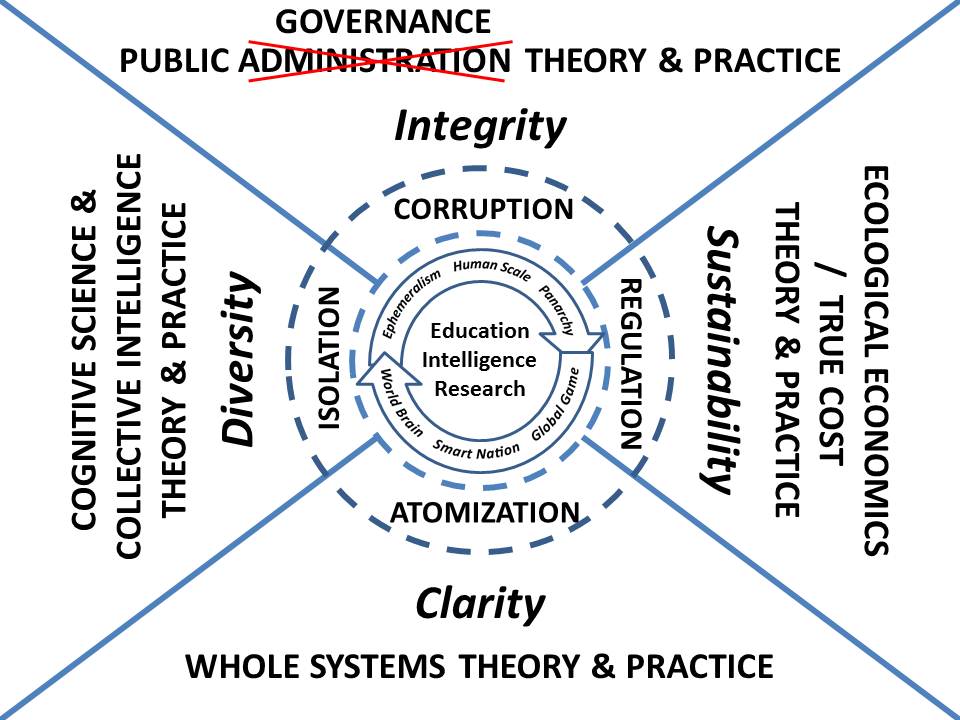
OSINT is old news for those of us that combine intelligence with integrity, but certainly something the next Secretary of Defense needs to think about, starting with 2009 DoD OSINT Leadership and Staff Briefings. The new meme is M4IS2 and the new new meme is OSE for Open Source Everything. M4IS2 is a Nordic military concept I learned from Col Jan-Inge Svensson, Multinational, Multiagency, Multidisciplinary, Multidomain Information-Sharing and Sense-Making. Although I was able to brief this concept to the Coalition Coordination Center (CCC) at CENTCOM, and later to the Multinational Intelligence Fellows Course at DIA, it never gained traction because “the system” is optimized — I use the word loosely — for unilateral top down top secret noise, not for multilateral bottom up interactive sense-making. OSE is the topic of my latest book, 2012THE OPEN SOURCE EVERYTHING MANIFESTO: Transparency, Truth & Trust, and it makes the case for needing to go “all in” on all the opens in order to scale M4IS2 and educate / catalyze the five billion poor while uniting the eight tribes in local to global information-sharing and sense-making. It could usefully be read together with my 2010 INTELLIGENCE FOR EARTH: Clarity, Diversity, Integrity, & Sustainability. Nothing any US secret agency head is doing now — and I include General Mike Flynn for whom I would be glad to work but evidently my two letters to him were intercepted and destroyed — is going to make a near or mid term difference in US Government priorities, policies, acquisition, or operations. “The system” is on auto pilot, no one is held accountable for failure, and by the time deep failure is understood (everything that failed under Mike Hayden, at both NSA and CIA, to take one noteworthy example) the individual is retired, on the lecture circuit, and his replacements are content to let sleeping dogs lie (pun intended). DoD principals interested in getting this right can begin with one email. Have brain, will travel.
Click on Image to Enlarge
I have put in one place all relevant information including graphics with respect to an Open Source Agency such as was called for in 1969 with the pages of CIA's own Studies in Intelligence, and championed in the 1970's by Jan Herring, then National Intelligence Officer for Science & Technology, George Marling of the Intelligence Producer's Council (IPC), and the joint civilian-military science & technology committees and working groups. Since 1988 I have been the primary proponent for OSINT around the world — embracing the proponents of sub-elements of OSINT such as Gray Literature and virtual (human) working groups — and today I am the primary proponent for M4IS2 and OSE, both inherently about connecting humans and accessing the 80-90% of the needed knowledge in real time that is NOT digital, NOT in English, and NOT accessible to CIA or anyone else in Washington, D.C. I am also the primary proponent for “full-spectrum HUMINT,” a term that I coined, and that in my judgment the center of gravity for the future of US and UN intelligence (decision-support). Technology has failed because integrity has been absent. We have to start over with an M4IS2/OSE approach, and only when that is in place as a baseline, can we then begin to think about unilateral deep secrecy in any form. Of course I have developed ideas about clandestine and covert operations and offensive and defensive counterintelligence, ideas that could begin to show results within 180 days if not sooner, but that aspect of my thinking is reserved for whoever wants to adjudicate me back into the system. With an OPM SSBI completed 15 March 2012, I am immediately adjudicatable.
Click on Image to Enlarge
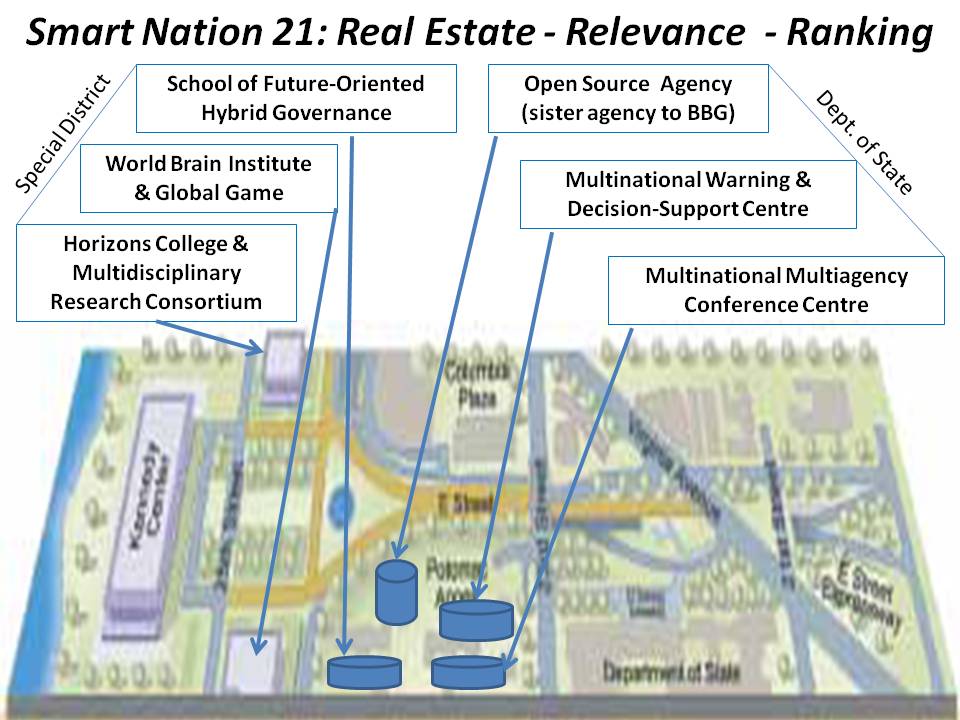
There is one thing and one thing only that will save the US secret intelligence community in these early years of the 21st Century, and frankly I do not expect to see this occur: the next Secretary of Defense must explicitly acknowledge that the truth at any cost lowers all other costs, and that absent whole system holistic analytics based on true cost economics and total transparency in Whole of Government establishment of priorities, policies, acquisition, and operations, the US secret world will remain the poop chute on the ship of state, a minor piece of plumbing full of crap, with no bearing on the direction of the government and the Republic. Clearing the South-Central Campus and creating the Open Source Agency as well as the University of the Republic there, while prevailing on the Saudis and the JFK Center to raise the money to create the long-desired Potomac Plaza Park over the mess of roads now cutting them off from the city and the city from the river, would be an excellent place to start the cleansing of the temple of misplaced secrecy lacking in both intelligence and integrity.
I knew 80% of all this in 1992, along with Tom Pedtke, Andy Shepard, Diane Webb, Kathy Lavigne, and a handful of others. We have wasted 20 years. Must we waste the next five? The next ten? The next twenty? St.
WRIGHT UPDATE: My ongoing exchange with Davidson among others was predicated on a quote from Phi Beta by a third party who started the discussion. Davidson and one other so far have simply joined in the discussion to express their disdain for the concept of OSINT.
This disdain is based on a complete misunderstanding of what OSINT is and how it works. The prevailing thought by Davidson and one other resfusnik, who both of have experience in the secret world, is that OSINT means random collection of everything all the time primarily from the Internet. This appears to be a major obstacle to accepting OSINT by folks who know little about it.
STEELE COMMENT: I have known all along that CIA has done nothing to change how OSINT and HUMINT and OSINT and all-source analytics interact from origin of requirement to feedback on finished products. In 1997 the Director of the National Intelligence Agency (NIA) in South Africa not only “got it,” he lectured the entire middle management of the national community on how he wanted the disciplines to interact as a “DNA spiral” (his original words) and he had me spend a half day with each of the disciplines including national counter-intelligence, and a half day with the South African National Security Council.. The Open Source Center (OSC) has been a false trail and set us back twenty years while also destroyed what was once a superb FBIS.
Click on Image to Enlarge
My plan for the first 99 days of the OSA is a matter of record, I have always planned on education by doing, showing individual collection managers, analytic branch heads, and specific consumers early on what they could do with the full power of OSINT in their support, this exchange reminds me again of how little the USG has learned in twenty years, and how much hard work lies ahead if we ever get leadership capable of doing the right thing instead of the wrong thing righter over and over again. I've known all along the policy makers would have to be educated, my plan there is also action based — providing them with superlative OSINT while providing copies to their Congressional jurisdictions, the media, and their constituents. Among the many differences between open and secret decision-support is that the open decision-support cannot be ignored. St.
No credit to the OSINT pioneers from 1969 onwards, but the slow are finally catching up. BUT they still think OSINT is a technical collection challenge rather than a HUMINT opportunity.
The digital information revolution has handed the U.S. intelligence community a slew of new challenges that are nowhere close to resolution, a new study says.
The 21st-century problems range from mountains of data to accelerated pace of change to competing information flow from nongovernmental sources to fears of violating privacy and civil liberties, according to a paper “Expectations of Intelligence in the Information Age,” released Thursday by the Intelligence and National Security Alliance, a nonprofit that brings together experts in the public, private and academic sectors.
The paper drew praise from Defense Intelligence Agency Director Lt. Gen. Michael Flynn, who spoke at a banquet in Arlington, Va., to mark the paper's release.
Gustl Mollath was put in a psychiatric unit for claiming his wife was involved in money-laundering at the Bavarian bank. But seven years on evidence has emerged that could set him free
A German man committed to a high-security psychiatric hospital after being accused of fabricating a story of money-laundering activities at a major bank is to have his case reviewed after evidence has emerged proving the validity of his claims.
In a plot worthy of a crime blockbuster, Gustl Mollath, 56, was submitted to the secure unit of a psychiatric hospital seven years ago after court experts diagnosed him with paranoid personality disorder following his claims that staff at the Hypo Vereinsbank (HVB) – including his wife, then an assets consultant at HVB – had been illegally smuggling large sums of money into Switzerland.
Mollath was tried in 2006 after his ex-wife accused him of causing her physical harm. He denied the charges, claiming she was trying to sully his name in the light of the evidence he allegedly had against her. He was admitted to the clinic, where he has remained against his will ever since.
But recent evidence brought to the attention of state prosecutors shows that money-laundering activities were indeed practiced over several years by members of staff at the Munich-based bank, the sixth-largest private financial institute in Germany, as detailed in an internal audit report carried out by the bank in 2003. The report, which has now been posted online, detailed illegal activities including money-laundering and aiding tax evasion. A number of employees, including Mollath's wife, were subsequently sacked following the bank's investigation.
The “Mollath affair”, as it has been dubbed by the German media, has taken on such political dimensions that it now threatens to bring down the government of Bavaria. Under the weight of public and political pressure Horst Seehofer, the prime minister of the rich southern state and a member of the Christian Social Union (CSU) – the sister party to Angela Merkel's Christian Democrats – has now called for the case to be reopened, amid charges that Mollath was possibly the victim of a gross miscarriage of justice.
Welcome to the Free Software Supporter, the Free Software Foundation's monthly news digest and action update — being read by you and 64,307 other activists. That's 1,124 more than last month!
Lebanese general, CIA base, Bandar assassination or grievious wounding? Not a word about Bandar since August, and July-August were all second and third stories.
“The Iranians are constantly putting out stories through their agents of some mishap about Bandar that have been all false so far,” Ottaway wrote Thursday in response to an email query.
Phi Beta Iota: We have no direct knowledge, but we do believe that the Syrian leadership understands the vulnerabilities of the Saudis as well as the Americans, and we share with Penguin the view that the car bomb on 19 October in Lebanon, the eradication of the CIA base in Benghazi, and the attack against Bandar are probably related to Syria and probably all “direct actions” funded and directed by the Syrian leadership. More to come.