OpenBTS GSM Simplified — Freeing Humanity

Advanced Cyber/IO, Autonomous Internet, Civil Society, Counter-Oppression/Counter-Dictatorship Practices, Cultural Intelligence, Hacking, Mobile, Real Time, Tools
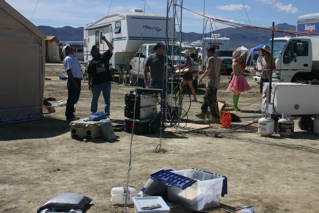
OpenBTS at BurningMan

OpenBTS is an open-source Unix application that uses the Universal Software Radio Peripheral (USRP) to present a GSM air interface (“Um”) to standard GSM handset and uses the Asterisk® software PBX to connect calls. The combination of the ubiquitous GSM air interface with VoIP backhaul could form the basis of a new type of cellular network that could be deployed and operated at substantially lower cost than existing technologies in greenfields in the developing world.

In plain language, we are working on a new kind of cellular network that can be installed and operated at about 1/10 the cost of current technologies, but that will still be compatible with most of the handsets that are already in the market. This technology can also be used in private network applications (wireless PBX, rapid deployment, etc.) at much lower cost and complexity than conventional cellular.
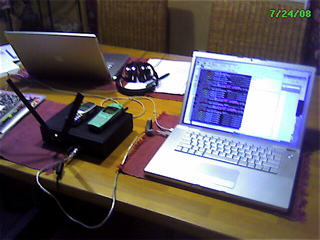
OpenBTS Official Photo

Project News (Last Updated 17 January 2011)

Kestrel Signal Processing OpenBTS Page with Links

OpenBTS YouTube Short Videos (Just Over 30)

Phi Beta Iota: This is as close to “world-changing” as it gets.  Neither Microsoft nor the cellular providers–nor the governments whose people stand to gain the most (but whose corrupt politicians prefer the status quo)–want to surf this wave, they would rather fight it.  If there were ONE social networking initiative that is guaranteed to change the world for the better, this is the one.  In our always humble opinion.

Disagree, but Engage–Free and Fair Elections in USA?

Civil Society, Cultural Intelligence

Disagree, but engage: That's civility

On issues ranging from abortion to guns, it is possible for adversaries to find common ground

February 10, 2011|By Robert Fersh and Andrew L. Yarrow

EXTRACT:  These processes are most successful when participants have strong, informed opinions and can make a difference if they reach agreement. This was the case in the U.S.-Muslim Engagement Project, where 34 diverse American leaders joined in an influential consensus report in 2008 to show a way forward for the United States in its relations with Muslim majority countries. The group included a former Clinton administration secretary of state, former Republican members of Congress, high-ranking former officials of the George W. Bush administration, 11 Muslim-American leaders, a former director of the American Israel Public Affairs Committee, clergy of differing faiths, and others. Vin Weber, a former Republican congressman from Minnesota, said: “This report provides clear-headed ideas and analysis that the American public and bipartisan leaders can get behind in working to improve U.S.-Muslim relations. The process by which the group reached consensus is a good model for dialogue for the tough issues our country faces.”

Continue reading “Disagree, but Engage–Free and Fair Elections in USA?”

Seth Godin: The Danger of Repeating Signals

Advanced Cyber/IO, Cultural Intelligence
Seth Godin Home

The danger of repeating signals

Kevin shares this great quote from the Count of Monte Cristo:

“I have been told,” said the count, “that you do not always yourselves understand the signals you repeat.”

“That is true, sir, and that is what I like best,” said the man, smiling.

“Why do you like that best?”

“Because then I have no responsibility. I am a machine then, and nothing else, and so long as I work, nothing more is required of me.”

Phi Beta Iota: The blinding flash of insight here, related to the Ladders of Inference Search, is that both the institutions that are rushing blindly and repetitively into the past with their archaic and failed paradigms, AND their critics who keep repeating the same criticisms, and going nowhere.  This realization is what powers the transpartisan, dialog & deliberation, and general “engagement for emergence” memes–UNTIL you are willing to sit down and LISTEN to those you consider antithetical to all that you are and do, you will not be capable of learning or evolving in a holistic manner.  Hence, Advanced Cyber/IO must be FIRST about connecting all to all, THEN about establishing TRUST (see Robert Garigue's Contributions), ONLY THEN about sharing and sense-making, and finally about concerted consensus.  The emphasis on cyber-security is ignorant and misplaced–it is a cancer on the art and science of global engagement.

Search: ladder of inference senge

Searches

Searches are how we harness the distributed intelligence of our visitors.  Thank you for this.  On this site, the search produces one reference to Senge:

Review: The Necessary Revolution–How individuals and organizations are working together to create a sustainable world.

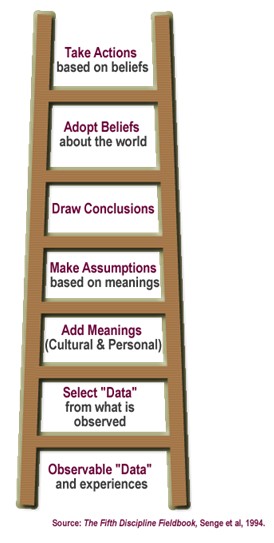
On the wider web, your search helps bring back to this site and its collective, the following, remixed in descending order of brevity and utility; multiple sources suggest this concept and primary diagram were developed by Chris Argyris then presented by Peter Senge in The Fifth Discipline.

Ladder of Inference: Short Circuiting Reality, One Screen, Three Images
Gene Bellinger, showing how beliefs & assumptions lead to data exclusion

Up and Down the Ladder of Inference (Best Look at Role of Diversity in Group Thinking)
Bob Larcher, January 2007, PDF Three Pages

The Ladder of Inference (Original Excerpt), One Screen, No Images
Senge, Kleiner, Roberts, Ross, Smith, The Fifth Discipline Fieldbook, 1994

The Ladder of Inference: How assumptions can cause miscommunication
Yvonne F. Brown, JAD Communications International, 7 pages, undated

See Also:

Continue reading “Search: ladder of inference senge”

OpenBTS at Burning Man: Best Full Story

Advanced Cyber/IO, Autonomous Internet, Counter-Oppression/Counter-Dictatorship Practices, Historic Contributions, Mobile, Real Time, Tools

Burning Man's open source cell phone system could help save the world

Solar-powered OpenBTS systems costs pennies a day and operates in the farthest outreaches of Earth.

By Julie Bort, Network World
August 30, 2010 02:47 PM ET

Today I bring you a story that has it all: a solar-powered, low-cost, open source cellular network that's revolutionizing coverage in underprivileged and off-grid spots. It uses VoIP yet works with existing cell phones. It has pedigreed founders. Best of all, it is part of the sex, drugs and art collectively known as Burning Man. Where do you want me to begin?

The Open Source Subnet
Cell towers that blend vs. those that offend

“We make GSM look like a wireless access point. We make it that simple,” describes one of the project's three founders, Glenn Edens.

The technology starts with the “they-said-it-couldn't-be-done” open source software, OpenBTS. OpenBTS is built on Linux and distributed via the AGPLv3 license. When used with a software-defined radio such as the Universal Software Radio Peripheral (USRP), it presents a GSM air interface (“Um”) to any standard GSM cell phone, with no modification whatsoever required of the phone. It uses open source Asterisk VoIP software as the PBX to connect calls, though it can be used with other soft switches, too. (More stats in a minute that I promise will blow away your inner network engineer.)

Direct to Source (If Still Up); Full Story Back-Up Copy Below This Line

Continue reading “OpenBTS at Burning Man: Best Full Story”

OpenMoko, OpenBTS, Free Your Phone & Humanity

11 Society, Advanced Cyber/IO, Autonomous Internet, Collaboration Zones, Communities of Practice, Counter-Oppression/Counter-Dictatorship Practices, IO Technologies, Mobile

Openmoko™ – Open. Mobile. Free.

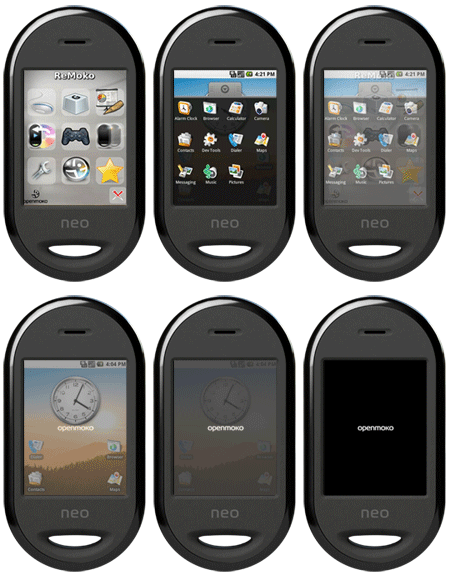
Openmoko™ is a project dedicated to delivering mobile phones with an open source software stack. Openmoko was earlier more directly associated with Openmoko Inc, but is nowadays a gathering of people with the shared goal of “Free Your Phone”. Distributors are currently selling updated versions of the Openmoko Inc's phone released in 2008, Neo FreeRunner, to advanced users, while the software stack for FreeRunner and future free phones is being developed by the community.

Burning Man's open source cell phone system could help save the world

Solar-powered OpenBTS systems costs pennies a day and operates in the farthest outreaches of Earth.

By Julie Bort, Network World
August 30, 2010 02:47 PM ET

Today I bring you a story that has it all: a solar-powered, low-cost, open source cellular network that's revolutionizing coverage in underprivileged and off-grid spots. It uses VoIP yet works with existing cell phones. It has pedigreed founders. Best of all, it is part of the sex, drugs and art collectively known as Burning Man. Where do you want me to begin?

The Open Source Subnet
Cell towers that blend vs. those that offend

“We make GSM look like a wireless access point. We make it that simple,” describes one of the project's three founders, Glenn Edens.

Read rest of article….

Continue reading “OpenMoko, OpenBTS, Free Your Phone & Humanity”

Rising Wisely — C-K Theory & Indian Brainpower

About the Idea, Advanced Cyber/IO

Rising Wisely

This blog is focused on India’s development from the perspective of the Next Generation Infrastructure Lab at the Center for Study of Science, Technology and Policy (CSTEP), a Bangalore think tank launched in 2008. The bloggers are CSTEP’s researchers, its visiting students, and scholars. It is a collaborative, creative space to blog about the issues that we think about at CSTEP, including clean energy and climate change, transportation, infrastructure, information design, how to make technology and information more democratic, and ways technology can make democracy more participatory.

C-K Theory Explained

Breakthrough in theory of learning and innovation

Based on mathematics but also executable at multiple levels

Powerful framework, especially for engineers

Essence of the problem: what is creativity–RESISTENCE to past fixations

Provoke expansion in a step by step way, adding properties, studying attributes, rearranging both

Already existing knowledge does not lead to innovation in a natural way–innovation has to be forced by circumstance or process–this is a process that forces innovation.

C-K theory implements forcing as a process

Mixing attributes and properties from disparate objects (e.g. floating and flying) can force a new third way.

C stands for the Concept Space

K stands for the Knowledge Space

noble gold