Journal: Chavez versus CIA–No Contest

07 Venezuela, Cultural Intelligence, Ethics, Government

Chavez Calls Sentence in CIA's Online Almanac “A Declaration of War” Against Venezuela

If you've ever been curious to know any country's GDP, literacy rate, languages, etc., at a glance, the CIA's online World Factbook is the place to start.

And evidently Venezuelan President Hugo Chavez has been Googling his own country lately, because he's taken serious issue with the sort of government-issue Wikipedia's summary description of the South American nation.

From the CIA World Factbook:

“…For most of the first half of the 20th century, Venezuela was ruled by generally benevolent military strongmen, who promoted the oil industry and allowed for some social reforms. Democratically elected governments have held sway since 1959. Hugo CHAVEZ, president since 1999, seeks to implement his “21st Century Socialism,” which purports to alleviate social ills while at the same time attacking globalization and undermining regional stability. Current concerns include: a weakening of democratic institutions, political polarization, a politicized military, drug-related violence along the Colombian border, increasing internal drug consumption, overdependence on the petroleum industry with its price fluctuations, and irresponsible mining operations that are endangering the rain forest and indigenous peoples.”

The text above constitutes, according to Chavez this past week, “a declaration of war.”

Phi Beta Iota: Chavez is right, CIA is wrong.  A World Factbook is not the place for subjective politicized “judgments,” and if one wishes to speak about the Open Veins of Latin America–Five Centuries of the Pillage of a Continent, the CIA should cut its own throat first or to use another metaphor, not throw stones when it lives in a glass house.    CIA is no longer the destructive monster it used to be, but perhaps worse, Clowns in Action or Contractors in Action, take your pick.  CIA should remove the offending words and surprise Venezuela with a printed corrected copy of the book, and a letter of apology–and it can apologize for its last bungled coup attempt while its at it.  Newsflash for CIA:  imperial globalization bad, indigenous self-determination good.  Duh.

See also:
Continue reading “Journal: Chavez versus CIA–No Contest”

Journal: Haiti Update 26 January 2010 PM

08 Wild Cards, Collective Intelligence, Cultural Intelligence, Earth Intelligence, Gift Intelligence, Peace Intelligence

Shame on America Especially!

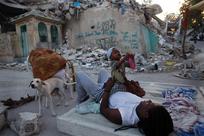
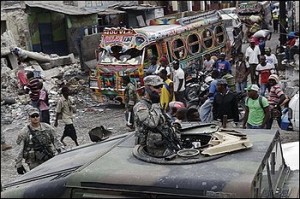
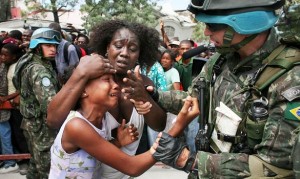
Crowds seeking aid in Haiti met with pepper spray and rubber bullets

Desperate crowds have overwhelmed peacekeepers trying to deliver aid. The World Food Programme says that Port-au-Prince represents the greatest logistical challenge it has ever faced

“They’re not violent, just desperate. They just want to eat,” Fernando Soares, a Brazilian army colonel, said. “The problem is, there is not enough food for everyone.”

Phi Beta Iota: We are furious at both the lack of decision-support (reliable broad information illuminating the breadth and urgency of the problem) and the lack of decision-makers with gravitas.  Someone needs to reach the Chairman of the Joint Chiefs of Staff (C/JCS) and tell him to pay attention.  Roll the C-130's and carpet bomb the place with water, food, tents, etc.   The National Guard C-130 pilots and crew chiefs know how to do “touch and go” drive-by load delivery without landing–why is our anemic military using just two of the six commercial capable airports and just one of the six commercial capable ports and NONE of the helicopter landing zones across the country?   We agree with William McNulty who has had EYES ON–we need to hold both commanders and their intelligence officers responsible for this massive failure to Observe, Orient, Decide, and Act (OODA).  We also recommend the observations by Dr. Zbigniew Brzezinski and the Italian leaderMr Bertolaso on the pathetic inadequacy of American assistance.  Uninformed, insufficient, a disgrace.

Meteorological Forecast: Rain and Diarrheal Illness

Forecasts for PAP calling for 20-30% chance of rain in the coming days.  Concerned about influence on transmission of gastroenteritis and diarrheal illness.  Monitoring closely.

Diarrheal disease was assessed to be the top priority in the immediate term following the earthquake.  We are now seeing indications of diarrheal disease increasing in the camps, particularly among the children.  We are very concerned about these reports.

Haiti Catastrophe Raises Biosecurity Concerns

As the slow process of recovery begins, re-establishing some normalcy of life will be critical and animals play a role in the lives of people in Haiti as they do around the world. One of the key issues will be focusing on Haiti's livestock and large population of stray animals.

On the Street

The response to these issues raises potential concerns for the U.S. livestock industries, says AASV. There are a number of reportable trans-border diseases endemic or suspected on the island of Hispaniola which, if introduced into the U.S. livestock herd, would have devastating effects on animal agriculture…

Haiti's children on their own on shattered streets

PORT-AU-PRINCE, Haiti — The children with no names lay mute in a corner of the General Hospital grounds Tuesday, three among thousands of boys and girls set adrift in the wake of Haiti's earthquake.

FullStory Online

Clinton: Critics of US Haiti relief misguided

WASHINGTON — Secretary of State Hillary Rodham Clinton said Tuesday she resents criticism of the U.S. effort to help stricken Haiti and pledged to redouble efforts to help survivors of the Jan. 12 earthquake.

“I deeply resent those who attack our country, the generosity of our people and the leadership of our president in trying to respond to historically disastrous conditions after the earthquake,” Clinton said.

Continue reading “Journal: Haiti Update 26 January 2010 PM”

Journal: Weak Signals–Obama Slipping Overseas

04 Indonesia

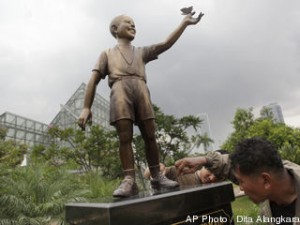
Indonesia Says It May Tear Down Obama Statue

To Be Listed on EBay?

Indonesian officials are considering a petition that calls for a bronze statue in Jakarta of a young Barack Obama to be torn down.

Last month, a bronze statue of Obama was unveiled in Jakarta's Taman Menteng Park. It depicts the U.S. President as a young boy, and commemorates the time he spent in Indonesia as a child.

Now, 55,000 people have joined a Facebook group that calls for the statue to be taken down, citing Obama's failure to “make a significant contribution to the Indonesian nation.”

Search: synergy strike force beer clapper

Collective Intelligence, Cultural Intelligence, IO Multinational, IO Sense-Making, Peace Intelligence
Home Page

Sample Cool Dude: Toff Hoffman.

Related project: STAR-TIDES (Sustainable Technologies Accelerated Research/Transformative Innovation for Development and Emergency Support)

Great project allowed to die: STRONG ANGEL

Phi Beta Iota: Including Rand Beer and Jim Clapper is what causes this search to fail.  Dr. Dr. Dave Warner, one of the co-founders of Earth Intelligence Network (EIN), is the originator of this idea.  Dr. Dr. Warner is too much the diplomat to point out the obvious: the concept requires open minds, a shelving of rankism, multinational engagement, and a raft of other minor but vital accommodations that are simply not in the DNA of those now serving.  They are all good people who mean well, but innovation like this is on the margins and receives lip service (much as the Open Government initiative has received lip service).

Continue reading “Search: synergy strike force beer clapper”

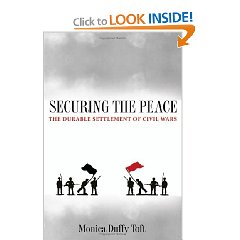
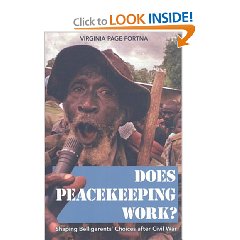
Worth a Look: Eight Books on Securing the Peace and the New Meme “Responsibility to Protect”

Peace Intelligence
Amazon Page

Timely and pathbreaking, Securing the Peace is the first book to explore the complete spectrum of civil war terminations, including negotiated settlements, military victories by governments and rebels, and stalemates and ceasefires. Examining the outcomes of all civil war terminations since 1940, Monica Toft develops a general theory of postwar stability, showing how third-party guarantees may not be the best option. She demonstrates that thorough security-sector reform plays a critical role in establishing peace over the long term.

Much of the thinking in this area has centered on third parties presiding over the maintenance of negotiated settlements, but the problem with this focus is that fewer than a quarter of recent civil wars have ended this way. Furthermore, these settlements have been precarious, often resulting in a recurrence of war. Toft finds that military victory, especially victory by rebels, lends itself to a more durable peace. She argues for the importance of the security sector–the police and military–and explains that victories are more stable when governments can maintain order. Toft presents statistical evaluations and in-depth case studies that include El Salvador, Sudan, and Uganda to reveal that where the security sector remains robust, stability and democracy are likely to follow.  [Phi Beta Iota: when rebels win, absent outside subsidies, they generally held the moral high ground to begin with–Saudi Arabia is a good example of a regime ready to fall hard.]

Amazon Page

Virginia Page Fortna has written a compelling and courageous book–compelling in the reinforcing comparisons that it makes between aggregate data and case-based research, and courageous in its first-person interviews, conducted with those who perpetrated as well as ended civil wars. The book bridges the worlds of the high-flying ‘quant' who sees only forests of data, and the ground-based case researcher knee-deep in political leaf litter. Drawing particular strength from the oft-ignored perspective of those on whose behalf peacekeepers do their work, Fortna's convergent analyses advance our understanding not only of how peacekeeping works but why.

Continue reading “Worth a Look: Eight Books on Securing the Peace and the New Meme “Responsibility to Protect””

Journal: Home-Grown Terrorism in USA

08 Immigration, 08 Wild Cards, 09 Justice, 09 Terrorism, 10 Security, 11 Society, Government, Law Enforcement
Full Review Online

The Homegrown Terrorist Threat to the US Homeland (ARI)

Lorenzo Vidino

ARI 171/2009 – 18/12/2009

EXTRACT 1: All these plots are very diverse in their origin, degree of sophistication and characteristics of the individuals involved. Yet they all contribute to paint the picture of the complex and rapidly changing reality of terrorism of Islamist inspiration in the US. Moreover, they smash or, at least, severely undermine an assumption that has been widely held by policymakers and analysts over the last 15 years. The common wisdom, in fact, has traditionally been that American Muslims, unlike their European counterparts, were virtually immune to radicalisation.

EXTRACT 2: The wave of arrests of the last months of 2009 has contributed to shedding light on a reality that is significantly more nuanced, showing that radicalisation affects some small segments of the American Muslim population exactly like it affects some fringe pockets of the Muslim population of each European country. Evidence supporting this view has been available for a long time, as the cases of American Muslims joining radical Islamist groups date back to the 1970s.[12] According to data collected by the NYU Center on Law and Security, for example, more than 500 individuals have been convicted by the American authorities for terrorism-related charges since 9/11.[13] Most of them are US citizens or long-time US residents who underwent radicalisation inside the US.

Phi Beta Iota: Recommended by Contributing Editor Berto Jongman.

See also:

Continue reading “Journal: Home-Grown Terrorism in USA”

Journal: In Search for Truth….Maybe Not

Civil Society, Cultural Intelligence, Ethics, Government, Media, Military
Story with Many Links

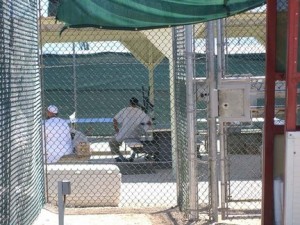
Pentagon’s Gitmo Recidivism Claims Don’t Add Up

Researchers at Seton Hall and New America Foundation track the Pentagon's claims that released Guantanamo detainees ‘returned to battle.'

Phi Beta Iota: Government claims 1 in 5 and counts those who speak to the press against USG and Guantanamo.  Researcers find 1 in 25 at best and observe that the USG is simply not able to get the same story told in the same way more than once.

Appeal Hearing on Guantanamo: Main Issues

On January 26, 2010, a panel of military officers will hear the historic first direct appeal from the military commissions at Guantanamo Bay.  Oral argument in the case of United States v. al Bahlul will focus on three constitutional issues that reach beyond military commissions and terrorism trials.    The main issue in the case asks whether the war on terrorism justifies the censorship of foreign media. [Emphasis added.]

My Truth & Only My Truth

The Age of Affirmation: A new study finds that TV viewers watch the news more for affirmation than for information.

A new study suggests that viewers worldwide turn to particular broadcasters to affirm — rather than inform — their opinions. It's a notion familiar to those dismayed by the paths blazed by cable news networks FOX and MSNBC — although the study finds one (perhaps unlikely) network may actually foster greater intellectual openness.

The study in the December issue of Media, War & Conflict by Shawn Powers, a fellow at the USC Center on Public Diplomacy, and Mohammed el-Nawawy, an assistant professor in the department of communication at Queens University of Charlotte, found that the longer viewers had been watching Al Jazeera English, the less dogmatic they were in their opinions and therefore more open to considering alternative and clashing opinions.

noble gold