NIGHTWATCH: China Leads Multinational Intelligence and Operations Initiative within Mekong River Basin

02 China, 03 Economy, 08 Wild Cards, 10 Security, 11 Society, 12 Water, Commerce, Military
Click on Image to Enlarge

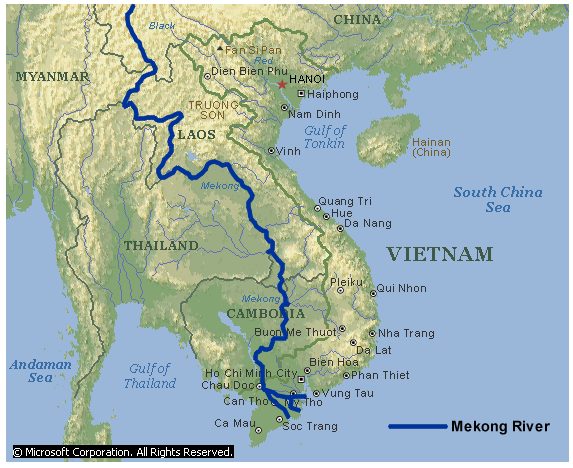
China-Mekong River Nations: Chinese press reported that joint security patrols with Thailand, Laos and Burma/ Myanmar will begin along the Mekong River. At a ministerial meeting in Beijing, the four countries agreed to begin the first patrol before 15 December and that the operation's headquarters be located in China. The patrols will allow shipping to restart and guarantee security with China to help train and equip police in Laos and Myanmar.

Comment: Many younger Readers might not know that the Mekong River originates in southwest China and flows southwards through Southeast Asia to the South China Sea. The omission of Cambodia from the joint agreement indicates the security problems are in the upper reaches of the river. Thus, the security problems are in effect, inland waterways security issues along navigable waterways.

The interesting dynamic is the Chinese success in moving southward, by exploiting lapses of local security along a key waterway, to extend the Chinese sphere of influence. The Chinese have not had Chinese patrol boats or river security advisors on the Mekong along the Laos, Burma and Thai borders in centuries.

NIGHTWATCH KGS Home

Phi Beta Iota:  Viet-Nam, long a co-equal and counter-weight to China in Southeast Asia, is not mentioned.  As the map illuminates, Cambodia and Viet-Nam control the entry points to the Mekong River.  Viet-Nam's control of the eastern coast also precludes–absent an agreement–an obvious option for future commerce, a major canal or rail cut from the Mekong east to Vinh, one of four Grade 1 cities in Viet-Nam, a major ground transport hub, and a notable port.

Robert Steele: Twitter Burns Google / Facebook

03 Economy, 04 Education, 11 Society, Commerce, InfoOps (IO), Strategy, Technologies
Robert David STEELE Vivas

This is fascinating at multiple levels.  Neither Google nor Facebook have been effective at helping humans “make sense,” now it appears that Twitter–perhaps combined with Hypothes.is–just might be a hair away from creating the skeleton of the World Brain.

Twitter Just Fired A Cannonball At Facebook And Google+

Matt Rosoff

Business Insider, 8 December 2011

Twitter is revamping the service with personal Twitter profile pages, a new timeline that includes rich media and other related informationembedded into tweets, and easier search for information based on @ symbols (usernames) and hash tags.

Talking at Twitter's unfinished new headquarters building in San Francisco, founder Jack Dorsey and CEO Dick Costolo explained that the changes are meant to make Twitter more accessible to everybody.

Their three goals:

  • Expose the “universe within every tweet.” Tweets aren't just 140 characters — there's also context like retweets and replies, and embedded content like videos, images, and songs. Today, accessing this material still feels like opening a “side drawer,” said Costolo.
  • Make Twitter less obscure to use. Today, the @ and # symbols are too obscure — people don't know what they mean. This contributes to a lot of people visiting Twitter but not really participating actively. The redesign surfaces these symbols and makes them the gateway to find out more infrmation about people and topics on the surface.
  • Share it with everybody. The world has 7 billion people. Most of those people are “not yet on Twitter,” said Costolo. The redesign will roll out to mobile devices simultaneously, and is streamlined to load up to 500% faster.

The trick is doing this without adding too much complexity. As Dorsey put it, “simplification is the key here.”


David Swanson: History of Corporate Personhood — How Lewis Powell & US Chamber of Commerce Bought the US Supreme Court

03 Economy, 07 Other Atrocities, 11 Society, Civil Society, Commerce, Commercial Intelligence, Corruption, Government, Money, Banks & Concentrated Wealth, Power Behind-the-Scenes/Special Interests
David Swanson

The Real History of ‘Corporate Personhood': Meet the Man to Blame for Corporations Having More Rights Than You

The real history of today's excessive corporate power starts with a tobacco lawyer appointed to the Supreme Court. 

By Jeffrey Clements, Berrett-Koehler Publishers, AlterNet

The following is an excerpt of Jeffrey Clement's Corporations Are Not People: Why They Have More Rights Than You Do and What You Can Do About It.

In 1971, Lewis Powell, a mild-mannered, courtly, and shrewd corporate lawyer in Richmond, Virginia, soon to be appointed to the United States Supreme Court, wrote a memorandum to his client, the United States Chamber of Commerce. He outlined a critique and a plan that changed America.

Complete excerpt below the line — real history killing real people.

Continue reading “David Swanson: History of Corporate Personhood — How Lewis Powell & US Chamber of Commerce Bought the US Supreme Court”

John Robb: Technology, Corruption, & Depressions

03 Economy, 09 Justice, Blog Wisdom, Commerce, Corruption, Government, Methods & Process, Technologies
John Robb

Technology Shifts and Economic Depression

Joseph Stiglitz (the Nobel prize winning economist) has a great new article: “The Book of Jobs“(behind Vanity Fair's paywall, sorry).   In it, he makes a convincing case that the first global depression was caused by a process similar to what we are seeing today (I'm very happy somebody in the social sciences is actually attempting to show how technological change was a driver of the first depression, it's about time).  Here it is in a nutshell:first depression, it's about time).

  1. Technological change in the form of the internal combustion engine (cars, tractors, trucks) improved transportation and farm productivity.  This led to an agricultural revolution that impacted a huge percentage of the US population.
  2. Farm productivity soared and prices dropped.  This forced many farmers into bankruptcy and led to a steady migration of people from rural to urban locations driving down incomes/demand.
  3. The downward pressure on incomes this caused resulted in a protraced economic depression that only ended when the US and Europe mobilized/nationalized every segment of the economy during WW2 (put everyone to work, trained them, etc.).

At this point in the article Stiglitz stumbles.

Continue reading “John Robb: Technology, Corruption, & Depressions”

Josh Kilbourn: Catagorizing Unemployed in the USA

03 Economy
Joshua Kilbourn

Categorizing the Unemployed by the Impact of the Recession

By Dr. Cliff Zukin, Dr. Carl E. Van Horn, and Charley Stone

Rutgers University Working Paper, 5 December 2011

Words like ‘shameful' and ‘national disgrace' do come to mind.

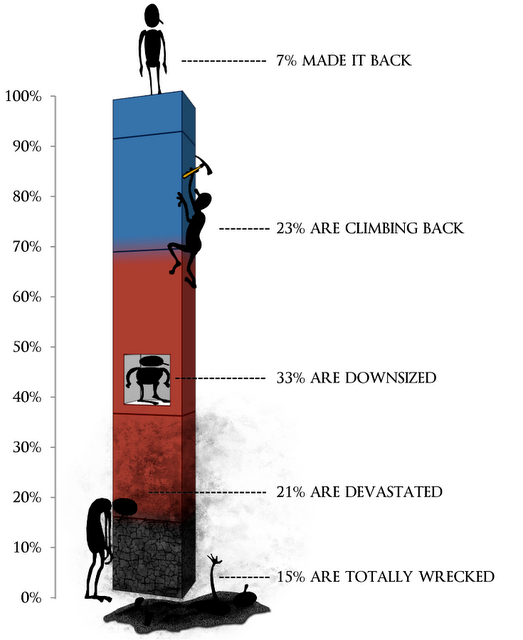
In August 2009, the John J. Heldrich Center for Workforce Development at Rutgers, The State University of New Jersey began following a nationally representative sample of American workers who lost a job during the height of the Great Recession.

Click on Image to Enlarge

The research began with a cross-sectional sample of 1,202 who had said they had lost a job at some point in the preceding 12 months (between August 2008 and 2009). They were resurveyed in March 2010, again in November 2010, and then in August 2011.

A total of 3,972 individual surveys were completed over the two years. Well over half of the original respondents participated in all four waves of the project, meaning they spent, on average, 50 minutes of their time responding to roughly 200 questionnaire items.

This resulting measure combines an assessment of the respondent/family’s current economic status with the magnitude of change in the quality of daily life, with an assessment of whether this change represents a new normal or is a temporary stay in limbo. Combining answers to these three questions result in a typology with five groups, defined as follows:

� Workers who have MADE IT BACK consider themselves in excellent, good, or fair financial shape and have experienced no change in their standard of living due to the recession.

� People ON THEIR WAY BACK have largely experienced a minor change to their standard of living, but say the change is temporary. They also consider themselves in excellent, good, or fair financial shape.

�� Workers who have been DOWNSIZED meet one of three conditions; they have experienced: a minor change that is permanent; a minor change that is temporary, but they are in poor financial shape; or a major change in their standard of living that is temporary and they are in at least fair financial shape.

� Workers classified as DEVASTATED have experienced a major change to their lifestyle due to the recession. They can be either in poor financial shape and think the change is temporary, or in fair financial shape but think this change is permanent.

� Workers that have been TOTALLY WRECKED by this recession have experienced a major change to their lifestyle that is permanent and are in poor financial shape.

Read the rest of this working paper here.

John Steiner: US Chamber of Commerce – Kill It?

01 Poverty, 03 Economy, 07 Other Atrocities, 09 Justice, 11 Society, Blog Wisdom, Budgets & Funding, Commerce, Corporations, Corruption, Counter-Oppression/Counter-Dictatorship Practices, Misinformation & Propaganda, Money, Banks & Concentrated Wealth, Non-Governmental, Politics of Science & Science of Politics, Power Behind-the-Scenes/Special Interests
John Steiner

Click here to sign your name:
“Google, stand up for democracy and your users—quit the U.S. Chamber of Commerce!”

Dear MoveOn member,

Right now we have a huge opportunity to deal what's being called a “serious blow to one of Washington's most powerful lobbies.”1

The U.S. Chamber of Commerce is an army of lobbyists for hire by mega-corporations like banks and those in the fossil fuel industry. In 2009, it spent more corporate money on lobbying than the next five biggest spenders combined.2 And 93% of its campaign spending goes to support Republicans and attack Democrats.3

Google is a paying member of the Chamber, which means that part of the money they make from Google users—ordinary people like us using Gmail, Google search, and other Google products—goes into the Chamber's pockets to fight for Wall Street and Big Oil. But the Washington Post and Politico recently reported that at Google headquarters, employees are intensely debating whether Google should quit the Chamber in the next few weeks.4

Continue reading “John Steiner: US Chamber of Commerce – Kill It?”

Steve Denning: Itemization of How We Blew Up the World

03 Economy, 07 Other Atrocities, 09 Justice, 10 Security, Analysis, Blog Wisdom, Commerce, Commercial Intelligence, Corporations, Corruption, Misinformation & Propaganda, Money, Banks & Concentrated Wealth, Policy, Power Behind-the-Scenes/Special Interests, Secrecy & Politics of Secrecy
Steve Denning

Lest We Forget: Why We Had A Financial Crisis

Steve Denning

Forbes, 22 November 2011

When a true genius appears in the world you may know him by this infallible sign, that the dunces are all in confederacy against him.

Jonathan Swift

It is clear to anyone who has studied the financial crisis of 2008 that the private sector’s drive for short-term profit was behind it. More than 84 percent of the sub-prime mortgages in 2006 were issued by private lending. These private firms made nearly 83 percent of the subprime loans to low- and moderate-income borrowers that year. Out of the top 25 subprime lenders in 2006, only one was subject to the usual mortgage laws and regulations. The nonbank underwriters made more than 12 million subprime mortgages with a value of nearly $2 trillion. The lenders who made these were exempt from federal regulations.

How then could the Mayor of New York, Michael Bloomberg say the following at a business breakfast in mid-town Manhattan on November 1, 2011?

It was not the banks that created the mortgage crisis. It was, plain and simple, Congress who forced everybody to go and give mortgages to people who were on the cusp. Now, I’m not saying I’m sure that was terrible policy, because a lot of those people who got homes still have them and they wouldn’t have gotten them without that. But they were the ones who pushed Fannie and Freddie to make a bunch of loans that were imprudent, if you will. They were the ones that pushed the banks to loan to everybody. And now we want to go vilify the banks because it’s one target, it’s easy to blame them and Congress certainly isn’t going to blame themselves.”

Barry Ritholtz in the Washington Post calls the notion that the US Congress was behind the financial crisis of 2008 “the Big Lie”. As we have seen in other contexts, if a lie is big enough, people begin to believe it.

Full Story Below the Line with BLOCKBUSTER Itemization

Continue reading “Steve Denning: Itemization of How We Blew Up the World”

noble gold