By IAN LIVINGSTON, HEATHER MESSERA, MICHAEL O’HANLON and AMY UNIKEWICZ January 2, 2010
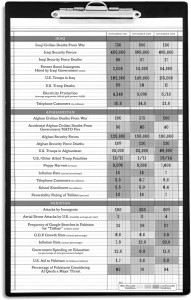
In 2009, Iraq, Pakistan and Afghanistan dominated American military and foreign policy. Which themes emerged over the last year?
Click Here For Graphic Statistics
In Iraq, 2009 was the year of relatively smooth transitions.
In Pakistan, 2009 was the year of the offensives.
In Afghanistan, 2009 was the year of decisions — by President Obama, of course, by Gen. Stanley A. McChrystal and by the Afghan people as they re-elected Hamid Karzai as president.
Phi Beta Iota: Although a puff piece in some ways, since it is well-known that Karzai is massively corrupt and the election was so fraudulent as to remind one of Idi Amin's elections, the statistics are indeed looking good, especially in Iraq. Our concern is that the US will finally de-occupy Iraq only to create new occupations in Yemen, Sudan, and Somalia. Neither CIA nor JSOC is actually up to the challenge of global operations without blow-back, the US has no strategy and no Whole of Goverment capability for waging peace so as to calm the context in which we do one man – one bullet operations, so on balance, we are very concerned.
Phi Beta Iota: We now know that no one briefed the White House on the fact that Iraq was deeply divided between Sunnis in power and Shi-ites under repression. We have to ask ourselves if anyone has figured out that Azerbaijan is the other Shi'ite majority nation.
Shi'ites Rock On....
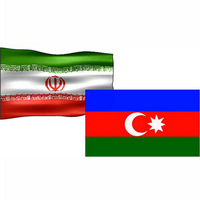
Iran starts to introduce visa-free regime with Azerbaijan on February 1 – Head of the press service of the Iranian Embassy
Earlier Iranian Ambassador to Azerbaijan Mohammad Bagir Behrami said that any Azerbaijani citizen can travel to Iran without a visa and stay for one month.
The ambassador expressed hope that the Azerbaijani side will take a similar step.
/PanARMENIAN.Net/ Armenian Center for National and International Studies (ACNIS) Director Richard Giragosian issued a statement today criticizing Azerbaijani President Ilham Aliyev’s renewed “threats of war.
Baku. Elmin Ibrahimov-APA. Afghanistan National Security Directorate (NSD) has announced that a member of the al-Qaida network was arrested in the country’s eastern province of Khost.
“Normalization of relations between Turkey and Armenia is not enough,” Turkish foreign ministry spokesman Burak Özügergin told a press briefing on Wednesday. “If Armenia does not resolve Upper Karabakh dispute with Azerbaijan, stability in the Caucasus can not be established. This is quite clear.”
FYI … I just found this interesting report. While the report focuses almost entirely on the political perspective to this conflict, note how he claims the Taleban increases its cohesion by organizing itself in a decentralized way the marries centralized intent with high degree of autonomy at lower levels. He thinks it is paradoxical that this type of organization improves cohesion, but it is right out of the maneuver warfare tradition, and it is hardly paradoxical that this kind of organization increases the variety, rapidity, and harmony of its OODA loops at all levels organization. Nor should it be surprising, given the sluggish, rigid OODA loops that result our highly centralized, techno-intensive approach to command & control, that the Taleban seized and maintains the initiative, as acknowledged by General McChrystal in his report to President Obama in August. Chuck
Report Online
35-Page Report includes Executive Summary, Introduction, Roots & Causes, Induced & Internal Factors, Pakistan Factor, Who Are the Insurgents, Talks or Reconciliation, Conclusion, and Recommendations.
High points:
1. Many actors, no strategy
2. Cannot reconcile extremists with corrupt government
3. Time for the UN to be the UN again and lead a 360 “all stakeholders” non-military convergence.
The reason the country is uneasy about the Obama administration's response to this attack is a distinct sense of not just incompetence but incomprehension. From the very beginning, President Obama has relentlessly tried to play down and deny the nature of the terrorist threat we continue to face.
. . . . . . .
Any government can through laxity let someone slip through the cracks. But a government that refuses to admit that we are at war, indeed, refuses even to name the enemy — jihadist is a word banished from the Obama lexicon — turns laxity into a governing philosophy.
Marcus Aurelius
Phi Beta Iota: The commentator, an extreme partisan from the right, confuses laxity with partisanship. Both parties are partisan extremists, and blinding America to the reality that it must acknowledge if it is to adapt to the unprecedented complexity that threatens us–many of the threats of our own making and many of the cost of our own volition, bad decisions made in the aftermath of what would otherwise be minor decisions. America lacks a non-partisan intelligence community able to get a grip on the Whole System; America lacks a Whole of Government capacity to balance means, ways, and ends; and America lacks above all any means of restoring comity and consensus in Congress, without which Congress will not fulfill its Article 1 Constitutional duty.
Very important article from one of the very best reporters covering the Middle East
Walking Into the Al-Qaeda Trap
Touch Yemen, Get Burned
By PATRICK COCKBURN
December 31, 2009
Skip to End of Article:
It is extraordinary to see the US begin to make the same mistakes in Yemen as it previously made in Afghanistan and Iraq. What it is doing is much to al-Qa’ida’s advantage. The real strength of al-Qa’ida is not that it can ‘train’ a fanatical Nigerian student to sew explosives into his underpants, but that it can provoke an exaggerated US response to every botched attack. Al-Qa’ida leaders openly admitted at the time of 9/11 that the aim of such operations is to provoke the US into direct military intervention in Muslim countries. It is a formula which worked under President George W Bush and it still appears to work under President Barack Obama.
In Yemen the US is walking into the al-Qa’ida trap. Once there it will face the same dilemma it faces in Iraq and Afghanistan. It became impossible to exit these conflicts because the loss of face would be too great. Just as Washington saved banks and insurance giants from bankruptcy in 2008 because they were “too big to fail,” so these wars become too important to lose because to do so would damage the US claim to be the sole super power.
In Iraq the US is getting out more easily than seemed likely at one stage because Washington has persuaded Americans that they won a non-existent success. The ultimate US exit from Afghanistan may eventually be along very similar lines. But the danger of claiming spurious victories is that such distortions of history make it impossible for the US to learn from past mistakes and instead to repeat them by intervening in other countries such as Yemen.
Nicht Schwerpunkt as a Prescription for Defeat by a 1000 Cuts
Operation Barbarossa
Recent events like the Fort Hood Massacre and the bungled attempt to fire bomb the airliner bound for Detroit have focused attention on and encouraged our escalating intervention in Yemen, which has been taking place quietly, as if Iraq, Afghanistan, and Pakistan were not enough to keep our strategic planners and stretched out military forces occupied. Our reactions to events in the so-called Long War on Terror suggest an aimless spreading of effort throughout the Middle East and Central Asia. This aimlessness brings to mind a comment General Hermann Balck, a highly decorated German officer in WWII, made to a small group of reformers in the Pentagon in the early 1980s. The subject was Operation Barbarossa, or Germany's invasion of the Soviet Union in June 1941. Balck pithily dismissed the German strategy shaping that invasion with the words: “Nicht Schwerpunkt.” Balck was saying there was no focus or main effort to the German invasion, and without a focus, there was no way to harmonize the thousands of subordinate efforts. The result was a spreading of effort that led to eventual overextension as can be seen in the following map.
Now the Eastern Front of WWII is very different from the ridiculously misleading label of a Central Front in the Long War on Terror. But the idea of schwerpunkt is germane to both efforts, and the US is showing all the signs of spreading and over extending its efforts which accompany a nicht schwerpunkt.
This is no small thing. As the American strategist Colonel John Boyd showed in his famous briefing, Patterns of Conflict, the idea of a schwerpunkt is central to organizing all effective military operations. It is far more than a simple question of concentrating forces. According to Boyd, the idea of a “Schwerpunkt represents a unifying medium that provides a directed way to tie initiative of many subordinate actions with superior intent as a basis to diminish friction and compress time in order to generate a favorable mismatch in time/ability to shape and adapt to unfolding circumstances.” Now this is a very compressed statement, pregnant with information, and based on a lot of research, but it nevertheless makes it self evident that there is no comparable unifying medium in America's Long War on Terror. Our failure to form a schwerpunkt is just as much a prescription for paralysis and defeat by a thousand cuts in a guerrilla war as it is in a mechanized conventional war between standing armies.
To see why, consider please the following three attachments:
Detroit jet terrorist attack was staged – journalist
The recent failed attack on a US passenger jet traveling from Amsterdam to Detroit was a set-up provocation controlled by US intelligence, author and journalist Webster Tarpley stated to RT.
“[The terrorist’s] father, a rich Nigerian banker, went to the US embassy in Nigeria on November 19 and said ‘my son is in Yemen in a terrorist camp, do something about this.’ Nevertheless, the son is allowed to buy a ticket in Ghana, paying cash, $2,800, for a one-way ticket,” Tarpley said.
After that, a mentally deficient young man who doubtfully could make it from one gate to another managed to illegally enter Nigeria and get on a plane to Amsterdam.
“There was a well-dressed Indian man who brought him to the gate and said, ‘my friend does not have a passport, get him on, he is Sudanese, we do this all the time – that is impossible!” said Tarpley.