Stephen Aftergood: What Is Overclassification?

10 Security, 11 Society, Definitions, Government, Ineptitude, IO Impotency, Military, Officers Call
Steven Aftergood
Steven Aftergood

WHAT IS OVERCLASSIFICATION?

When people criticize overclassification of national security information, what exactly are they talking about?  Is it too much secrecy?  The wrong sort of secrecy?  Classifying something at too high a level?  Oddly, there is no widely-accepted definition of the term.

But since the solution to overclassification, if any, will naturally be shaped by the way the problem is understood, it is important to specify the problem as clearly as possible.

In 2010 Congress passed (and President Obama signed) the Reducing Over-Classification Act, which mandated several steps to improve classification practices in the executive branch.  But in a minor act of legislative malpractice, Congress failed to define the meaning of the term “over-classification” (as it was spelled in the statute).  So it is not entirely clear what the Act was supposed to “reduce.”

Among its provisions, the Act required the Inspectors General of all classifying agencies to perform an evaluation of each agency's compliance with classification rules.

To assist them in their evaluations, the Inspectors General turned to the Information Security Oversight Office (ISOO) for a working definition of overclassification that they could use to perform their task.  ISOO's answer was cited by the Inspector General of the Department of Justice in its new report.  (Audit of DOJ's Implementation of and Compliance with Certain Classification Requirements, Inspector General Audit Report 13-40, September 2013.)

    “Over-classification,” according to ISOO, means “the designation of information as classified when the information does not meet one or more of the standards for classification under section 1.1 of

Executive Order (EO) 13526

    .”  If something is classified in violation of the standards of the executive order– then it is “over-classified.”


So, for example, information that is not owned by the government, such as a newspaper article, cannot be properly classified under the terms of the executive order.  And neither can information that has no bearing on national security, such as an Embassy dinner menu.  And yet information in both categories has been known to be classified, which is indeed a species of overclassification.

Unfortunately, however, this ISOO definition presents the problem so narrowly that it misses whole dimensions of overclassification.


Continue reading “Stephen Aftergood: What Is Overclassification?”

Berto Jongman: John Naugton on Edward Snowden and Public Indifference About Total Surveillance

09 Justice, 11 Society, Cultural Intelligence
Berto Jongman
Berto Jongman

Edward Snowden: public indifference is the real enemy in the NSA affair

Most people don't seem to worry that government agencies are collecting their personal data. Is it ignorance or apathy?

Edward Snowden's revelations exposed a terrifying level of ‘passive acceptance' of surveillance. Photograph: Sergei Grits/AP

One of the most disturbing aspects of the public response to Edward Snowden‘s revelations about the scale of governmental surveillance is how little public disquiet there appears to be about it. A recent YouGov poll, for example, asked respondents whether the British security services have too many or too few powers to carry out surveillance on ordinary people. Forty-two per cent said that they thought the balance was “about right” and a further 22% thought that the security services did not have enough powers. In another question, respondents were asked whether they thought Snowden's revelations were a good or a bad thing; 43% thought they were bad and only 35% thought they were good.

Edward Snowden

Writing in these pages a few weeks ago, Henry Porter expressed his own frustration at this public complacency. “Today, apparently,” he wrote, “we are at ease with a system of near total intrusion that would have horrified every adult Briton 25 years ago. Back then, western spies acknowledged the importance of freedom by honouring the survivors of those networks; now, they spy on their own people. We have changed, that is obvious, and, to be honest, I wonder whether I, and others who care about privacy and freedom, have been left behind by societies that accept surveillance as a part of the sophisticated world we live in.”

I share Henry's bafflement. At one point I thought that the level of public complacency about the revelations was a reflection simply of ignorance. After all, most people who use the internet and mobile phones have no idea about how any of this stuff works and so may be naive about the implications of state agencies being able to scoop up everybody's email metadata, call logs, click streams, friendship networks and so on.

Continue reading “Berto Jongman: John Naugton on Edward Snowden and Public Indifference About Total Surveillance”

4th Media: 4 in 5 in US Face Near-Poverty, No Work

01 Poverty, 03 Economy, 07 Other Atrocities, 11 Society

4th media cropped4 in 5 in US Face Near-Poverty, No Work

Four out of 5 U.S. adults struggle with joblessness, near-poverty or reliance on welfare for at least parts of their lives, a sign of deteriorating economic security and an elusive American dream.

Click on Image to Enlarge

Survey data exclusive to The Associated Press points to an increasingly globalized U.S. economy, the widening gap between rich and poor, and the loss of good-paying manufacturing jobs as reasons for the trend.

The findings come as President Obama tries to renew his administration’s emphasis on the economy, saying in recent speeches that his highest priority is to “rebuild ladders of opportunity” and reverse income inequality.

As nonwhites approach a numerical majority in the U.S., one question is how public programs to lift the disadvantaged should be best focused — on the affirmative action that historically has tried to eliminate the racial barriers seen as the major impediment to economic equality, or simply on improving socioeconomic status for all, regardless of race.

Read full article with excellent photos and graphics.

Paul Craig Roberts: Americans Selling Body Parts for Income

01 Poverty, 03 Economy, 07 Other Atrocities, 11 Society, Civil Society
Paul Craig Roberts
Paul Craig Roberts

Bloomberg News — Americans Sell Body Parts For Income

The American economic crisis of the 21st century is becoming worse. Wall Street and the multinational US corporations have offshored millions of US jobs that provided middle class incomes. Americans who lost these jobs have experienced dramatic reductions in their incomes and access to medical care. They have used up their savings and now have to sell parts of their bodies for money. This crisis will worsen as the American economic collapse proceeds. Income and wealth are concentrated in the hands of a few oligarchs, with 400 families having as much wealth as 150,000,000 Americans. Bloomberg is wrong about “the four-year-old economic expansion.” The alleged recovery is a product of statistical manipulation, as John Williams (shadowstats.com) has made clear.

Bodies Double as Cash Machines With U.S. Income Lagging: Economy

By Victoria Stilwell

Bloomberg News, Oct 15, 2013

Hair, breast milk and eggs are doubling as automated teller machines for some cash-strapped Americans such as April Hare. Out of work for more than two years and facing eviction from her home, Hare recalled Louisa May Alcott’s 19th-century novel and took to her computer.

“I was just trying to find ways to make money, and I remembered Jo from ‘Little Women,’ and she sold her hair,” the 35-year-old from Atlanta said. “I’ve always had lots of hair, but this is the first time I’ve actually had the idea to sell it because I’m in a really tight jam right now.”

The mother of two posted pictures of her 18-inch auburn mane on www.buyandsellhair.com, asking at least $1,000 and receiving responses within hours. Hare, who also considered selling her breast milk, joins others exploring unconventional ways to make ends meet as the four-year-old economic expansion struggles to invigorate the labor market and stimulate incomes.

In all but two quarters since the beginning of 2011, “hair,” “eggs,” or “kidney” have been among the top four autofill results for the Google search query, “I want to sell my…,” according to Nicholas Colas, chief market strategist at New York-based ConvergEx Group, which provides brokerage and trading-related services for institutional investors. While Americans can legally sell hair, breast milk and eggs, the sale and purchase of a kidney in the U.S. is against the law.

“The fact that people even explore it indicates that there are still a lot of people worried about their financial outlook,” said Colas, who tracks off-the-grid economic indicators. “This is very much unlike every other recovery that we’ve had. It’s going to be a slow-grinding, very frustrating recovery.”

Read full article.

LtCol X: CSA Sends – Strategic Priorities for the Army – with Phi Beta Iota Comments

10 Security, 11 Society, Corruption, Cultural Intelligence, Director of National Intelligence et al (IC), DoD, Ethics, Ineptitude, IO Deeds of War, IO Impotency, Lessons, Military, Officers Call, Peace Intelligence, Strategy
Click on Image to Enlarge

Please note Army Chief of Staff General Raymond T. Odierno‘s updated strategic priorities for the US Army, arranged in five (5) categories. PDF Slide Show: CSA Strategic Priorities vFinal 16Oct13

From those, here is an extract .

EXTRACTS:

[DOWNSIZED ARMY; EXPEDITIONARY]

– Downsize, transition, and then sustain a smaller, but ready and capable Total Army that provides Joint and Combined forces with expeditionary and enduring landpower for the range of military operations and features unique competencies such as operational leadership, mobility, command and control, and theater logistics at all echelons.

Raymond T. Odierno
Raymond T. Odierno

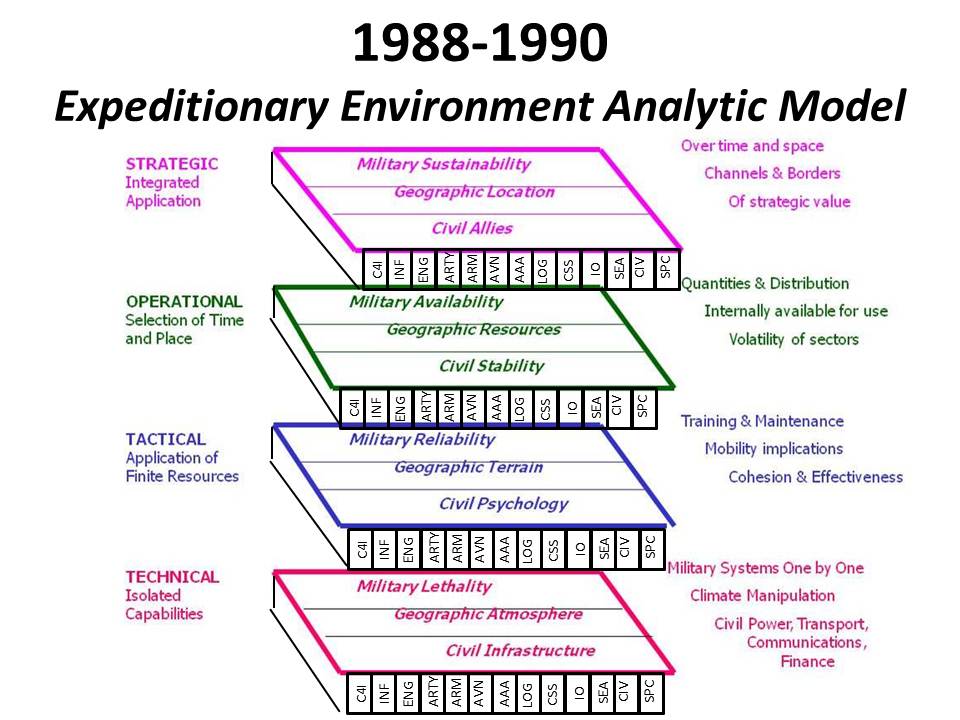
Phi Beta Iota: To downsize effectively you have to have ethical evidence-based decision-support immediately applicable to strategy, policy, acquisitions, and operations.  This does not exist.  NGIC once upon a time had Tim Hendrickson and GRAND VIEW but they never made the leap to holistic analytics and true cost economics. Army flags — including the very best of them — simply do not know what they need to know to demand of the intelligence “professionals” what the latter have no clue how to produce.  We have not seen a single useful strategic, policy, or acquisition document come out of DIA in the past twenty years…nor CIA.  All these people are still in the cut and paste fluff mode that Col Mike Pheneger, USA (SOF) blew the whistle on in 1988.  Nothing has changed in substance — just more people, more money, more (retarded) technology, and much less useful thinking.

Click on Image to Enlarge

[ENABLERS; EXPEDITIONARY; UNIFIED ACTION PARTNERS (UAPs)] – Support the Joint Force with critical enablers such as aviation, intelligence, engineers, logistics, medical, signal, and special operations, both while enroute to, and operating within, expeditionary environments alongside Unified Action Partners.

Phi Beta Iota: The Marine Corps led the way with Planning and Programming Factors for Expeditionary Operations in the Third World, and then lost its integrity and started chasing money instead of producing ethical evidence-based decision-support relevant to what General Al Gray wanted in the first place, compelling support for honest light-footprint low-cost acquisition (something the other four services need but refuse) along with strategic and operational support to what he called “peaceful preventive measures.”  The Navy has imploded — as many Admirals as ships, and the whole lot of them are not worth anything in terms of rapid precision response, this leaves the Marine Corps both 4-6 days away from anywhere, and totally exposed (e.g. no Naval Gunfire, rotten CAP) once they get there.  Army cannot do what it wants to do without an honest long-haul Air Force and a complete make-over of close air support (to include transfer of CAS to the Army) as well as reconnecting to reality at the geospatial, cyber, and cultural levels.

Continue reading “LtCol X: CSA Sends – Strategic Priorities for the Army – with Phi Beta Iota Comments”

Eagle: Working Cannot Stop Poverty (Really)

01 Poverty, 03 Economy, 06 Family, 11 Society, Commerce, Corruption, Government
300 Million Talons...
300 Million Talons…

Put another way, the 1% have so thoroughly screwed the system that one adults working full time (or two adults working part-time four times) cannot support their children at the same time that social and other state services are collapsing.

Alan Milburn says child poverty ‘no longer problem of the workless and work-shy'

Working parents in Britain “simply do not earn enough to escape poverty”, the government's social mobility tsar Alan Milburn has warned.

Two-thirds of poor children are now from families where an adult works, his report found.

Read full article.

Eagle: Are We Approaching Peak Retirement?

03 Economy, 11 Society, Corruption, Government, Idiocy, Ineptitude
300 Million Talons...
300 Million Talons…

Are We Approaching Peak Retirement?   (October 15, 2013)

If stocks, bonds and real estate all decline going forward, where are pension funds going to earn their 7+% annual yields?If we look at the foundations of retirement–Social Security, stocks, bonds and real estate–it seems we may have reached Peak Retirement. Let's start the discussion by noting that the primary Federal retirement programs–Social Security and Medicare–are “pay as you go,” meaning the checks sent out to beneficiaries this year are funded by payroll tax revenues collected this year from workers.

As Mish and I (as well as others) have tirelessly pointed out, the “trust funds” for these programs are phantoms of imagination. When these programs run deficits, the government raises the money to fund the deficit the same way it funds all its deficit spending–by selling Treasury bonds.

Click on Image to Enlarge

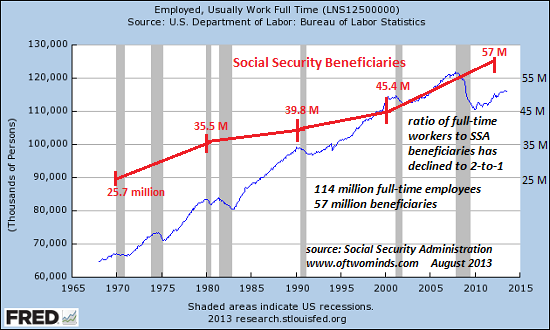
These programs were founded on a demographic illusion, i.e. that the number of retirees (beneficiaries) would magically remain a small percentage of the workforce paying payroll taxes. Alas, the number of beneficiaries is rising fast while the number of full-time workers is stagnating.

Full-time employment and the number of Social Security beneficiaries: the ratio of full-time workers to beneficiaries is already 2-to-1, and set to decline. Below 2-to-1, either payroll taxes will have to icnrease or benefits will have to be trimmed, or some of both.

Read more.

noble gold