The Japanese government has asked for help — but is the plea two years too late?
Despite previous assurances, the Fukushima nuclear power plant disaster continues to contaminate the world’s oceans — and the Japanese government is finally asking for international help.
The March 2011 power plant meltdown was the worst nuclear disaster since Chernobyl, and after frequent attempts to stem contamination — including the use of ice rings and the construction of a second processing plant to filter radioactive particles from contaminated water — the Japanese government has finally asked for global aid to stem radioactive leaks entering the Pacific Ocean, which is endangering the world’s food supply and ecosystems.
At a conference on Sunday, Prime Minister Shinzo Abe said:
“We are wide open to receive the most advanced knowledge from overseas to contain the problem. My country needs your knowledge and expertise.”
Despite Abe’s comments to the International Olympic Committee last month that the leaks were “under control,” untold thousands of tons of radioactive liquid have entered the world’s oceans, with plant operator Tokyo Electric Power Co. (TEPCO) reporting a new leak this week caused by human error, and a spill of 80,000 gallons in August.
“Google Inc. is now aligned with the notorious ALEC. Quietly, Google has joined ALEC — the American Legislative Exchange Council — the shadowy corporate alliance that pushes odious laws through state legislatures. In the process, Google has signed onto an organization that promotes such regressive measures as tax cuts for tobacco companies, school privatization to help for-profit education firms, repeal of state taxes for the wealthy and opposition to renewable energy disliked by oil companies. ALEC's reactionary efforts — thoroughly documented by the Center for Media and Democracy — are shameful assaults on democratic principles. And Google is now among the hundreds of companies in ALEC. Many people who've admired Google are now wondering: How could this be? Well, in his recent book Digital Disconnect: How Capitalism Is Turning the Internet Against Democracy, Robert W. McChesney provides vital context. “It is true that with the advent of the Internet many of the successful giants — Apple and Google come to mind — were begun by idealists who may have been uncertain whether they really wanted to be old-fashioned capitalists,” he writes. “The system in short order has whipped them into shape.”
Conclusion up front. When will the Arabs AND the Americans wake up?
And the Israeli-Saudi axis will keep blossoming. Few in the Middle East know that an Israeli company – with experience in repressing Palestinians – is in charge of the security in Mecca. (See here and here (in French)). If they knew – with the House of Saud's hypocrisy once more revealed – the Arab street in many a latitude would riot en masse.
One thing is certain; Bandar Bush, as well as the Saudi-Israeli axis, will pull no punches to derail any rapprochement between Washington and Tehran. As for the Bigger Picture, the real “international community” may always dream that one day Washington elites will finally see the light and figure out that the US-Saudi strategic alliance sealed in 1945 between Franklin D Roosevelt and King Abdul Aziz ibn Saud makes absolutely no sense.
Every sentient being with a functional brain perceives the possibility of ending the 34-year Wall of Mistrust between Washington and Tehran as a win-win situation.
Here are some of the benefits:
The price of oil and gas from the Persian Gulf would go down;
Washington and Tehran could enter a partnership to fight Salafi-jihadis (they already did, by the way, immediately after 9/11) as well as coordinate their policies in Afghanistan to keep the Taliban in check post-2014;
Edward Snowden, who has leaked classified information about intelligence collection activities of the National Security Agency (NSA), reportedly told the South China Morning Post that he sought a job as a contractor at government consulting firm Booz Allen Hamilton with a goal: to collect proof about the NSA’s domestic surveillance programs and alert the public to the programs. However, Snowden is not the typical insider threat. Most insiders who later betray their employer’s trust don’t start out with that intent. The change from benign employee to malicious insider can be spurred by anything from home-life stress to frustration at being passed over for a promotion to the thought that the company does not appreciate one’s contributions.
Though the risk is great, it is not possible to deny insiders the access to data that they will need to do their jobs. So what can a company do?
The company must have clear policies regarding how corporate data is to be handled and safeguarded, and confidential data should be clearly labeled, with access as restricted as feasible. Additionally, the company should secure the data itself and use software to track access and seek signs of suspicious activity, especially with regard to what information leaves the system or is copied. This article focuses, however, on the human factor—what companies can do in the hiring process and throughout employment to detect signs that a person is likely to become, or has become, an insider threat.
The comment on this article, the last sentence which is in red print, is the most telling. This whole article is a good example that proves two things:
1. There is “stuff” really is going on behind the scenes which is being kept secret.
2. It is difficult, if not impossible, to know who the white hats are and who the black hats are. In this case the general(s) who was “fired” might have been fired by the positive military because he was negative military, following cabal orders. Or he might have been fired by the cabal because he wouldn't follow cabal orders. We don't know without further information.
This is literally a sickening story, a cautionary tale of what happens when corporate interests trump national wellness and this is affirmed by all the branches of the government. It is no longer possible to take it as a given that food in an American supermarket is safe to eat. Here is the proof of that. There needs to be a citizen outcry about this, and it should be a major issue in the 2! 014 elections.
As an especially vicious salmonella outbreak sickens hundreds across the country, U.S. Department of Agriculture regulators have declined to crack down on the poultry processing plants that spread the pathogen. On Monday, the USDA threatened to close the California-based Foster Farms facilities, but decided to keep the plant open under scrutiny on Thursday night after Foster Farms submitted a plan for ‘immediate substantive changes to their slaughter and processing to allow for continued operations.”
The outbreak has sickened at least 300 people in 17 states, and 42 percent of the victims have been hospitalized – twice the normal hospitalization rate for salmonella. Yet neither state nor federal regulators have issued a recall order, stating the chicken is safe if fully cooked.
Since 9/11, two consecutive U.S. administrations have labored mightily to help Afghanistan create a state inhospitable to terrorist organizations with transnational aspirations and capabilities. The goal has been clear enough, but its attainment has proved vexing. Officials have struggled to define the necessary attributes of a stable post-Taliban Afghan state and to agree on the best means for achieving them. This is not surprising. The U.S. intervention required improvisation in a distant, mountainous land with de jure, but not de facto, sovereignty; a traumatized and divided population; and staggering political, economic, and social problems. Achieving even minimal strategic objectives in such a context was never going to be quick, easy, or cheap.
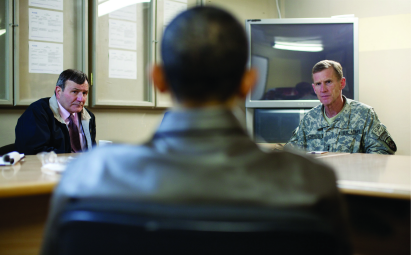
Eikenberry, Obama, and General Stanley McChrystal in Afghanistan, March 2010. (Pete Souza / White House)
Of the various strategies that the United States has employed in Afghanistan over the past dozen years, the 2009 troop surge was by far the most ambitious and expensive. Counterinsurgency (COIN) doctrine was at the heart of the Afghan surge. Rediscovered by the U.S. military during the wars in Afghanistan and Iraq, counterinsurgency was updated and codified in 2006 in Field Manual 3-24, jointly published by the U.S. Army and the Marines. The revised doctrine placed high confidence in the infallibility of military leadership at all levels of engagement (from privates to generals) with the indigenous population throughout the conflict zone. Military doctrine provides guidelines that inform how armed forces contribute to campaigns, operations, and battles. Contingent on context, military doctrine is meant to be suggestive, not prescriptive.
Broadly stated, modern COIN doctrine stresses the need to protect civilian populations, eliminate insurgent leaders and infrastructure, and help establish a legitimate and accountable host-nation government able to deliver essential human services. Field Manual 3-24 also makes clear the extensive length and expense of COIN campaigns: “Insurgencies are protracted by nature. Thus, COIN operations always demand considerable expenditures of time and resources.”
The apparent validation of this doctrine during the 2007 troop surge in Iraq increased its standing. When the Obama administration conducted a comprehensive Afghanistan strategy review in 2009, some military leaders, reinforced by some civilian analysts in influential think tanks, confidently pointed to Field Manual 3-24 as the authoritative playbook for success. When the president ordered the deployment of an additional 30,000 troops into Afghanistan at the end of that year, the military was successful in ensuring that the major tenets of COIN doctrine were also incorporated into the revised operational plan. The stated aim was to secure the Afghan people by employing the method of “clear, hold, and build” — in other words, push the insurgents out, keep them out, and use the resulting space and time to establish a legitimate government, build capable security forces, and improve the Afghan economy. With persistent outside efforts, advocates of the COIN doctrine asserted, the capacity of the Afghan government would steadily grow, the levels of U.S. and international assistance would decline, and the insurgency would eventually be defeated.
Blindly following COIN doctrine led the U.S. military to fixate on defeating the insurgency while giving short shrift to Afghan politics.

 Fukushima nuclear disaster now global environmental problem