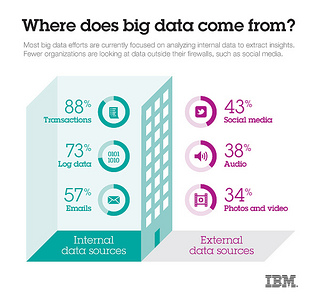
Phi Beta Iota: IBM and the US secret intelligence community share the same intellectual deficiencies — they just cannot come to grips with two facts: a) 80% or more of the data that is online is Deep Web and NOT subject to search discovery in its present state of infantile development; and b) 80% of relevant information is not digital, not in English, and not even published in analog form.
A brief video summarizing Robert Steele's most recent work, the impending Open-Source Revolution, and how We the People can create a New World. Your support is much appreciated!
Web hosting firm ServerBeach recently received a Digital Millennium Copyright Act (DMCA) violation notice from Pearson, the well-known educational publishing company. The notice pertained to Edublogs, which hosts 1.45 million education-related blogs with ServerBeach, and it focused on a single Edublogs page from 2007 that contained a questionnaire copyrighted by Pearson. ServerBeach informed Edublogs about the alleged violation, and Edublogs says it quickly took down the allegedly infringing content.
Instead of calling the matter settled, though, ServerBeach took Edublogs' servers offline last Wednesday, temporarily shutting off all 1.45 million blogs, according to Edublogs. ServerBeach confirms taking all of the Edublogs offline, telling Ars that the outage lasted for “roughly 60 minutes before we brought them back online and confirmed their compliance with the DMCA takedown request.”
As you might expect, ServerBeach and Edublogs have slightly different accounts of how it all happened.
Phi Beta Iota: The criminal insanity of how ServerBeach handled this matter should be broadcast widely. We certainly would not trust any company so cavalier, so utterly oblivious to the unwarranted cost of their unbirdled actions. This specific instance should be the poster child for why an Autonomous Internet is needed with multiple backups such that no one unprincipled moron can wreak such havoc. ServerBeach – posterchild for how not to do business.
An imminent report on an emerging threat to individual privacy to be issued by the European data protection authorities raises even more serious issues than those it is likely to address. The report will consider Google's asserted right to expand its data mining to combine users' personal data across all their accounts and services, including Gmail, internet searching, map and location information and photo sharing, with no way for individuals to opt out. At least one technology blogger has accused Microsoft of planning similar changes, while two new Facebook programmes to aggregate user data with other advertising and loyalty card data have also drawn concern. Whatever the merits of each case, the larger issue deserves greater public attention.
There is a powerful reason why cloud services and other data-mining companies aggregate data across multiple accounts and services: the results are extremely valuable. Just as tiny bits of coloured tile can be combined and transformed into a coherent piece of art, tiny bits of seemingly unrelated personal data, when aggregated and mined at huge scale, can provide immense value to advertisers, marketers, corporate sales forces and others. The revenue generated by combining and monetising such data – by mining the mosaic – is the reason “free” cloud services can afford to be free.