Edit of 22 Dec 07 to add links. We now know that Dick Cheney has hijacked the Presidency and subverted Article 1 of the Constitution for eight years and all the way back to the Ford Administration. The question begs to be asked: why on earth are the Democratic contenders ignoring the need for both Electoral Reform, and impeachment of Dick Cheney?
—–
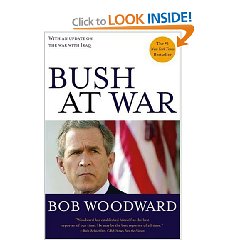
As America confronts the very real probability that the Administration manipulated and distorted and fabricated intelligence in order to go to war against Iraq, and as calls rise for the impeachment of the President and the Vice President (the one naive, the other conniving), this book takes on added value–Bob Woodward has done a superb job of documenting both the “keystone cops” nature of the Administration's “strategic deliberations”, and the very specific manner in which Paul Wolfowitz (too controversial to be Secretary of Defense but a power in his own right) guided the Bush team toward a war on Iraq as a “solution” to problems they could not deal with directly, to wit, the war on terrorism.
There is an Alice in Wonderland quality to this book–or more properly stated, to the conversations that are quoted among the principals. Their wandering short-hand conversations, the degree to which the President is mis-led about our capabilities, the inability of the Secretary of Defense to answer a direct question, always having to go back to his office for an answer–the entire book is, as one reviewer suggests, practically a recount of a handful of recollections about scattered conversations, as if the center of the world were one room in the White House, and nothing outside those walls really mattered. It is also somewhat revisionist–as I recall from published news at the time, all of the principals wanted to delay the taking of Kabul until the spring, and it was President Putin of Russia, speaking directly to President Bush, who made the case, based on his superior intelligence sources on the ground, for how quickly Kabul would fall, leading to the US acceptance of rapid advances by the Afghan warlords. The absence of this essential and openly known fact casts doubt on the entire process of writing the book, and how information was researched and selected for inclusion.
There are, however, some major gems that make a careful reading of this book very worthwhile and I list them for consideration by other readers:
1) The Directorate of Intelligence does not appear as a listed player–CIA special operations rather than CIA analysis appears to have been the DCI's best card to play;
2) The clandestine service, as Dewey Claridge notes in concluding his “Spy for All Seasons,” died in the 1990's, with only 12 case officers in one year's class–the book misrepresents the increase from 12 to 120 as stellar–it was actually a return to the norm before a series of mediocre leaders destroyed the Directorate of Operations;
3) The CIA had been “after” bin Laden for five years prior to 9-11, the DCI even “declaring war” on him, to zero effect. Worse, post 9-11 investigations determined that bin Laden had been planning the 9-11 attack for two years without any substantive hint being collected by U.S. intelligence–and at the end of the book, Rumsfeld reflects on how the three major surprises against the U.S. prior to 9-11 not only happened without U.S. intelligence detecting them, but we did not learn of them for five to thirteen years *after the fact* (page 320);
4) Presidential-level communications stink–the Secretary of State could not talk to the President when flying back for seven hours from Latin America, and the National Security Advisor could not get a reliable secure connection to the President from her car right in Washington, D.C.
5) The Secret Service idea of security for Presidential relatives in a time of crisis is to take them to the nearest Federal Center–the kind that got blown up in Oklahoma.
6) Throughout the discussions, it was clear to the principals that the U.S. military is designed to find and destroy fixed physical targets with obvious signatures; it cannot do–it is incompetent at–finding mobile targets, whether vehicles or individuals (cf. page 174)…and of course as General Clark documented in his book, and David Halberstam repeats in his most recent tome, and as the principals learned again vis a vis Afghanistan, the U.S. Army does not do mountains.
There are three remarkable aspects of this story, only one even remotely hinted at in the book: we failed to get bin Laden. The CIA went to Afghanistan with the right orders: “bin Laden dead or alive.” They promptly forgot their orders and settled for spending $70M to play soldier. The two stories that are not told in this book, but are clearly apparent: 1) Russia saved the day, both for the CIA and for the Department of Defense; and 2) Saudi Arabia never came up as a serious problem that needed to be dealt with sooner than later.
Finally, and this only became clear to me after the early months of 2003 when the obsession of a few people in the Administration brought the world to a crisis over Iraq, the book provides really excellent documentation of how a tiny minority, led by Paul Wolfowitz, basically pushed the President to treat Iraq as an alternative to substantive action on global terrorists networks, and the book documents how the uniformed leadership of the Pentagon clearly opposed this line of thinking that is unsupported by intelligence, either on Iraq, or on the relative threat of Iraq (not imminent) in relation to many other threats that are both more imminent and more costly if not addressed now.
This is a useful book, worthy of reading, but the real story with all the details will not be known for some time. However, in the aftermath of the failed effort in Iraq, and the clear and compelling evidence that the American people and Congress were deceived about the Iraq threat, this book has an added luster, an added value, and become a “must read.”
Other books (see also my lists, one on Evaluating Dick Cheney, the other on The Case for Impeachment).
Vice: Dick Cheney and the Hijacking of the American Presidency
Running on Empty: How the Democratic and Republican Parties Are Bankrupting Our Future and What Americans Can Do About It
Breach of Trust: How Washington Turns Outsiders Into Insiders
The Broken Branch: How Congress Is Failing America and How to Get It Back on Track (Institutions of American Democracy)
Independents Day: Awakening the American Spirit
Day of Reckoning: How Hubris, Ideology, and Greed Are Tearing America Apart
The Tao of Democracy: Using Co-Intelligence to Create a World That Works for All
A Power Governments Cannot Suppress
Democracy's Edge: Choosing to Save Our Country by Bringing Democracy to Life
Society's Breakthrough!: Releasing Essential Wisdom and Virtue in All the People