I am adding this book to my list of excessively expensive books. I only list those books I would havb bought had the price been reasonable. It cost the publisher less than $5.00 to print this book. Amazon pays 45% of the retail price, so call it a $25 return. That is too much and completely contrary to the desperate need for making it easier for information to be shared.
I urge all authors to post free online copies of their work and to retain original copyright as we do at OSS.Net and Earth Intelligence Network.
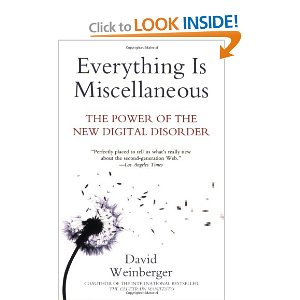
I totally disagree with the reviewers that pontificate against this book. It is not a techno-geek book, or a philosophy book, it is simply a common sense overview that I personally consider to be educated, helpful to the point of essential. At $16, with the Amazon discount, this book is a bargain.
I started with the index, and immediately discovered Meta-Data had 18 lines.
The book opens with examples from Staples (“hacking the physical”) to Apple iTunes (end of bundling) and I am immediately charmed by the combination of an end to fraudulent store organization (Giant supermarket moves everything from one week to the next to force searching which increases impulse buying) and an increase in focus on serving the individual rather than serving up a “one size fits all” solution. Separately I am looking at Chinese medicine for a health intelligence book, and this resonates.
Early on one sees the author agreeing with Jean Francois Noubel (the end of the pyramidal organization) and Jim Rough (rise of the circle of citizen wisdom)–I myself enraged the secret intelligence mandarins by announcing in the 1990's that “in the age of decentralized information central intelligence is an oxymoron.” The author is one of the gurus of what is becoming known as the axis of Cognitive Science and Collective Intelligence (the Art), and he and another 54 authors are brought together in the first collective work of its kind, Collective Intelligence: Creating a Prosperous World at Peace which is also free online in full pdf or chapter docs. Disclosure: I published the book–I do not know the author personally, but Jock Gill, a gifted communicator, exposed me to the author's earlier work on Open Spectrum, something that inspired my own informal views on “Open Everything” and unlike most of the other contributors that were identified by Tom Atlee or Mark Tovey (the editor), I personally sought his contribution to the book because of my very high regard for his “take” on all this.
I bought the book as a fan already, but the content easily validates my appreciation The discussion of first order pigeon-holing (the Weberian concept of bureaucracy applies), second order cross referencing (naturally limited and often wrong in early generations–Library of Congress and Dewey Decimal System are toast), versus unlimited tagging, chunking, clustering, socially-informed selection, and other aspects of the power of the collective, are all illuminated by this book.
I am further impressed early on with his stellar discussion of Mortimer Adler and the limitations of alphabetization. I was a penniless graduate student when I discovered the Great Books, and as a young officer, spent my first $700 acquiring a set. The Syntopicon that the author mentions in the book is better understood by the image I introduce above, something I created in 1979, my second of four analytic models (the first was on predicting revolution across all domains).
I have two notes at this point:
1) Truth or what can be known constantly changing, a fixed or slow to adapt “index” process cannot scale or survive.
2) 2008 election is already lost–neither candidate offers us what we deserve: listening instead of stump speeches; appointed cabinet and balanced budget now, as part of the campaign, instead of empty promises; and 24/7 interaction with all 65 political parties, instead of focusing on the one third that is their base and a slice of the middle third.
He emphasizes that knowledge is not top down, and with a tip of the hat to Kirkpatrick Sale, author of Human Scale and also facilitator for the nation-wide network of 27 separatist movements, I also post above an image of Epoch B “bottom up” leadership that none of our world leaders understand.
Page 80, discussion of Ranganathan (India) Colon Classification system impresses me. I think to myself, wow, needs to be integrated into Pierre Levy's Information Economy Meta Language, or IEML.
The middle of the book discusses–engagingly, I feel–how the digital world enables infinite variations in relationships and labels that can in turn create infinite variations of just right, just in time, just enough visualizations.
Crowd tagging leads to sub-set clustering which leads to contextual sense-making.
He spend time on Wikipedia. I admire Jimbo Wales and try to attend the Wikimanias, but I have given up on Wikipedia because in the case of the Open Source Intelligence (OSINT) page, I had to give up–while the author would have me engage and patiently lead the recalcitrant along (I have 20 years experience with that in the real world) I have come to a different conclusion: I believe that anyone should be allowed to CREATE, but only master moderators should be allowed to destroy.
The summary of the book's message is offered by the author with four concepts:
1) Filter on the way OUT, not in (this is the difference between the read only publishing model, and the read-write Creative Commons model)
2) Put each leaf on as many branches as possible–unlike the physical world, each leaf can have infinite lives
3) Everything is meta data and everything can be a label (he provides a fine discussion of bar codes, RFIDs, and Thinglinks)
4) Give up control. He admires Wikipedia for doing precisely that. When I first started the modern OSINT movement in 1992, I coined the phrase, “Give up control to gain control” meaning that centralized intelligence had to give way to decentralized sharing and sense-making. The spies still don't get it, but public intelligence in the public interest is here to stay. A corollary here is that the best approach is to include all–optimize inclusiveness and diversity; and where there is conflict or disagreement, postpone exclusion or resolution, more data later will make it easier and easier to come back to…
The final section of the book deals with mapping the implicit, mining the clouds of tags, creating an infrastructure of meaning with infinite potential. I have a note: unites the eight tribes of intelligence (governmenbt, military, law enforcement, academia, business, media, non-profits, and civil societies including religions and labor unions).
Other flyleaf notes:
+ Stupid works. Keep it simple and let it evolve on its own.
+ Bit by bit, not all at once. Provide for innovation at the intersections and on the margins
+ Kind of and sort of rule, not the black and white that did rule
+ I learn of Valdis Krebs and his concepts of social cartography
+ I am engaged with the discussion of information sprawl and natural typologies
+ The author concludes that the search for knowledge will constantly struggle between the simple and the complex (sources and methods).
+ Going meta is what is so cool about web ecology and evolution.
The author does NOT say this, but I mark his book down as being in favor of the human web of sense-making beating out the semantic web and machine learning schools.
Page 230, this is a quote that really grabs my attention: “It's not about who is right and who is wrong. It's how different points of view are negotiated, given context, and embodied with passion and interest. Individual thinking out-loud now have weight, and authority and expertise are losing some of their gravity.” The rest of this page is equally good.
I am surprised to learn that the author holds a PhD in philosophy, and that he advised Howard Dean. I am not surprised to learn that he has been twice renewed as a fellow at the Berkman Center.
There are many others, most obvious. Please do see the two images I post above–I firmly believe that the last eight years were a gift from heaven, a necessarily catastrophic gutting of our Nation so that we might properly conclude that both political parties stink with corruption, and it is time we put We the People back into the Republic, 24/7. This book is a solid brick in our foundation for understanding why this is both possible, and necessary.
Superb Re-Discovery of Core Knowledge, Presents New Insights,
July 4, 2009
David N. Gibbs
At the age of 56, having been educated in the 1970's when political science created “comparative studies” as a ruse for avoiding field world and foreign language mastery in favor of statistical comparisons from afar, I am now quite accustomed to seeing each generation rediscover core knowledge.
Even more distressing for one who loves books as artifacts of human wisdom, is to see each generation re-discover knowledge known to earlier generations, without citation. Scholarship seems to be on a wheel making little forward progress, at least in the humanities.
This is a fine book. It is exceptional for both its clear-eyed understanding of the combination of evil and banal ignorance that characterizes those in power, whether of one party or another. In the 1970's, for the US Institute of Peace, I wrote that the greatest threat to peace was the cataclysmic separation of those with power from those with knowledge. This book manifests all of that brilliantly.
It is also exceptional in this era for being a clear-eyes appraisal of the evil of military intervention. This again is not new knowledge, but it is helpful to have this generation be reminded.
Great evil has been done “in our name,” for the basest of reasons. I pray that our rising generation of digital literati will not be as ignorant in power as those who now surround world leaders–sychophants, dilitants, and craven opportunists.
Not listed on Amazon, but available via the web from the UK, is Ben Gilad's book Blindspots, which I continue to regard as the single best work for a CEO willing to consider the possibility that their information is inevitably filtered, biases, incomplete, and late.
Good Intentions, Some Misrepresentation, July 5, 2008
Arnaud de Borchgrave
The basic idea being executed by CSIS is sound: identify top experts and get them to discuss the terrorist threat and particularly how it is morphing and developing.
Unfortunately, CSIS does not do citation analysis, and builds its networks the same way the US intelligence community does, drawing on a limited number of individuals known to the expert in charge.
Also unfortunately, CSIS does not do multi-lingual capture and analysis, something the Foreign Broadcast Information Service (FBIS)/Open Source Center (OSC) is finally trying to get a grip on, but they lack the expert linguists across the 12 variants of Arabic and the other 32 languages necessary to fully map socio-economic and ideo-cultural mass movements and micro-gangs.
At 84 pages this rates four stars for good intentions. In the comment I provide a URL for the Earth Intelligence Network. At the menu item labeled EarthWiki, the Amazon reader can see the top authorities identified by citation analysis for all ten of the high-level threats facing humanity (terrorism is ninth, and not as a threat but rather for its potential in causing mass casualties).
Brilliantly Conceived and Executed, Totally Absorbing, July 5, 2008
Helmut K. Anheier
Half the book is text and half superb illustrations and charts.
The publisher has failed to provide a table of contents, the easiest way to make it instantly clear to any prospective purchaser that this book is quite unusual in its scope and weight.
This is the first book in a series, the next two will focus on culture and economy, and then on culture and politics.
Close to 50 contributors, and a process of conferences in advance of the book's preparation, assure the quality and diversity of this offering.
Chapters 1-6 are introductory, each by different authors or pairs of authors, focusing on approaches and developments in the cultural dimension of conflicts and tensions.
Chapters 7-13 discuss different regional realities, including China and how the US cultural wars went global (no focus on the global class war in this book).
Chapters 14-17 discuss tensions; chapters 18 & 19 values, and chapters 20-22 migration into respectively, the USA, Argentina, and Malaysia.
Chapters 23-27 introduce the concept of culture as a tool for preventing and resolving conflict and are followed by a massive resource section, the cultural indicators suite.
My fly-leaf notes from the text half of the book:
+ Globalization can weaken social agencies and impose suffering on minorities
+ PERCEPTION of fairness or unfairness a major factor
+ Cultural entrepreneurs (e.g. Islamic clerics or American ministers) can hijack culture for their own ends (e.g. influence or wealth)
+ State fragmentation or shrinking reduces social safety nets
+ Globalization seen differently by varied groups
+ Lack of solid data on culture and conflict
+ Culture now transnational and subnational
+ Globalization equals competing world views in contact and collision
+ Culture moves globally as knowledge, artifacts or goods, and people in migration
+ Four general cultural protagonist groups:
– Davos Culture
– Faculty Club
– McWorld
– Religious revival
+ Globalization and global threats not being adequately addressed at global scale (e.g. the UN and Red Cross are not cutting it)
+ Identity politics can become conflictual–religion amplifies social differences
+ Huntington is anti-thesis to this book, a cliché
+ Worldview more useful term than civilization
+ Cultural conflicts are manufactured
+ Cultural heritage is a collective memory
+ When ethnic immigrant unemployment if 3 to 4 times that of natives, this invites conflict
+ Civil wars on rise and ethno-nationalist up to 90% from 25% in 1935
+ “Cultural practice” is a new set of competencies for dealing with the reality of conflict among groups
+ Theater can be used to role play and articulate repressed anger
+ Memory wars waiting to erupt
+ Cultural imperialism furthers immoral capitalism
+ Culture can help reconcile differences but cannot compensate for lack of water, food, shelter, security
+ Resistance strategies of Canada, Malaysia, and Kazakhstan reviewed
+ Fascinating chapter on Singapore fails to mention four official national languages: English, Mandarin, Malay, and Hindi
+ European model emphasizes somewhat imperfectly:
– Jobs and growth
– Economic policies
– Flexible labor
– Knowledge economies
– Investment in education
– Human rights
– Ecological issues
– Immigration
– Aging population
– Public reform
+ Fourth world: immigrants with no rights or recognition
+ China has seen rise of nationalism, anti-Americanism, cultural conservatives
+ On balance China's leadership has successfully managed Chinese capitalism and cultural shifts
+ USA in confusion, experiencing a 4th great awakening since 1975
+ Fault lines are North versus South, Arabs versus West, Religion versus Identity Politics, Europe versus USA
+ Mediating or cross-cultural “concord” organizations are needed:
– Logic of collective investment
– Promote overarching values
– Balance bridging and bonding
– Establish rules of engagement
– Recognize and reward investment
– Prevent proselytizing
– Acknowledge and receive legitimacy
– Avoid “gotcha”
– Accept incomplete understanding or less than full acceptance
– Support single-community endeavors
– Develop leaders
+ Citizen radio in Colombia helped (I think of multi-media Internet and cell phone broad and narrowcasting
My word limit prevents me from doing this book full justice. I hope someone else will provide a good overview and review of the second half of the book where the indicators are developed. While similar to Banks & Textor in the 1970's, and to many of the “State of ….” Graphical and Visual Atlases, I found this book to be completely engrossing and extremely worthwhile. Worth every penny. A signal contribution.
Have Ordered Book to Do It Justice, Initial Reaction is Pooh, July 12, 2008
Michael Heller
EDIT of 11 August 2008: Not going back to the book. Glad I gave it four stars to begin with, brilliant on one idea in narrow context, but disappointing in relation to immoral capitalism, breaches of political trust, true costs, cradle to cradle, the power of we, and so many other bigger ideas, just not going to do this a third time.
EDIT of 19 July 2008: After a second pass, I see one idea that I did not recognize at first: that unlike MEGA-ownership (e.g. destruction of all family farms), it is MICRO-ownership that the author addresses. HOWEVER, this is largely a specious distinction for two reasons: first, all the patents tend to be owned by MEGA organizations (including one recently created to do just that–buy patents as a basis for litigation); and second, micro-ownership by micro-people is easily resolved with money. I continue to see a lack of strategic perspective on how to restore the Commonwealth of the Republic by firing Congress, having a second Constitutional Convention, creating an amendment that restricts personality protection to individuals born in the USA of at least one citizen-parent, and so on. In the middle of a Hackers on Planet Earth conference, so the detailed dissection will have to wait a week.
EDIT of 15 July 2008: I have spent an hour with this book. It is a strange mix of interesting detail, facile assumption, grotesque naivete (or disingeneousness), along with some robust ignorance, topped off with extraordinarily detailed property law discussions to the exclusion of all else. The INDEX does not list the words Corruption, Crime, Culture, Ethics, Politics, Public Interest, or White House. Congress has five (I am *not* making this up) references. There is no bibliography, something I find especially annoying. The author is oblivious to key references (for example, in his discussion of spectrum, he makes no mention of the single most important reference in recent time, David Weinberger on “Open Spectrum.”)
Case in point: the author goes on about how 25 more runways would solve all our air traffic congestion problems. He evidently has no clue, or does not wish to dilute his point, about the alternatives to “hub” airline travel, among which NASA and (now DayJet) include point to point aviation; and of course high-speed trains,as well as a restoration of home rule, eat local, and so on.
At first serious glance (one hour), this book fails to factor in white collar crime, organized crime, political crime, or public ignorance. To his credit the author states, in a rather low-key fashion, that the extension of copyright may not be in the best interests, but the reader must struggle to find harsh detailed references about how Disney and the music and film industries have orchestrated billion dollar corruption and mass deception campaigns to steal from the public.
Bottom line: when I finish reading this and dissecting it, I am sure it will be a weak four. My original pre-evaluation remains valid. Should it be weakened by a full reading of this book, I will be the first to say so.
SIDE NOTE: The rapid posting of several rather shallow reviews is not unusual, what *is* unusual is the equally rapid number of positive votes for reviews that generally lack specificity or any evidence of familiarity with broader literatures and larger contexts. Could the publisher be stacking the deck? Am interested in a co-reviewer willing to dialog as we dissect this book together. My email is bear/oss.net.
—original pre-assessment below—
This book is getting enough traction, but strikes me as very out of touch with a broad range of libertarian, collective intelligence, and citizen home rule, to the point that I expect my own review will be negative.
Let's start with corporate personality. The limited liability of corporate officials who have looted one fifth of the financial value, funded two dysfunctional parties, and the limited accountability of public officials who have sold public land and public spectrum to corporations below market value, while refusing to invest in local education and welfare, are all part of a massive decline of the Republic.
Of course too much private ownership is bad for the economy. Duh.
I read a lot, so my angst and my presumed annoyance with this book and its putative naivete about how we can free innovation may be more aggressive than many might think the author deserves. Who does he think sold off bandwith rather than supporting open spectrum, and how much were they bribed to betray the public interest?
I won't mention the books I have written, edited, or published, but I will say that I stand in shock and outrage as America (the portion that reads–NASCAR folks do not, see my review of Hunting with Jesus) is tillated by this “cool idea.” Cool? It was cool in the 1970's when Limits to Growth, Global Reach, Silent Spring, and all the other classics came out. The problem is that We the People allowed money to talk while abdicating our role as armed and informed, to keep government honest.
I'll go with Lawrence Lessig on eliminating corruption, Yochai Benkler on the wealth of networks, Mark Tovey on collective intelligence, Jim Rough on Society's Breakthrough, and on and on and on (true cost, natural capitalism, triple bottom line, buy-cott).
A full review by next week-end. For now, based on multiple reviews and what the publists have shared, this book merely annoys.
Home rule. Eat local. Take back our open spectrum (see comment for my “Open Everything” keytone to Gnomedex 2008. I am scheduled to appear at the last meeting of Hackers on Planet Earth 18-20 July, in New York City.
We do not lack for good ideas. We lack for outraged citizens (Lou Dobbs does not count unless he learns the ten high-level threats and twelve core policies that he must address), honest politicians, and accountable corporations. And all of those live or die on how inert we are in both our thinking and our buying habits. We are a dumb nation led by a crooked government with war criminals in charge of the Executive. Bah humbug.

 Exhorbitant Pricing, June 22, 2008