Strategic Comments Expanded Below: 01 NATO does not know 80% of what it needs to know; 02 NATO does not plan for 60% or more of what it needs to plan for (all ten high-level threats instead of just war and terrorism); 03 NATO needs to plan for de-Americanization of NATO and Europe; 04 NATO needs to help EU and EU police plan for the de-Nazification of Europe including the retirement of all GLADIO arms, cash, and personalities; 05 NATO could and should shift toward becoming a global peace-building enterprise orchestrating military contributions to Whole of Government and Multinational Multi-Agency programs that apply Open Source Everything Engineering (OSEE) to the achievement of the UN Sustainable Development Goals (SDG).
The end of peacekeeping, and what comes next for Canada’s soldiers
Mr. Trudeau loves the nostalgia of the Canadian peacekeeper and wants to pursue it as an idealized brand. The answer is the new Peace and Stabilization Operations Program. Up to 600 Armed Forces personnel will be deployed, in conjunction with the United Nations, to hot spots in Africa and elsewhere. These men and women will serve as ground troops, provide police training, and offer medical and engineering expertise. Afghanistan redux? Quite possibly.
The United States has long been a target of hybrid warfare by states seeking to disrupt or influence U.S. decision-making. Hostile activities can be categorized under four paradigms: nullification of political actors – creating discord within a constituency so that it cannot effectively unify around a policy, or undercutting the credibility of a prominent policymaker who champions unwanted outcomes; assistance to anti-government movements – identifying elements in society which are willing to attack (rather than participate in) the policymaking process with vitriol or violence; fomenting distrust of the U.S. policymaking process, in order to sap its legitimacy; and appearing to fill needs / wants that the U.S. government cannot and thereby supplanting the U.S. government in a specific area. (Of course the countries that have been most active in this area – Cuba and Venezuela – have been unable to sustain their own states.)
Constructing houses out of mud with a 3D printer … this looks like a great advance for getting building costs down to what can be afforded locally just about anywhere!
The future of affordable (and sustainable) housing may lie with 3D printing. The World’s Advanced Saving Project (WASP) has unveiled the world’s largest delta-style 3D printer, which can build full-size buildings out of mud and clay for nearly zero cost. The massive BigDelta printer stands 12 meters tall (40 feet), and it's nearly completed its first house at a cost of just 48 euros so far. Read more, watch video, see compelling photographs.
Training Offered: Austere Operations Centers in support of Civil-Military Operations (Transitioning to Phase IV)
Abstract: Complex contingencies often require military organizations to adapt to novel challenges. Military forces, especially those involved in supporting civil military operations and special operations require a clear understanding of what capabilities civilian organizations bring to bear both to facilitate civil operations as well as to facilitate emergency operations such as the recovery of kidnapped personnel.
The course outlined in this proposal will provide attendees with a clear understanding of what kinds of technologies and operational techniques civilian organizations use to support their operations. The course is also designed as an information exchange so that military personnel can become more familiar with the sensitivities and challenges of civil-military operations from the civilian side.
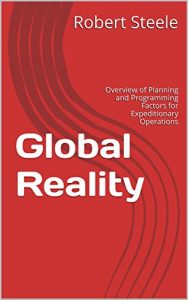
This is the author's preliminary draft of the second of three monographs focused on the future of the US Army as an expeditionary force in a complex world that is rapidly decentralizing while also facing major development challenges. This second monograph (the first presented a notional Grand Strategy for discussion) presents the holistic analytic model and the resulting strategic generalizations from the Marine Corps’ original study, Overview of Planning and Programming Factors for Expeditionary Operations in the Third World (Marine Corps Combat Development Command, March 1990).[1] The model is neither complete nor current – it is a starting point for reflection. A new comprehensive model is needed that supports Grand Strategy not only across the D3 – Defense, Diplomacy, and Development – planning and programming domains, but across Whole of Government (WoG) as well, and ideally, also into the multinational and “eight tribe”[2] conceptual space as well – future operations demand the full integration of both estimative intelligence and operational inclusion of all elements of society, not just government – military.
UK one of only four major Western economies identified as ‘low risk’ in new Modern Slavery Index
Modern slavery constitutes a ‘high’ or ‘extreme risk’ in 115 countries, according to a new global ranking released by risk analytics company Verisk Maplecroft. The research concludes that Asian and African commodity producers and manufacturing countries pose the greatest challenge to companies navigating new legislation on supply chain disclosure, such as the UK Modern Slavery Act. Significantly, the Asian heavyweight exporters of China and India feature in the ‘extreme risk’ category, alongside important natural resource hubs, including DR Congo, Iran and Côte d’Ivoire.

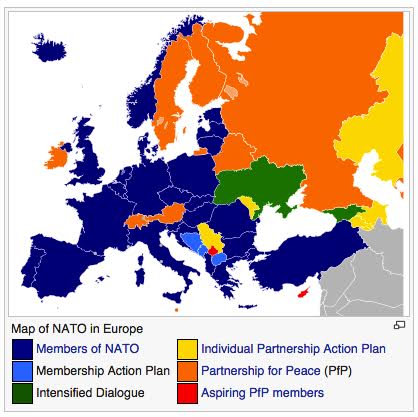 Strategic Comments Expanded Below: 01 NATO does not know 80% of what it needs to know; 02 NATO does not plan for 60% or more of what it needs to plan for (all ten high-level threats instead of just war and terrorism); 03 NATO needs to plan for de-Americanization of NATO and Europe; 04 NATO needs to help EU and EU police plan for the de-Nazification of Europe including the retirement of all GLADIO arms, cash, and personalities; 05 NATO could and should shift toward becoming a global peace-building enterprise orchestrating military contributions to Whole of Government and Multinational Multi-Agency programs that apply Open Source Everything Engineering (OSEE) to the achievement of the UN Sustainable Development Goals (SDG).