Berto Jongman: Clint Watts on Seven Flaws in US Strategy to Counter ISIS

04 Inter-State Conflict, 05 Civil War, 05 Iran, 07 Other Atrocities, 08 Wild Cards, 09 Terrorism, Government, Ineptitude, Military, Strategy
0Shares
Berto Jongman
Berto Jongman

Seven Flaws In the U.S. Strategy to Counter ISIS

(Editor's Note: This blog post is derived from Clint Watts' Ginsburg Lecture delivered at the National Liberty Museum on September 16, 2014.)

The past week’s debate on how to counter ISIS has proven just how effective terrorism is as a tactic for extremist groups.  Two videos showing the beheading of American hostages have provoked the largest U.S. response since the attacks of 9/11, compelling President Obama to hastily gather up a strategy to counter ISIS. Aside from the general confusion over what to call the group, there is even greater disagreement over what to do.  Overall, I don’t disagree with most of the actions the U.S. is taking to counter ISIS, but I am baffled why ISIS, America’s third or fourth most pressing national security concern right now, requires such a reaction.  The lesson for other extremist groups scattered from Morocco to Malaysia is clear – fly a black flag, film an atrocity and post it on the Internet and you too can capture the American media cycle and provoke a U.S. response.

LIST ONLY

1. Syrian Civil War
2. Turkish Border
3. Double-Edged Sword of Saudi Arabia
4. Arab Partner Nations
5. Iran is a bigger adversary to the US than ISIS
6. Sunni partners in Iraq
7. Shi'a dominated Iraqi Government

Read full article.

See Also:

ISIS @ Phi Beta Iota

Berto Jongman: US in 5-134 Wars (Right Now)

Government, Idiocy, Military, Peace Intelligence
0Shares
Berto Jongman
Berto Jongman

The US is now involved in 134 wars or none, depending on your definition of ‘war'

The White House spent much of last week trying to figure out if the word “war” was the right one to describe its military actions against the Islamic State.

US Secretary of State John Kerry was at first reluctant:

“We're engaged in a major counterterrorism operation,” he told CBS News on Sept. 11. “I think war is the wrong terminology and analogy but the fact is that we are engaged in a very significant global effort to curb terrorist activity… I don't think people need to get into war fever on this. I think they have to view it as a heightened level of counter terrorist activity.”

Kerry said similarly hedgy things during interviews on CNN and ABC.

By the next day, the Obama administration appeared more comfortable with the word war, yet hardly offered any more clarity. White House Press Secretary Josh Earnest told reporters, “The United States is at war with ISIL in the same way we are at war with Al Qaeda and its affiliates.”

The problem is that our traditional definition of “war” is outdated, and so is our imagination of what war means.

Read full article.

Chuck Spinney: Uri Avnery on the Obsolescence of the Nation-State

Cultural Intelligence, Government, Peace Intelligence
0Shares
Chuck Spinney
Chuck Spinney

Scotland on the Euphrates

The Obsolescence of the Nation-State

by URI AVNERY

Counterpunch, WEEKEND EDITION SEPTEMBER 19-21, 2014

[This essay originally appeared at http://www.avnery-news.co.il/english/index.html ]

TWO COUNTRIES competed this week for first place in news programs all over the world: Scotland and the Islamic State in Iraq and Syria.

There could not be a greater difference than between these two countries. Scotland is damp and cold, Iraq is hot and dry. Scotland is called after its whisky (or the other way round), while for ISIS fighters, drinking alcohol is the mark of unbelievers, who should lose their head (literally).

However, there is one common denominator of both crises: they mark the approaching demise of the nation-state.

Continue reading “Chuck Spinney: Uri Avnery on the Obsolescence of the Nation-State”

Electronic Frontier Foundation: Human Rights Require a Secure Internet

Advanced Cyber/IO, Civil Society
0Shares

effHuman Rights Require a Secure Internet

Between 15th-19th of September, in the week leading up the first year anniversary of the 13 Necessary and Proportionate Principles, EFF and the coalition behind the Principles will be conducting a Week of Action explaining some of the key guiding principles for surveillance law reform. Every day, we'll take on a different part of the principles, exploring what’s at stake and what we need to do to bring intelligence agencies and the police back under the rule of law. You can read the complete set of posts online. The Principles were first launched at the 24th Session of the United Nations Human Rights Council in Geneva on 20 September 2013. Let's send a message to Member States at the United Nations and wherever else folks are tackling surveillance law reform: surveillance law can no longer ignore our human rights. Follow our discussion on twitter with the hashtag: #privacyisaright

Human Rights Require a Secure Internet

The ease by which mass surveillance can be conducted is not a feature of digital networks; it's a bug in our current infrastructure caused by a lack of pervasive encryption. It's a bug we have to fix. Having the data of our lives sent across the world in such a way that distant strangers can (inexpensively and undetectably) collect, inspect and interfere with it, undermines the trust any of us can have in any of our communications. It breaks our faith not only with the organizations that carry that data for us, but the trust we have with each other. On a spied-upon network, we hold back from speaking, reading, trading and organizing together. The more we learn about the level of surveillance institutions like the NSA impose on the Net, the more we lose trust in the technology, protocols, institutions and opportunities of the Net.

Read full article.

Berto Jongman: Paul Krugman on Saving the Planet “For Free” PLUS New Book List

Earth Intelligence
0Shares
Berto Jongman
Berto Jongman

Paul Krugman: Saving The Planet ‘Might Be Free’

Economist and columnist for The New York Times Paul Krugman says he’s been reading “two new reports on the economics of fighting climate change” that prove saving the planet could be “cheaper and easier than almost anyone imagines.”

Here’s a sampling of the evidence that suggests to him that the “economics of climate protection look even better now than they did a few years ago”:

On one side, there has been dramatic progress in renewable energy technology, with the costs of solar power, in particular, plunging, down by half just since 2010. Renewables have their limitations — basically, the sun doesn’t always shine, and the wind doesn’t always blow — but if you think that an economy getting a lot of its power from wind farms and solar panels is a hippie fantasy, you’re the one out of touch with reality.

On the other side, it turns out that putting a price on carbon would have large “co-benefits” — positive effects over and above the reduction in climate risks — and that these benefits would come fairly quickly. The most important of these co-benefits, according to the I.M.F. paper, would involve public health: burning coal causes many respiratory ailments, which drive up medical costs and reduce productivity.

Of course, the wrench in the machine of Krugman’s last point is the utter lack of evidence that leaders in government and business run their cost-benefit analyses with entire societies in mind. Rather, they limit their concerns to their locales, social classes and enterprises—and sometimes, as in cases of control fraud, to themselves alone.

Continue reading “Berto Jongman: Paul Krugman on Saving the Planet “For Free” PLUS New Book List”

2014 The National Intelligence Strategy of the USA — 3 Strikes and Out

Corruption, Director of National Intelligence et al (IC), Government, Ineptitude, IO Impotency
0Shares
Click on Image to Enlarge

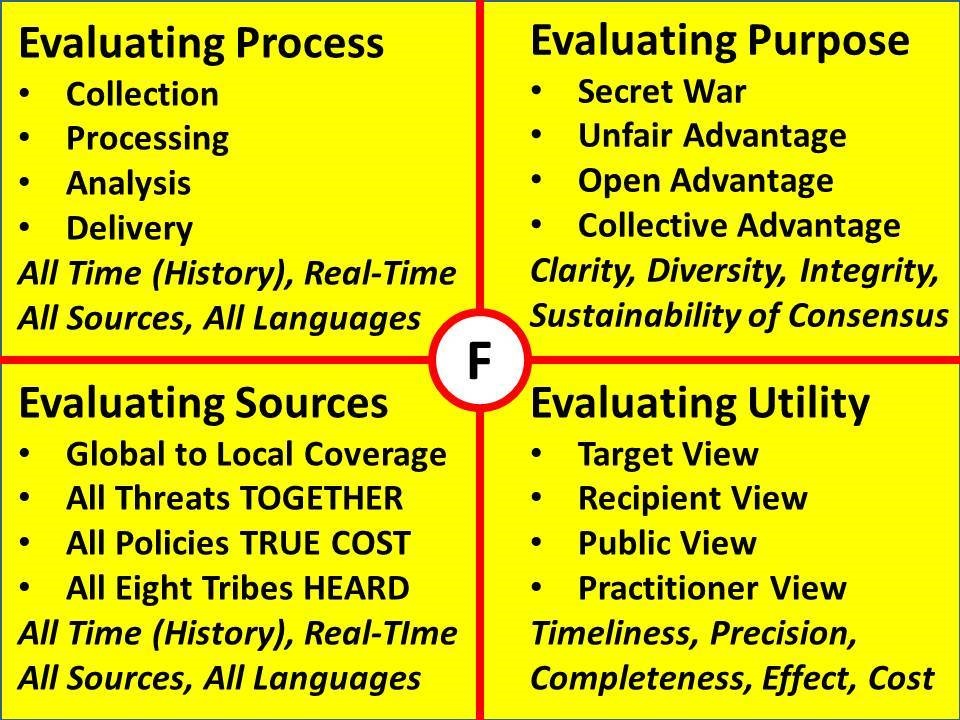
(U) 2014 US National Intelligence Strategy

STRIKE ONE: Refuses counterintelligence on domestic enemies.

STRIKE TWO: Refuses Whole of Government.

STRIKE THREE: Refuses Acquisition.

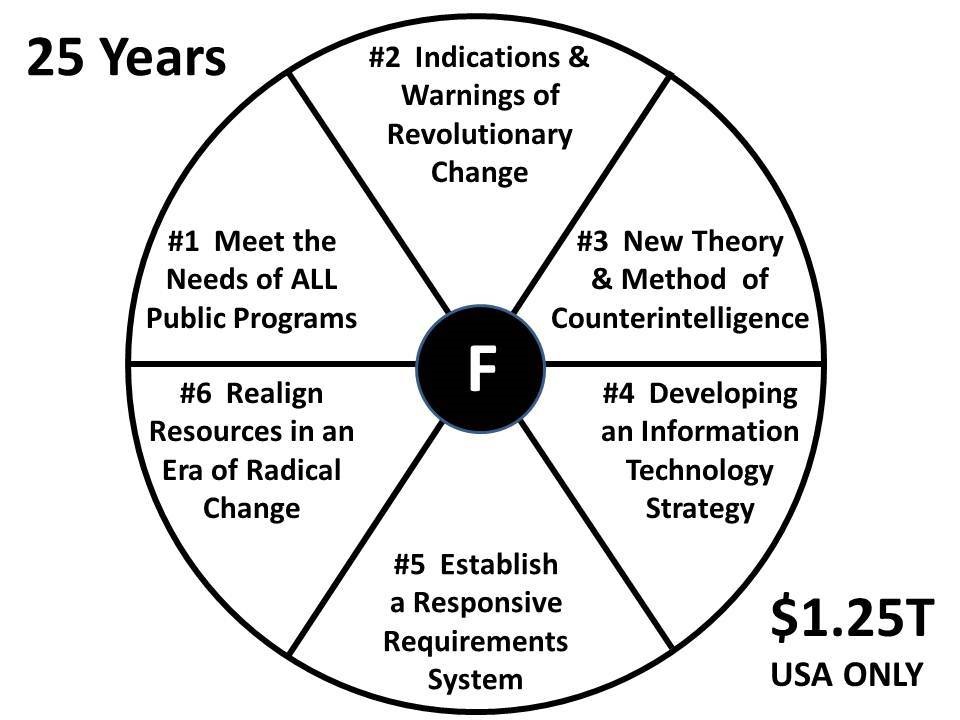
The six sucking chest wounds identified in 1990 continue. HUMINT/CI are dead in the water, followed by OSINT and mature holistic analytics integrating true cost economics. We continue to process 1% of what we collect by technical means, while being so far removed from human-centric ground truth about everything as to cause one to wonder, just who is the US IC supposed to be helping?

Keep the money moving, rah rah rah.

Click on Image to Enlarge

See Especially:

1989 Al Gray (US) on Global Intelligence Challenges

1990 Intelligence in the 1990′s – Six Challenges

See Also:

1989+ Intelligence Reform

1976+ Intelligence Models 2.1

1957+ Decision Support Story

Books By and With Robert Steele (includes Amazon links and free online links)

Worth a Look: Book Reviews on Intelligence (Most)


Stephen E. Arnold: Google as Architect of Cities?

IO Impotency
0Shares
Stephen E. Arnold
Stephen E. Arnold

Google and Its Possible Really, Really Big Ambitions

I read “Looking Past the Search Results: Google 2.0 Will Build Airports and Cities Says Report.” The “report” appears to be the work of an outfit doing business as “The Information.” The founder of The Information is Jessica E. Lessin. She was a Wall Street Journal reporter. She morphed into a “reportrepreneur.” (See About the Information for more about the company.)

The “report” costs money. The Independent’s summary of the main idea reveals:

Larry Page has set up a ‘company within a company’ dubbed ‘Google 2.0’ that will look at the tech giant’s long-term future – presumably for when advertising revenue from search traffic (inevitably) dries up.

The “report” suggests that Google may build airports and cities. I assume these will complement the Loon, Glass, Death, and other moon shot projects.

Continue reading “Stephen E. Arnold: Google as Architect of Cities?”