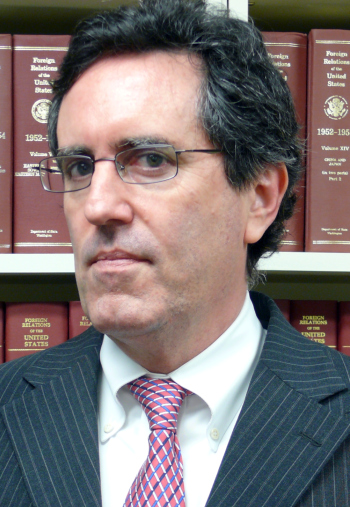
Steve Aftergood: HPSCI Seeks Continuous Monitoring of Security-Cleared Employees [We Do NOT Make This Stuff Up!]

Cultural Intelligence, Government, Idiocy
0Shares
Steven Aftergood
Steven Aftergood

HPSCI Seeks “Continuous Evaluation” of Security-Cleared Employees

Recent unauthorized disclosures of classified information might have been prevented if U.S. intelligence agencies “continuously evaluated the backgrounds of employees and contractors,” according to the House Permanent Select Committee on Intelligence (HPSCI).

In its new report on the FY 2014 intelligence authorization bill, the Committee would require intelligence agencies to “continuously determine whether their employees and contractors are eligible for access to classified information” by using all available transactional records and social media.

“Continuous evaluation allows the IC to take advantage of lawfully available government and public information to detect warning signals that the current system of five-year periodic reinvestigation misses,” the HPSCI report said. “That information might include: foreign travel; reports of foreign contacts financial disclosure information; checks of criminal, commercial marketing, and credit databases; and other appropriate publicly available information.”

The recently developed concept of continuous evaluation (CE) “allows for a review at any time of an individual with eligibility or access to classified information or in a sensitive position to ensure that that individual continues to meet the requirements for eligibility,” said Brian Prioletti of the ODNI National Counterintelligence Executive at a November 13 hearing of the House Homeland Security Committee.

“As envisioned in the reformed security clearance process, [continuous evaluation] includes automated record checks of commercial databases, government databases, and other information lawfully available,” Mr. Prioletti said. “Manual checks are inefficient and resource-intensive. The C.E. initiative currently under development will enable us to more reliably determine an individual’s eligibility to hold a security clearance or a sensitive position on an ongoing basis.” Continue reading “Steve Aftergood: HPSCI Seeks Continuous Monitoring of Security-Cleared Employees [We Do NOT Make This Stuff Up!]”


Eagle: Charles Hughes Smith on China Falling Flat

02 China, 03 Economy
0Shares
300 Million Talons...
300 Million Talons…

Take the Money and Run: China's Ill-Gotten Wealth Flees Overseas

The front door is covered with official pronouncements of “the China Dream” and blustery demands of hegemony, but the back door is choked with members of the financial/political Elite fleeing China and taking their wealth with them.The first thing to understand about China is there is always a front door and a back door to everything. The front door is what's presented to the outside world; the back door is for everything that doesn't fit the PR image created by the front door.

The front door presents positive “face,” the back door is for everything that would “lose face,” so it's hidden and never discussed, except in private, and only with trusted family or friends.

Click on Image to Enlarge

A friend who once worked for the Chinese government recently returned home after several years absence, and found that all her bosses had moved to the West: Australia, Canada, etc. These were typical officials: their base salary was low but they managed to buy multiple homes, support mistresses, have upscale autos, and so on.

In a word, ill-gotten wealth. There are tens of thousands of these beneficiaries of China's boom in credit and corruption, and they have all either fled (with their ill-gotten wealth) to the West or “safe-haven” East (Singapore, for example). Those who haven't fled yet have passports to a safe haven, and cash and homes overseas awaiting their arrival.

It is common knowledge that the offspring of top officials all have passports and homes awaiting them in the West.

That every one of your political bosses has left China is an astounding revelation into the mindset of those who have benefited most from China's boom: they obviously fear that some upheaval could strip away their ill-gotten wealth, otherwise, why not simply move to some wealthy enclave in China?

Continue reading “Eagle: Charles Hughes Smith on China Falling Flat”

SmartPlanet: The Open Source Business Model

Culture, Design, SmartPlanet, Software
0Shares

smartplanet logoFreedom from shareholders: how to succeed as an open-source business

For many launching businesses in today's fast-moving tech sector, the goal is to attract investors and shareholders, and eventually selling it all to an even larger company. One tech vendor, however, is bucking this urge, preferring instead to have a positive impact on its communities — both users and the cities in which it is locating offices. 

“A lot of companies are following that typical Silicon Valley path,” says Brian Cheung, CEO and co-founder of Liferay, Inc., a Los Angeles-based company which provides portal technology to organizations. “They’ve got their investors, and they’re aiming for that acquisition or that public offering. We're very conscientious about not doing that. We're still independent, privately held, with no outside capital.” The advantage to staying private is that becoming beholden to shareholders stifles innovation, he adds.

I recently had the opportunity to sit down with Cheung at Liferay's recent confab in San Francisco, in which he expounded on his company's unique philosophy toward innovation and community development. The company, which builds and distributes its software via an open-source model, is founded on the belief that innovation and growth comes from helping to make its customers and communities stronger.

Continue reading “SmartPlanet: The Open Source Business Model”

SmartPlanet: Voiceprints to Fight Fraud? 97% Accuracy, 100 Identifiable Attributes

Commercial Intelligence
0Shares

smartplanet logoWhat businesses want with your voice

You'd be forgiven for not wanting to give businesses a recording of your voice. They get your email address and your inbox is flooded; the same goes for physical address. But, if a business asks for voiceprint in the near future, it might actually be for your own benefit.

One way hackers go about breaking into your accounts is through the phone. They obtain a few pieces of information and pretend to be you to try and dupe workers at a call center into giving up your “forgotten password.” But now businesses are increasingly looking to collect voiceprints to verify your identity when you call saying you forgot your credentials. As BBC reports:

Digital voiceprints contain over 100 identifiable elements. And, by using complex mathematical algorithms and the latest high-definition audio equipment, voice biometric companies believe they can now identify people accurately more than 97% of the time.

Even identical twins, who share the same DNA, can be told apart from their voiceprints, making the technology reliable enough to be used as evidence in courts of law.

Like any biometric security, it's not a perfect system. Depending on how strict the system is, someone could use a recording of your voice. Still, it's working better than the alternative, so far. According to BBC, before Barclays Wealth started using voiceprints, 25 percent of fraud phone calls got past the bank's security system. That percentage has since dropped to zero.
Read more: BBC

Stephen E. Arnold: NSA and Google Compete for Internet – We All Lose

Commerce, Corruption, Government, IO Deeds of War, IO Impotency, IO Privacy, IO Secrets
0Shares
Stephen E. Arnold
Stephen E. Arnold

The NSA and Google Compete for the Internet, and We All Lose

An article posted on Tech Eye titled US Spying is Killing the Internet Claims Google explains the outrage expressed by Google when it was released that the NSA had tapped into their system in order to obtain user information. Google’s security director Richard Salgado warns that the US government’s snooping could eventually lead to a “splinter net” in which governments put up barriers and cause the market to be restricted.

The article explains:

“Salgado warned that the NSA operations led to “a real concern” inside and outside the United States about the role of government and the Foreign Intelligence Surveillance Court, which decides in secret on legal problems about electronic surveillance efforts.”

But is the lady protesting too much? Google has been accused of its own plans to take over the Internet, as this article titled Google’s Latest Scheme to Control the Internet May Surprise You investigates on Worldcrunch. Google Plus in particular might warrant extra attention. In spite of being considered a failure when likened to Facebook, the article suggests that comparison is faulty. The number of Google Plus members may be small, but more important is Google’s ability to track and store the information we input.

And the money talks:

“Perhaps the proof is in the numbers: Google generated $50 billion in 2012 revenue, $40 billion of it from advertising. And though 2.7 billion Facebook “likes” are being registered every day, its revenue during the same period was just $4 billion.”

So let Google worry about the NSA all they want. Some of us are preoccupied with our paranoia about another company, which the article sums up as a Keanu Reeves style matrix in which we will all stay happily ignorant of our dependence.

Chelsea Kerwin, November 27, 2013

Sponsored by ArnoldIT.com, developer of Augmentext

Tikkun Rabbi Michael Lerner: Lynce Pinkard on Revolutionary Suicide – Risking Everything to Transform Society and Live Fully

Collective Intelligence, Cultural Intelligence, Earth Intelligence, Peace Intelligence
0Shares
Rabbi Michael Lerner

Revolutionary Suicide: Risking Everything to Transform Society and Live Fully

by Lynice Pinkard

Tikkun, October 22, 2013

Global capitalism is a system, or rather, an interlocking network of systems. Permeating every area of our lives, it operates much like the Catholic Church operated in Europe before the Reformation. It transcends nationhood but is immersed in politics. Its faults and hypocrisies can easily be pointed to, but that does little to sway the hearts and minds of the vast majority of people who have faith in its ideals or power. Its influence permeates every aspect of our daily lives. It forms a universe that controls our entire life cycle and rituals that guide the cycles of our days. It shapes what we have come to expect and to view as “normal.” Indeed, it is more powerful than the church ever was; Marx nailed his theses on the door and capitalism has only grown in power, crushing its reformation in a way the Catholic Church never could.

Click on Image to Enlarge

It is, of course, ludicrous to believe that identity politics as it is conventionally understood could do much at all to halt the voracious appetite of a force this powerful. But it is similarly ludicrous to believe that all we need to do is to “give up identity politics” and do “real” and “important” work on capitalism, or to believe that if we address the economic system, racism will be resolved because it is secondary to economic oppression. White supremacy constantly works against our efforts to build principled coalitions to confront global capitalism.

The problem with narrow forms of identity politics is that they assume that groups of people organized around identity can achieve liberation from oppression in silos—in other words, as separate, individual identity groups. But the truth is that we are not individually salvageable.

I’d like to present an alternative to conventional identity politics, one that requires that we understand the way that capitalism itself has grown out of a very particular kind of identity politics—white supremacy—aimed at securing “special benefits” for one group of people. It is not sufficient to speak only of identities of race, class, and gender. I believe we must also speak of identities in relation to domination. To what extent does any one of us identify with the forces of domination and participate in relations that reinforce that domination and the exploitation that goes with it? In what ways and to what extent are we wedded to our own upward mobility, financial security, good reputation, and ability to “win friends and influence people” in positions of power? Or conversely, do we identify (not wish to identify or pretend to identify but actually identify by putting our lives on the line) with efforts to reverse patterns of domination, empower people on the margins (even when we are not on the margins ourselves), and seek healthy, sustainable relations?

Continue reading “Tikkun Rabbi Michael Lerner: Lynce Pinkard on Revolutionary Suicide – Risking Everything to Transform Society and Live Fully”