Put another way, the 1% have so thoroughly screwed the system that one adults working full time (or two adults working part-time four times) cannot support their children at the same time that social and other state services are collapsing.
Information and knowledge have been both feared and sought in the past. New information brings change, and change is often met with fear and resistance. In the past books were burned by the church and new technology destroyed by Luddites. The change that new information and knowledge brought was often regarded as threat to established interests. But inevitably with time, it brings benefits for all. New information changes our perception of ourselves, others and our environment. It breeds ideas and solutions for the obstacles we face and creates a positive feedback loop which is the driving force behind progress.
In prehistory people were educated by the demonstration of acquired skills directly to one another and from generation to generation. Ideas were communicated through storytelling, song and rituals, but it wasn't until approximately 3500 years ago symbolism and finally written language emerged. This drastically changed the way people learned, communicated and organized information because now it could be stored outside of the brain and retrieved later for use. Written language also helped reduce loss and corruption of information because recall was no longer limited to physical memory.
Water is destiny. And here, once again, is evidence of this. China's water and, thus, food problems hold tremendous implications for not just China but the world.
BEIJING — CHINA endures choking smog, mass destruction of habitats and food poisoned with heavy metals. But ask an environmentalist what is the country’s biggest problem, and the answer is always the same. ‘Water is the worst,” says Wang Tao, of the Carnegie-Tsinghua Centre in Beijing, ‘because of its scarcity, and because of its pollution.” ‘Water,” agrees Pan Jiahua, of the Chinese Academy of Social Sciences. ‘People can’t survive in a desert.” Wang Shucheng, a former water minister, once said: ‘To fight for every drop of water or die: that is the challenge facing China.”
He was not exaggerating. A stock image of China is a fisherman and his cormorant on a placid lake. The reality is different. The country uses 600 billion cubic metres (21,200 billion cubic feet) of water a year, or about 400 cubic metres a person-one-quarter of what the average American uses and less than half the international definition of water stress.
Water Security: Afghanistan Transboundary Water Resources in Regional Context
NATO Allied Command Operations (ACO) Civil-Military Fusion Centre (CFC)
Rainer Gonzalez Palau
Afghanistan Team Leader
Social and Strategic Infrastructure Desk Officer
This document outlines the global trends in water security and the threats to regional stability posed by the transboundary water resources. Moreover, the document presents salient details in the particular case of Afghanistan's transboundary water resources, reviews disputes over the four main international basins Afghanistan shares with its neighbouring countries, and introduces a framework to properly manage water resources. Further information on these issues is available at www.cimicweb.org. Hyperlinks to source material are highlighted in blue and underlined in the text.
Within the next twenty years, the global demand for water will exceed expected supply by forty per cent, according to a report by McKinsey & Company. Since “water security is the gossamer that links together the web of food, energy, climate, economic growth, and human security challenges,” a shortage of water will escalate food prices, disrupt energy availability, limit trade, increase refugee flows and undermine authority, says the World Economic Forum (WEF). If the worsening water security structural problem is unheeded, it will inevitably tear into various parts the global economic system. Illustratively, water was at the heart of the agricultural challenges that caused the unprecedented volatility in food prices between 2007 and 2010. As economies grow and societies develop more water is needed to match the accelerating demand for food and obtain energy to supply the rapidly increasing urban and industrial systems. At the same time rainfall and weather patterns shift and rivers and groundwater sources are becoming more polluted.
This report is divided into four sections: (i) global trends in water security issues and how these can affect global stability in the future; (ii) drivers of transboundary water management conflicts in Central and South Asia; (iii) overview of the four critical international basins that Afghanistan shares with neighbouring countries; and (iv) recommendations by experts for improving water management and avoiding conflict over transboundary water resources.
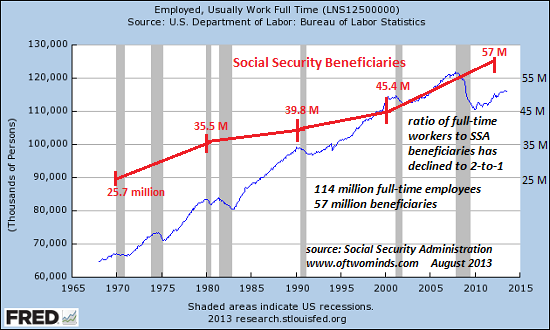
If stocks, bonds and real estate all decline going forward, where are pension funds going to earn their 7+% annual yields?If we look at the foundations of retirement–Social Security, stocks, bonds and real estate–it seems we may have reached Peak Retirement. Let's start the discussion by noting that the primary Federal retirement programs–Social Security and Medicare–are “pay as you go,” meaning the checks sent out to beneficiaries this year are funded by payroll tax revenues collected this year from workers.
As Mish and I (as well as others) have tirelessly pointed out, the “trust funds” for these programs are phantoms of imagination. When these programs run deficits, the government raises the money to fund the deficit the same way it funds all its deficit spending–by selling Treasury bonds.
Click on Image to Enlarge
These programs were founded on a demographic illusion, i.e. that the number of retirees (beneficiaries) would magically remain a small percentage of the workforce paying payroll taxes. Alas, the number of beneficiaries is rising fast while the number of full-time workers is stagnating.
Full-time employment and the number of Social Security beneficiaries: the ratio of full-time workers to beneficiaries is already 2-to-1, and set to decline. Below 2-to-1, either payroll taxes will have to icnrease or benefits will have to be trimmed, or some of both.
This year’s World Disaster Report was just released this morning. I had the honor of authoring Chapter 3 on “Strengthening Humanitarian Information: The Role of Technology.” The chapter focuses on the rise of “Digital Humanitarians” and explains how “Next Generation Humanitarian Technology” is used to manage Big (Crisis) Data. The chapter complements the groundbreaking report “Humanitarianism in the Network Age” published by UN OCHA earlier this year.
Most of America can’t imagine the evening news could look and sound any other way.
That’s how solid the long-term brainwashing is.
The elite anchors, from Douglas Edwards and John Daly, in the early days of television, all the way to Brian Williams and Scott Pelley, have set the style. They define the genre.
The elite anchor is not a person filled with passion or curiosity. Therefore, the audience doesn’t have to be passionate or filled with curiosity, either.
The anchor is not a demanding voice on the air; therefore, the audience doesn’t have to be demanding.
The anchor isn’t hell-bent on uncovering the truth. For this he substitutes a false dignity. Therefore, the audience can surrender its need to wrestle with the truth and replace that with a false dignity of its own.
The anchor takes propriety to an extreme: it’s unmannerly to look below the surface of things. Therefore, the audience adopts those manners.