Great right up to the line where he says nothing will change (emphasis added).
Phi Beta Iota: We agree with Brother Marcus — the line he has emphasizes tells us that Hagel will not be a change agent, he has agreed to support business as usual, and clearly has no close aides with the intelligence and integrity to get him on the right path. DoD will be a total loss for the next four years, continuing to be part of the problem instead of part of the solution.
Message to the Department from Secretary of Defense Chuck Hagel
As Written by Secretary of Defense Chuck Hagel, The Pentagon, Wednesday, February 27, 2013
UPDATED 1 Mar 2013 to add Comment from Paul Harper at Google+.
The US Government is incredibly stupid about counterintelligence. They learned nothing from the Falcon and the Snowman, and it is clear that the defense team for Bradley Manning will be able to bracket the charges with a) government misconduct as revealed in the cables merited disclosure; b) government ineptitude at failing to protect sensitive communications from easy internal theft; and c) more government misconduct in violation of the Constitution with cruel and unusual punishment.
The Army private charged in the biggest leak of classified material in U.S. history pleaded guilty to 10 charges Thursday and offered an impassioned defense of his actions, arguing that he sought to spark a national debate about what he described as the nation’s obsession with “killing and capturing people.”
The testimony marked Pfc. Bradley Manning’s first detailed account of his disclosure of a trove of U.S. diplomatic cables and military documents in 2010 to WikiLeaks, an anti-secrecy organization he said he approached after he was unable to entice The Washington Post and the New York Times.
FREE ONLINE BOTH LIVE AND AS DOWNLOADABLE RECORDING
If, in your deepest hopes and ambitions for a better self and a better world, you’ve sensed that something more is possible–yet has so far eluded us–you’re right.
I’m excited to be giving the Keynote address at the Social Media and Response Management Interface Event (SMARMIE 2013) in New York this morning. A big thank you to the principal driver behind this important event, Chuck Frank, for kindly inviting me to speak. This is my first major keynote since joining QCRI, so I’m thrilled to share what I’ve learned during this time and to my vision for the future of humanitarian technology. But I’m even more excited by the selection of speakers and caliber of participants. I eager to learn about their latest projects, gain new insights and hopefully create pro-active partnerships moving forward.
You can follow this event via live stream and @smarmieNYC & #smarmie). I plan to live tweeting the event at @patrickmeier. My slides are available for download here (125MB). Each slide include speaking notes, which may be of interest to folks who are unable to follow via live stream. Feel free to use my slides but strictly for non-commercial purposes and only with direct attribution. I’ll be sure to post the video of my talk on iRevolution when it becomes available. In the meantime, these videos and publications may be of interest. Also, I’ve curated the table of contents below with 60+ links to every project and/or concept referred to in my keynote and slides (in chronological order) so participants and others can revisit these after the conference—and more importantly keep our conver-sations going via Twitter and the comments section of the blog posts. I plan to hire a Research Assistant in the near future to turn these (and other posts) into a series of up-to-date e-books in which I’ll cite and fully credit the most interesting and insightful comments posted on iRevolution.
Complex Society in Radical Middle (December 2012), Bojan Radej*, Mojca Golobič**, Mirna Macur***. University of Ljubljana, Biotechnical Faculty, Department for Landscape Planning, 240 pp.
EXTRACT
Society is complex because it is composed of irreconcilable constituents. As a consequence, every important social issue is evaluated conflictingly as being both horizontally incommensurable (among interest groups) and vertically incommensurable (micro – macro). Social incommensurability (Munda) as a category concerns incompatible but legitimate social claims. When different principles of social primacy are applied, no objective basis exists for rational choice between alternatives (Wacquant). This raises concern for the possibility of holistic evaluation of complex social matters. Because of an aggregation problem (Scriven; Virtanen Uusikylä) our ability to reach wide social consensus on the content and process of social transformation is critically undermined. Hence it appears that increased complexity leads to the disintegration of contemporary societies.
Click on Image to Enlarge
We are of the opposite opinion! By definition, holistic evaluation of incommensurable social issue is not achievable in a direct way. An indirect approach is needed – such as in a mesoscopic perspective. Its core theoretical background derives from mathematics (Pythagorean Hipassus) and philosophy of science (Kuhn) because of their elaboration of incommensurability concept, complexity theory with the concept of meso (Prigogine, Wallerstein, Leontief, Dopfer, Easterling, Kok, and Rotmans), and theory of social integration (Giddens, Bourdieu and Wallerstein) in sociology.
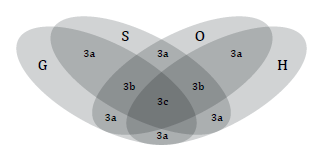
The major characteristic of meso evaluation is its capacity for addressing incommensurable oppositions in intersectional way. “Intersectional” means through overlaps between oppositions which take place only in non-essential instances that are only marginally important to the corresponding agents who pursue incommensurable claims. For example, social-economy is an overlap between conventional economic and social policies as two incommensurable components of sustainable welfare.
. . . . . . . . . .
Complex society in the meso
The five methodological studies have been accomplished with the aim to illustrate difficulties in holistic evaluation of complex social matters. The main findings: it appears that trend of social disintegration is not a result of increasing social complexity but only of oversimplified approaches (micro or macro) to evaluation of socially complex concerns. For eliminating oversimplification, a meso frame is proposed. In meso frame, social totality does not emerge from commensurable elementary parts piled up together but from partial and incommensurable wholes, which remain separated and as such cannot directly coalesce toward ever higher unity. Instead, these partial wholes sometimes compete and sometimes cooperate for more holistic characterization of social good and for more integral strategies for achieving it. Hence, social totality can be emphasised only indirectly, preliminarily, in an open way and educationally.