Bank failures: Towards an « Icelandation » of the banking crisis’ management
In the face of this shock, our team estimates that most countries, including the United States, will approach management of the crisis in an “Icelandic style”, i.e. not to bail out the banks and to let them collapse (16). We have already had a glimpse with the liquidation of the Irish bank IBRC which has given many people ideas: “How Ireland liquidated its banking albatross in one night” headlined La Tribune (17) admiringly. This possibility seems to increasingly be the solution in the event of the banks backsliding, for the following reasons: first, it seems much more effective than the 2008-2009 bailout plans judging by Iceland’s recovery; second, countries don’t really have the means to pay for new bailouts anymore; finally, one can’t deny that it must be a big temptation for leaders to get rid in a popular fashion of part of the debts and “toxic assets” which encumber their economy.
Many are only just getting their heads around the idea of 3D printing but scientists at MIT are already working on an upgrade: 4D printing. At the TED conference in Los Angeles, architect and computer scientist Skylar Tibbits showed how the process allows objects to self-assemble. It could be used to install objects in hard-to-reach places such as underground water pipes, he suggested. It might also herald an age of self-assembling furniture, said experts.
Smart materials
TED fellow Mr Tibbits, from the MIT's (Massachusetts Institute of Technology) self-assembly lab, explained what the extra dimension involved. “We're proposing that the fourth dimension is time and that over time static objects will transform and adapt,” he told the BBC. The process uses a specialised 3D printer that can create multi-layered materials. It combines a strand of standard plastic with a layer made from a “smart” material that can absorb water. The water acts as an energy source for the material to expand once it is printed. “The rigid material becomes a structure and the other layer is the force that can start bending and twisting it,” said Mr Tibbits.
Who has never been in the situation that he had a set of data where some of them just didn’t seem to fit. A simple adjusting of the numbers or omitting of strange ones could solve the problem. Or so you would think. I certainly have been in such a situation more than once, and looking back, I am glad that I left the data unchanged. At least in one occasion my “petty” preformed theory proved to be wrong and the ‘strange data’ I had found were corresponding very well with another concept that I hadn’t thought of at the time.
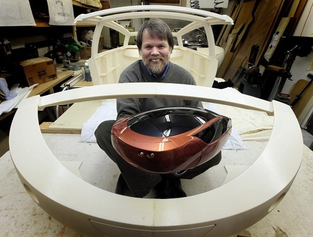
Kor and his team built the three-wheel, two-passenger vehicle at RedEye, an on-demand 3-D printing facility. The printers he uses create ABS plastic via Fused Deposition Modeling (FDM). The printer sprays molten polymer to build the chassis layer by microscopic layer until it arrives at the complete object. The machines are so automated that the building process they perform is known as “lights out” construction, meaning Kor uploads the design for a bumper, walk away, shut off the lights and leaves. A few hundred hours later, he’s got a bumper. The whole car – which is about 10 feet long – takes about 2,500 hours.
A German by birth, he was imprisoned in Nazi camps during World War II
At the camps he was waterboarded during torture sessions
Time for Outrage became an inspiration for Occupy Wall Street movement
Jill Reilly
MailOnline, 27 February 2013
Stephane Hessel
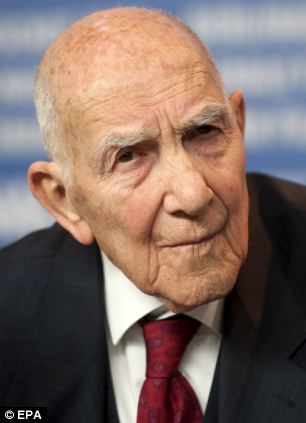
Stephane Hessel, the concentration camp survivor who inspired the Occupy Wall Street movement has died aged 95.
Mr Hessel who was a member of the French resistance passed away overnight in Paris according to his wife.
As a spy for the French Resistance, he survived the Nazi death camp at Buchenwald by assuming the identity of a French prisoner who was already dead.
As a diplomat, he helped write the U.N.'s Universal Declaration of Human Rights.
And at age 93, after a distinguished but relatively anonymous life, he published a slim pamphlet that even he expected would be little more than a vanity project.
But Mr Hessel's 32-page Time for Outrage sold millions of copies across Europe, tapping into a vein of popular discontent with capitalism and transforming him into an intellectual superstar within weeks.
Translated into English, the pocket-sized book became a source of inspiration for the Occupy Wall Street movement.
In the book, Mr Hessel urges young people to take inspiration from the anti-Nazi resistance to which he once belonged and rally against what he saw as the newest evil: The love of money.
This controversial, impassioned call-to-arms for a return to the ideals that fueled the French Resistance has sold millions of copies worldwide since its publication in France in October 2010. Rejecting the dictatorship of world financial markets and defending the social values of modern democracy, 93-old Stéphane Hessel — Resistance leader, concentration camp survivor, and former UN speechwriter — reminds us that life and liberty must still be fought for, and urges us to reclaim those essential rights we have permitted our governments to erode since the end of World War II.
“This slim but powerful volume answered the public's need for a voice to articulate popular resentment of ruling-class ruthlessness, police brutality, stark income disparities, banking and political corruption, and victimization of the poor and immigrants.” (The Nation )
“INDIGNEZ-VOUS! is creating the sort of stir in France Emile Zola did in 1898, when he published J'Accuse!” (The National Post )
“Like a song you hum or a film you recommend to friends, INDIGNEZ-VOUS! crystallises the spirit of the time. To buy it is a militant act, a gesture towards community and participation in a collective emotion.” (Liberation )
‘The book urges the French, and everyone else, to recapture the wartime spirit of resistance to the Nazis by rejecting the “insolent, selfish” power of money and markets and by defending the social “values of modern democracy”. (The Independent )
Also See:
Indignez Vous!/Time for Outrage! translations (FREE) – Version 1 | Version 2 (pdf)
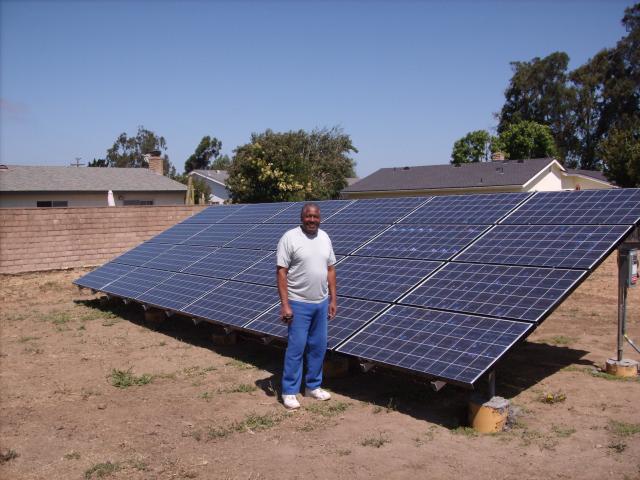
This is a picture of all of the electricity a family will need for the next twenty years:
Click on Image to Enlarge
Doesn't seem like much, does it?
It gets even better.
If every family in a community had an installation like this, the community would be close to never experiencing a blackout again.
On top of that, the community would be exporting energy. Wealth would be flowing into the community and not out of it.
Amazing, isn't it.
So, why doesn't everyone have an installation like this?
Until recently, even with government subsidies, it didn't make economic or technological sense except in extreme situations.
That's changed. DIY solar energy is now ready for prime time (I'm currently working on a Solar Energy report that blows the lid off of this — stay tuned).
Despite that, many people still don't have the upfront money needed to make it happen.
Here's an innovative way to solve that problem: Community Financing.
There was a time when science could be broken down into neat-and-tidy disciplines — straightforward things like biology, chemistry, physics, and astronomy. But as science advances, these fields are becoming increasingly specialized and interdisciplinary, leading to entirely new avenues of inquiry. Here are 11 emerging scientific fields you should know about.
In recent years the phrase ‘indigo-children’ has become a buzz-word for those youngsters whose intellectual potential significantly surpasses that of most adult scientists. While many remain skeptical towards the idea of the ‘genius youth’, one can hardly ignore the growing number of teenagers endowed with exceptional and often unprecedented talents in various spheres of science and humanities.
John Taylor Gatto, former school-teacher, outspoken reformer, and author of Underground History of American Education, on what the Public Education System is neglecting to teach the majority of kids and why we continue to churn out generations of impotent and docile consumers. THE POINT: Taught in the elite private schools, NOT taught in the public schools.
01. Understand human nature.
02. Have a strong experience with the active literacies (writing and public speaking).
03. Insight into the major institutional forms and how to pit them against one another.
04. Repeated exercises in forms of good manners and politeness — civility as foundation.
05. Independent work. Teacher is NOT the primary learning channel.
06. Energetic physical sports are required means of learning grace and handling pain.
07. Complete theory of access to any workplace or person.
08. Responsibility as an utterly essential part of the curriculum outside the classroom.
09. Arrive at a personal code of standards for production, behavior, and morality.
10. Familiarity with master creations across all of the arts — be at ease with the arts.
11. Power of accurate observation and recording. Drawing is a way to sharpen perception.
12. Ability to deal with challenges of all sorts –Gatto's personal favorite.
13. Habit of caution in reasoning to conclusions.
14. Constant development and testing of judgment of discriminate value.