The Rev. Jeremiah Wright, the president's former Chicago pastor whose sermons touched off a firestorm in the 2008 political campaign, urged today that Barack Obama heed the words of the late Rev. Martin Luther King Jr. and transform the country into the world's “No. 1 purveyor of peace.”
Wright, in the capital today but skipping the inauguration, recalled a speech by King during the Vietnam war, when the civil rights leader denounced the U.S. as “the greatest purveyor of violence in the world.”
In the debate over climate change, I find myself paying more attention to authorities who highlight important positive feedback loops through which a warming atmosphere triggers increased climate change. Their troubling scenarios come not from innate pessimism but from paying attention to system dynamics.
A feedback loop is a systemic dynamic through which outputs re-enter the system, magnifying (positive feedback) or balancing (negative feedback) the conditions in the system. For a positive feedback loop, consider a wealthy person who donates to a candidate and gets legislation favorable to his business, so that he can make more money to support candidates who pass favorable legislation, etc. His investments (output) generate returns (input) which he reinvests (output) ad infinitum, steadily increasing his stock of money as he repeats this feedback process.
Feedback dynamics have a powerful impact shaping what happens next in a system. To the extent we understand the feedback dynamics, we gain insight into what will happen next in a system and, perhaps most importantly, what we might do about it.
So here are four major positive feedback dynamics impacting the rate of climate change. They involve reflective ice, methane, oil reserves, and trees, and they cause the atmosphere to continue to warm faster than we would expect if we didn't take them into account.
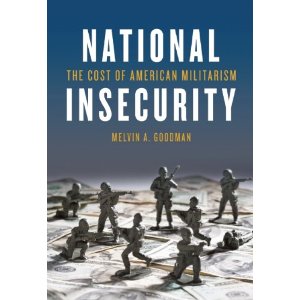
“Mel Goodman has spent the last few decades telling us what's gone wrong with American intelligence and the American military, and now, in National Insecurity, he tells us what we must do to change the way the system works, and how to fix it. Goodman is not only telling us how to save wasted billions–he is also telling us how to save ourselves.” — Seymour M. Hersh, The New Yorker
Upon leaving the White House in 1961, President Eisenhower famously warned Americans about the dangers of a “military industrial complex,” and was clearly worried about the destabilizing effects of a national economy based on outsized investments in military spending. As more and more Americans fall into poverty and the global economy spirals downward, the United States is spending more on the military than ever before. What are the consequences and what can be done?
Amazon Page
Melvin A. Goodman, a twenty-four-year veteran of the CIA, brings peerless authority to his argument that US military spending is indeed making Americans poorer and less secure while undermining our political standing in the world. Drawing from his firsthand experience with war planners and intelligence strategists, Goodman offers an insider's critique of the US military economy from President's Eisenhower's farewell warning to Barack Obama's expansion of the military's power. He outlines a much needed vision for how to alter our military policy, practices, and spending in order to better position the United States globally and enhance prosperity and security at home.
Melvin A. Goodman is the Director of the National Security Project at the Center for International Policy. A former professor of international security at the National War College and an intelligence adviser to strategic disarmament talks in the 1970s, he is the author of several books, including the critically acclaimed The Failure of Intelligence.
“Too big to fail is too big to continue. The megabanks have too much power in Washington and too much weight within the financial system.” Who said this and when?
The answer is Peggy Noonan, the prominent conservative commentator, writing recently in The Wall Street Journal.
. . . . . . . .
As Ms. Noonan puts it bluntly: “People think the G.O.P. is for the bankers. The G.O.P. should upend this assumption.”
This is a significant opportunity for anyone with clear thinking on the right – someone looking for a Teddy Roosevelt trustbusting or Nixon-goes-to-China moment. Again, Ms. Noonan gets it right: “In this case good policy is good politics. If you are a conservative you’re supposed to be for just treatment of the individual over the demands of concentrated elites.”
Recall that some grass roots conservatives are already there: House Republicans initially voted down TARP, the former presidential candidate Jon Huntsman’s plan to end too big to fail received widespread applause from many Republicans and a number of influential commentators, including George Will and Ms. Noonan, have advocated ending too big to fail.
This would play well in the Republican presidential primaries – and even better in the general election. Watch PBS “Frontline” on Jan. 22 for an articulate presentation of why serious potential financial crimes were not prosecuted during the first Obama administration, and think about how to turn these facts into political messages.
A smart candidate could even mobilize plenty of financial-sector support in favor of breaking up or otherwise restricting the too-big-to-fail financial entities. The megabanks have very few genuine friends.
The lasting legacy of Timothy Geithner is to create the perfect electoral issue for Republicans. Will they seize it?
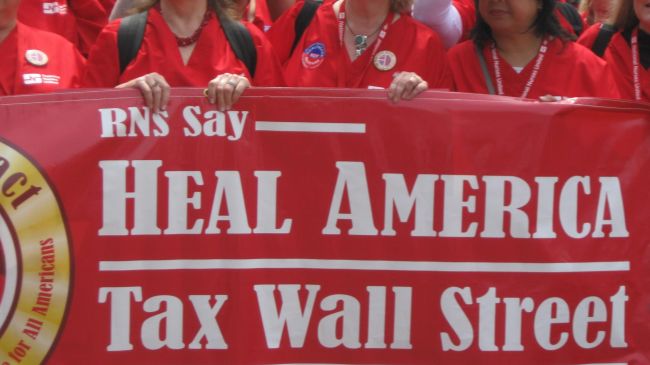
In the midst of the current haggling over the US federal budget, the main fact is being ignored: the fiscal shortfall of the US government over decades is largely due to Wall Street’s rigging of the tax code so that the main money center banks pay little or nothing in the way of taxes.
Like the haughty nobility in France before the Revolution of 1789, the Wall Street banks are practically exempt from taxation, and the burden of paying for the government is shifted to the middle class. Anybody who is serious about reducing the power of Wall Street bankers in US politics must now mobilize to educate public opinion about the situation and its main remedy – the 1% Wall Street Sales Tax.