West Point Combatting Terrorism Centrer, January 15, 2013
In the last few years, and especially since 2007, there has been a dramatic rise in the number of attacks and violent plots originating from individuals and groups who self-identify with the far-right of American politics. These incidents cause many to wonder whether these are isolated attacks, an increasing trend, part of increasing societal violence, or attributable to some other condition. To date, however, there has been limited systematic documentation and analysis of incidents of American domestic violence.
This study provides a conceptual foundation for understanding different far-right groups and then presents the empirical analysis of violent incidents to identify those perpetrating attacks and their associated trends. Through a comprehensive look at the data, this study addresses three core questions:
When I walk through my home and around my yard, I'm constantly looking for ways to do more with the space I have available.
More? No, I'm not talking about finding ways to store more stuff by stacking and packing it in every nook and cranny.
Instead, I'm talking about finding ways to produce more in less space.
One of the secrets I've found to producing more, is to stack functionality so that the same space can do many things simultaneously.
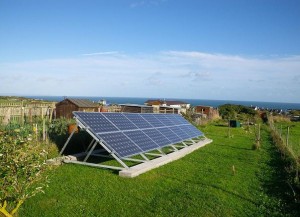
Here's an example. Here's ground mounted solar system that a family in Devon, UK had installed (via Chris Rudge). Incidentally, this install is about what a family needs to power their home.
Ground mounted solar panels are often a smart choice, if you have a place to put them for a variety of reasons (cost to performance). However, ground mounted panels deprive you of usable land unlike roof mounted panels.
How do you fix this?
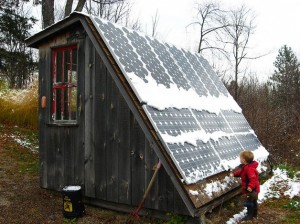
By using the space under the panels as a shed, chicken coop, or other useful structure. Something like this solar shed (via Pete Blanchard):
Can more functionality be added? Sure. You could turn the panels into a rainwater harvesting system, by adding a gutter and a cistern.
You could also turn the shed into a place that houses a battery bank to provide back up power for your house. Or, you could turn the shed into a workshop to use the power produced by the panels to make things you can sell to the world.
Be creative. If you have some ingenious ideas, please share them in the comments below.
Resiliently Yours,
JOHN ROBB
PS: This is a classic engineering technique. It's also something that is used in permaculture design.
PPS: Think about stacking functions serially and in parallel.
Despite two consecutive years of falling global unemployment, the number of jobless is once again on the rise. And projections for future years aren’t looking much better.
According to a new report from the International Labour Organization, the global unemployment rate in 2012 rose to 5.9 percent of the workforce, increasing by 4.2 million people. Over 197 million people are now considered unemployed.
“An uncertain economic outlook, and the inadequacy of policy to counter this, has weakened aggregate demand, holding back investment and hiring,” said ILO Director-General Guy Ryder. “This has prolonged the labour market slump in many countries, lowering job creation and increasing unemployment duration even in some countries that previously had low unemployment and dynamic labour markets.”
Much of the increase can be blamed on rising unemployment in advanced economies.
The job market is particularly bad for workers under 24, as 12.6 percent are unemployed. And while the situation is expected to improve for young people in advanced economies, it’s only projected to worsen in emerging economies in Eastern Europe, East and Southeast Asia and the Middle East.
But, overall, a rising middle class in emerging economies should help soften the unemployment blow but not enough to prevent rising unemployment in the coming years.
So what can governments do?
“[M]any of the new jobs require skills that jobseekers do not have,” Ryder added. “Governments should step up efforts to support skills and retraining activities in order to address such mismatches which particularly affect young people.”
The report also noted that 39 million people left the labor market last year.
The more I read about the GMO controversy the more it appears to be a story of commercializing a new technology before it was really understood, leaving us vulnerable to unintended consequences. Here is an example of what I mean.
As long as we see ourselves as something apart from the great cycles of nature, which is a fundamental assumption of our energy and agriculture sectors, we will destroy the earth and ourselves. There is an alternative.
All models are wrong, some models are useful – statistician George Box
The mental model we share of this thing we call the publishing industry is no longer useful. Most of us think of the publishing industry’s product as “books”. That’s like thinking that Amazon sells two products, bits and cardboard boxes. Amazon ships stuff in cardboard boxes. It’s what’s inside the box that you are buying. Likewise, it’s the information contained in the bits that you are buying when you buy a digital product from Amazon.
Physical books were never really the publishing industry’s product. It was always the stories, ideas, and information contained in the books. Now that there are competing digital containers for almost everything that has traditionally been delivered via physical books, it is imperative that we take a hard look at the different industries which were hidden from view by our once-useful model of the publishing industry. Because these industries are moving to the digital world at vastly different rates and to very different digital containers: ebooks, apps, and the web. In my terminology, an app is a digital container that promotes user interaction with content rather than linear reading; an ebook is a self-contained reading unit mostly without external links; and the defining feature of the web is external linking. To understand the future of publishing, we have to let go of the idea of “the publishing industry” and look at its products based on the needs they fulfill.
The first [of four] industry to begin disappearing from the print world was the database packaging industry. Directories, encyclopedias, and dictionaries are well on their way to extinction in the print world. The mass-market products in this industry have moved almost entirely to the web. A few of the higher-end products have moved to specialized apps. Because this industry was always peripheral to the main business, many folks in publishing didn’t fully comprehend the implications of this change: some products that were previously only available as physical books had a natural affinity to a different form and business model.