Howard Rheingold: Google’s Next Step in Search

Advanced Cyber/IO, Commercial Intelligence
0Shares
Howard Rheingold

This is what “Metaweb” was working on before they were acquired by Google — Howard

“When you search, you’re not just looking for a webpage. You’re looking to get answers, understand concepts and explore.

The next frontier in search is to understand real-world things and the relationships among them. So we're building a Knowledge Graph: a huge collection of the people, places and things in the world and how they're connected to one another.

This is how we’ll be able to tell if your search for “mercury” refers to the planet or the chemical element–and also how we can get you smarter answers to jump start your discovery.”

Introducing the Knowledge Graph

Phi Beta Iota: Google continues to do math hacks on digital garbage. While it is beneficial to connect the Internet of things with the Internet of words and numbers, Google is a) not a search company, something most do not understand, and b) not at all committed to making sense in the public interest. When Google can cannot every mind, written and spoken word, thing, and location relevant to understanding poverty, then we will be impressed. Until then, like Microsoft, Google is part of the problem, not the solution.


Patrick Meier: Stages of Resistance to Innovation — From Naval Gunfire to Blind Spys

Cultural Intelligence
0Shares
Patrick Meier

From Gunfire at Sea to Maps of War: Profound Implications for Humanitarian Innovation

MIT Professor Eric von Hippel is the author of Democratizing Innovation, a book I should have read when it was first published seven years ago. The purpose of this blog post, however, is to share some thoughts on “Gunfire at Sea: A Case Study in Innovation” (PDF), which Eric recently instructed me to read. Authored by Elting Morison in 1968, this piece is definitely required reading for anyone engaged in disruptive innovation, particularly in the humanitarian space. Morison was one of the most distinguished historians of the last century and the founder of MIT's Program in Science, Technology and Society (STS). The Boston Globe called him “an educator and industrial historian who believed that technology could only be harnessed to serve human beings when scientists and poets could meet with mutual understanding.”

Morison details in intriguing fashion the challenges of using light artillery at sea in the late 1,800's to illustrate how new technologies and new forms of power collide and indeed, “bombard the fixed structure of our habits of mind and behavior.” The first major innovative disruption in naval gunfire technology is the result of one person's acute observation. Admiral Sir Percy Scott happened to watched his men during target practice one day while the ship they were on was pitching and rolling acutely due to heavy weather. The resulting accuracy of the shots was dismal save for one man who was doing something slightly different to account for the swaying. Scott observed this positive deviance carefully and cobbled existing to technology to render the strategy easier to repeat and replicate. Within a year, his gun crews were remarkable accurate.

Continue reading “Patrick Meier: Stages of Resistance to Innovation — From Naval Gunfire to Blind Spys”

JUST OUT: The New Designing A World That Works for All by Medard Gabel & Global Laboratory Participants

Earth Intelligence, Knowledge
0Shares
Home Page

purchase a paperback copy

download color version pdf (32MB)
download black-and-white version pdf (16MB)

Goals of the Lab

See the movie

Medard Gabel, co-creator with Buckminster Fuller of the analog World Game, is the designer of EarthGame(TM) and the foremost comprehensive architect for a massive multiplayer game that connects all humans with all information in all languages all the time.  A founding member of the guiding council of Earth Intelligence Network, he remains the single most focused personality at the intersection of design, open source, serious games, and informed participatory budgeting and policy making.

PETITION Deadline 19 June, For Open Access to Taxpayer-Funded Research Information

Cultural Intelligence
0Shares

we petition the obama administration to:

Require free access over the Internet to scientific journal articles arising from taxpayer-funded research.

We believe in the power of the Internet to foster innovation, research, and education. Requiring the published results of taxpayer-funded research to be posted on the Internet in human and machine readable form would provide access to patients and caregivers, students and their teachers, researchers, entrepreneurs, and other taxpayers who paid for the research. Expanding access would speed the research process and increase the return on our investment in scientific research.

The highly successful Public Access Policy of the National Institutes of Health proves that this can be done without disrupting the research process, and we urge President Obama to act now to implement open access policies for all federal agencies that fund scientific research.

Click here to learn more and — if desired — sign the petition.

David Swanson: Even Failed Activism Succeeds

Cultural Intelligence
0Shares
David Swanson

Why Even Failed Activism Succeeds

I enjoy reading histories of past activism, including memoirs by long-time activists, such as Lawrence Wittner's new book, Working for Peace and Justice.

Almost every such account includes belated discoveries of the extent to which a government was been spying on and infiltrating activist groups.

And almost every such account includes belated discoveries of the extent to which government officials were influenced by activist groups even while pretending to ignore popular pressure.

These revelations can be found in the memoirs of the government officials as well, such as in George W. Bush's recollection of how seriously the Republican Senate Majority Leader was taking public pressure against the war on Iraq in 2006.

Of course, activism that appears ineffectual at the time can succeed in a great many ways, including by influencing others, even young children, who go on to become effective activists — or by influencing firm opponents who begin to change their minds and eventually switch sides.

The beautiful thing about nonviolent activism is that, while risking no harm, it has the potential to do good in ways small and large that ripple out from it in directions we cannot track or measure.

Continue reading “David Swanson: Even Failed Activism Succeeds”

Josh Kilbourn: Unemployed College Graduates – Trending Ugly

03 Economy, 07 Other Atrocities, 11 Society, Commerce, Commercial Intelligence, Corruption, General Accountability Office, Government, Office of Management and Budget
0Shares
Josh Kilbourn

The Benefits Of A College Education

Tyler Durden

ZeroHedge, 05/21/2012

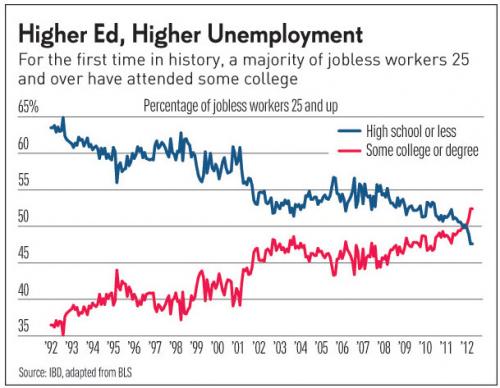
… Are what again? As the following graphic from IBD demonstrates, for the first time in history, a majority of jobless workers over 25 have attended some college, and now outnumber those without a job who simply have a high school diploma or less. But at least those in the fomer category have tens of thousands of non-dischargeable debt to show for it.

Click on Image to Enlarge

.. Are what again? As the following graphic from IBD demonstrates, for the first time in history, a majority of jobless workers over 25 have attended some college, and now outnumber those without a job who simply have a high school diploma or less. But at least those in the fomer category have tens of thousands of non-dischargeable debt to show for it.

Read full article.