Berto Jongman: Deena Metzger– Seeing through Indigenous Eyes, Weaving Community Dreams, Stories and Spirit

Augmented Reality, Civil Society, Collective Intelligence, Cultural Intelligence, Ethics
0Shares
Berto Jongman

Indigenous “intelligence” appears to be making a comeback in public consciousness.

Deena Metzger– Seeing through Indigenous Eyes, Weaving Community Dreams, Stories and Spirit

Deena Metzger's Bio

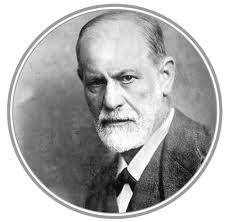
Deena Metzger  is a poet, novelist, essayist, storyteller, teacher, healer and medicine woman who has taught and counseled for over forty years, in the process of which she has developed therapies (Healing Stories) which creatively address life threatening diseases, spiritual and emotional crises, as well as community, political and environmental disintegration.

Click on Image to Enlarge

She has spent a lifetime investigating Story as a form of knowing and healing. As a writer, she asks: Who do we have to become to find the forms and sacred language with which to meet these times?

She conducts training groups on the spiritual, creative, political and ethical aspects of healing and peacemaking, individual, community and global, drawing deeply on alliance with spirit, indigenous teachings and the many wisdom traditions. One focus is on uniting Western medical ways with indigenous medicine traditions.

With her husband, writer/healer Michael Ortiz Hill, she has introduced the concept of Daré, meaning Council, to North America. The Topanga Daré relies on Council, alliance with Spirit and the natural world, ancestor work, indigenous and wisdom traditions and teachings, music healing, dream telling, divination, kinship, and story telling to achieve personal transformation, community healing and social change.

She is the author of many books, including most recently, the novels La Negra y Blanca and Feral; Ruin and Beauty: New and Selected Poems; From Grief Into Vision: A Council; Doors: A fiction for Jazz Horn; Entering the Ghost River: Meditations on the Theory and Practice of Healing; The Other Hand; Tree: Essays and PiecesA Sabbath Among the Ruins, Looking for the Faces of God andWriting For Your Life.

Very VERY rough interview notes

DefDog: 800+ Companies Helping Government Spy on Individuals

Commerce, Commercial Intelligence, Corruption, Government
0Shares
DefDog

Integrity at risk, extending from an invasive government cloaked under the guise “protection” to the sell out by commercial organizations…..

CISPA supporters list: 800+ companies that could help Uncle Sam snag your data

As the campaign against the Cyber Intelligence Sharing and Protection Act (CISPA) heats up, it's important for the opposition movement to understand just how many companies directly or indirectly support the legislation (i.e. through a trade group). Here, the complete list of CISPA supporters.

During the week of April 23, the House of Representatives is expected to vote on the Cyber Intelligence Sharing and Protection Act of 2011 (CISPA). And starting on Monday, a variety of organizations, including the Electronic Frontier Foundation, the American Civil Liberties Union, the Center for Democracy and Technology, The Constitution Project, Demand Progress, Engine Advocacy, Fight for the Future, Free Press, Reporters Without Borders, Techdirt, and TechFreedom plan to launch a “week of action” campaign against CISPA, a bill they believe remains dangerously broad in its language, which could result in abuse by the government, and damages to our civil liberties.

Click on Image to Enlarge

While many are comparing CISPA to the Stop Online Piracy Act (SOPA), the two bills are entirely different for a number of reasons. First, CISPA is a cybersecurity bill that pertains to the sharing of information between the government and private companies. SOPA was an anti-piracy bill that sought to block access to “foreign rogue” websites that illegally distributed copyrighted material. Second, SOPA was opposed by many of the technology and Internet industry’s biggest players. CISPA, on the other hand, effectively has the support of hundreds of technology and Internet companies — a key difference that could drastically affect whether the anti-CISPA crowd can successfully block passage of the bill.

To give you a full picture of just how much political firepower the CISPA has in Congress, we’ve listed most, if not all, of the companies and organizations that have voiced either direct support for CISPA (by writing a letter, or otherwise expressing support for this specific bill), or indirect support through the direct support of a trade group. The organizations or companies listed in bold have voiced direct support. Those companies not in bold have not necessarily given direct support (though quite a few have), but have supported the bill through the trade group, which is listed in bold. The links go to the .pdf files of the letters the company sent to the House Intelligence Committee to express their support of CISPA.

As you can see, the list of CISPA supporters is massive, and should give anyone who thinks this will be an easy political fight a dose of reality. Not that CISPA can’t be stopped but, well, scroll down and you’ll see what we mean.

See full list here.

Chuck Spinney: Analysis of Cost of Neo-Con Idiocy on Iran

Corruption, Government
0Shares
Chuck Spinney

The attached essay by investigative journalist Robert Parry is an excellent — and important — summary of the trashing of the Iranian nuke deal in 2010. CS

How Neocons Sank Iran Nuke Deal

Exclusive: Iran is resuming talks over its nuclear program with leading international powers – the United States, Britain, Russia, China, France and Germany – with the prospect of an agreement to swap some enriched uranium for research isotopes. But a similar plan was torpedoed by U.S. neocons in 2010, recalls Robert Parry.

By Robert Parry, ConsortiumNews.com, April 12, 2012

Two years ago, Washington’s influential neoconservatives – both inside and outside government – shot down a possible resolution to the Iranian nuclear dispute because they wanted a confrontation with Tehran that some hoped would lead to their long-held dream of “regime change.”

In the ensuing two years, the cost of that confrontation has been high not just for Iranians, who have faced harsh sanctions, but for the world’s economy. For instance, Israeli Prime Minister Benjamin Netanyahu’s recent escalation of bomb-Iran rhetoric contributed to the spike in gasoline prices that seems to be choking off the U.S. recovery, just as job growth was starting to accelerate.

Theophillis Goodyear: Reflections on Anarchy versus Open Source

Blog Wisdom, Cultural Intelligence
0Shares
Theophillis Goodyear

The term anarchy is antithetical to Open Source, because anarchy, by strict definition at least, sees all forms of state organization as structures that need to be eliminated. Open Source, on the other hand, is about spreading control of these systems of organization to the general population, rather than leaving them concentrated in the hands of the few at the top. It's not about eliminating systems of organization. That can have disastrous and unforeseeable social consequences.

And although many anarchists may agree with this basic component of Open Source systems, the term anarchy is a relic that needs to be discarded. It can only confuse things and hold back the Open Source movement from reaching it's ultimate potential. People have been talking about the information age for decades. But the true information age hasn't even arrived yet. It will arrive when it has become commonplace for humans to link their brains through computer systems and thereby increase human intelligence exponentially. The true age of information means intelligence squared.
Prematurely killing “the state” could kill the very systems of organization required to make Open Source a reality. And once open source becomes a reality, what anarchists currently call “the state,” as we know it, will no longer exist anyway. Anarchists need to catch up with the times and stop getting so hung up on worn out terminologies and ideologies. Often the greatest obstacles to human progress are our antiquated intellectual models and habitual mindsets. Just as the founding fathers of America could never have envisioned the complexities and potentials of contemporary society, neither could the original anarchists. Strict constitutionalists often use the ideas of the founding fathers to block reasonable progress. At times it looks to like anarchists are doing the same thing. They need to let go of the past and start looking toward the future.

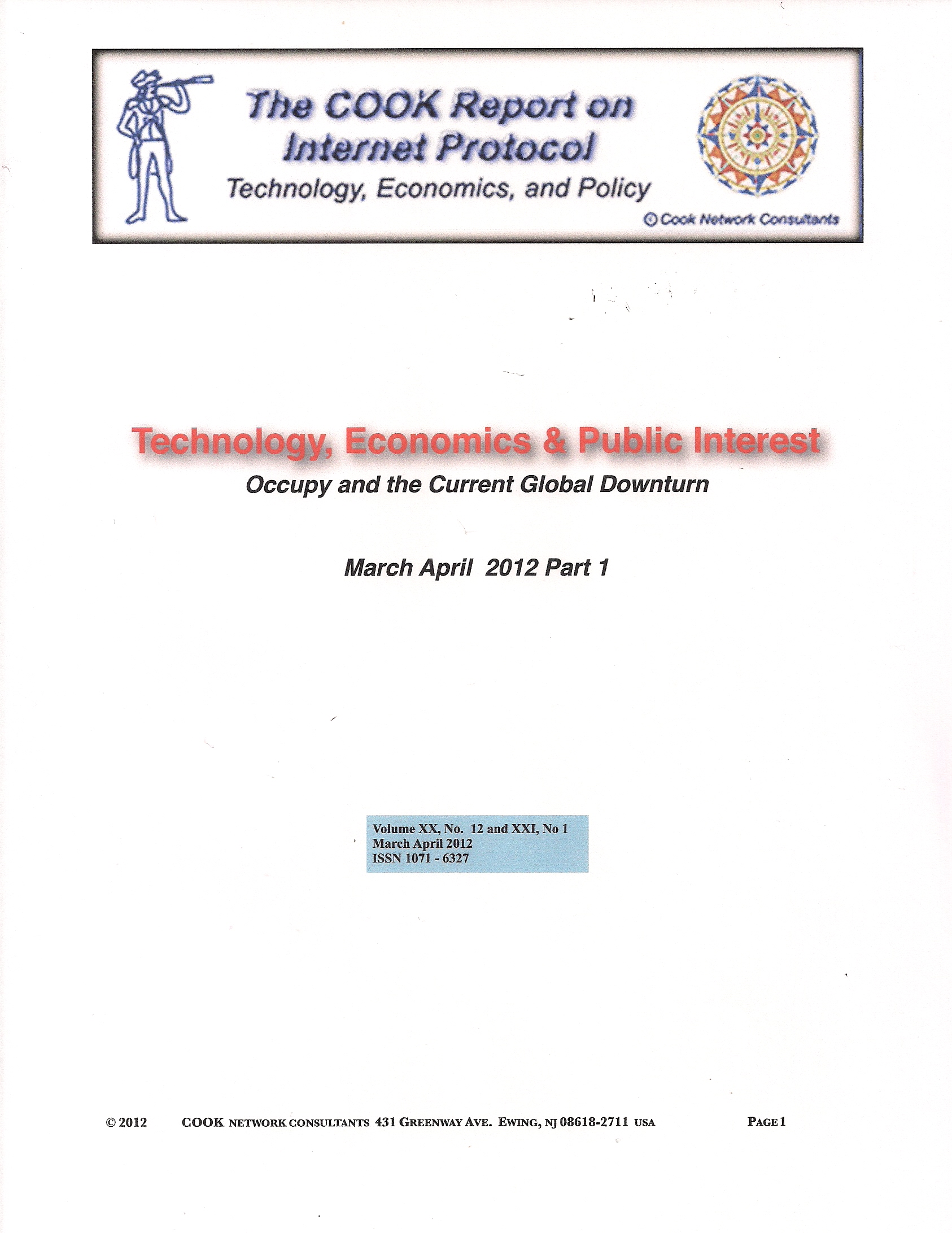
Reference: Gordon Cook on Technology, Economics & Public Interest – Occupy and the Current Global Downturn

Advanced Cyber/IO, Autonomous Internet
0Shares
Click on Image to Enlarge

2012-04-13 Cook Report Technology Economy and Public Interest

Phi Beta Iota:  Gordon Cook sets the gold standard for thoughtful integrated observations and analysis of the Internet.  His materials is read by the greatest of pioneers such as Vint Cerf, as well as by those who aspire to be pionoeers, such as those building the Freedom Tower and the Autonomous Internet Roadmap.  Some say data is the new dirt.  Others say data is the new gold.  We say that cyber is the new world mind, in which humans, information, and the connections among them become the World Brain and implement a transparency so strong that it eradicates corruption and ends fraud, waste, and abuse against the many and in favor of the few.

See Also:

Reference: Gordon Cook on Freedom Tower and the Autonomous Internet – Peer to Peer User-Owned Communications and Computing Infrastructure

THE OPEN SOURCE EVERYTHING MANIFESTO: Transparency, Truth & Trust

DefDog: The infamous ‘take down the Internet in 30 minutes’ hearing from 1998 — Tens of Billions Later, NSA and OMB Have Not Done Their Jobs, US Cyber is Wide Open and Unsafe at Any Speed + Meta-RECAP

Corruption, Government, IO Impotency, Military
0Shares
DefDog

This is the famous hearing where Mudge told senators he could K-O the Internet in 30 minutes. It was a wide-ranging discussion, though Mudge's claim is what the media ran with at the time. Watch and ask yourself, as Trustwave's Tom Brennan does on his Facebook page this morning: “14 Years… have we gotten better?”

I think as Tom said, with all the spending, with all the hoopla, we have not achieved any security  (as you and Winn noted in the early 90's).  For everything that has been said, for the government it has turned into another method to rob the citizen blind…..

The infamous ‘take down the Internet in 30 minutes' hearing from 1998

A video has surfaced from 1998, showing some well-known members of the hacker community testifying before the United States Senate Committee on Governmental Affairs.

In this video, recorded on May 19, 1998, you will see Brian Oblivion, Kingpin, Tan, Space Rogue, Weld Pond, Mudge, and Stefan von Neumann.

This is the famous hearing where Mudge told senators he could K-O the Internet in 30 minutes. It was a wide-ranging discussion, though Mudge's claim is what the media ran with at the time. Watch and ask yourself, as Trustwave's Tom Brennan does on his Facebook page this morning: “14 Years… have we gotten better?”

Phi Beta Iota: Winn Schwartau and Peter Black were among the first to warn all of us in 1990. In 1994 the alarm was sounded with a letter and very specific spending recommendations from Jim Anderson, then a top NSA security consultant, Winn Schwartau, Bill Caelli, and Robert Steele.  The letter was ignored.  Today, just short of 20 years later, the US Government remains ignorant, unethical, and ineffective in cyberspace.

See Also:

Continue reading “DefDog: The infamous ‘take down the Internet in 30 minutes' hearing from 1998 — Tens of Billions Later, NSA and OMB Have Not Done Their Jobs, US Cyber is Wide Open and Unsafe at Any Speed + Meta-RECAP”

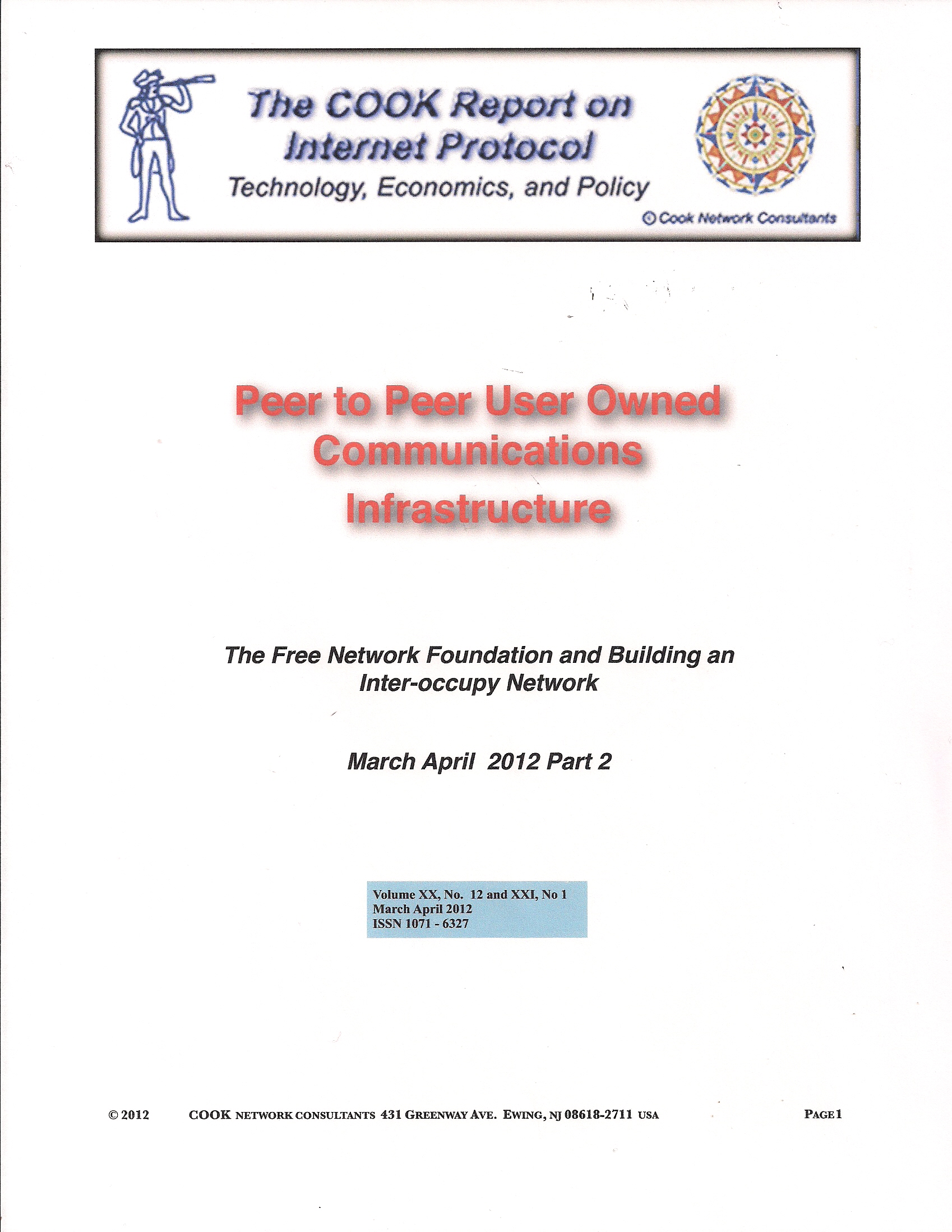
Reference: Gordon Cook on Freedom Tower and the Autonomous Internet – Peer to Peer User-Owned Communications and Computing Infrastructure

Advanced Cyber/IO, Autonomous Internet
0Shares
Click on Image to Enlarge

2012-04-13 Cook Report Peer to Peer Freedom Tower

Phi Beta Iota:  This is a hugely important reference work, the first of its kind, and very strongly recommended to all who care about human dignity, human freedom, and human evolution.

See Also:

Reference: Gordon Cook on Technology, Economics & Public Interest – Occupy and the Current Global Downturn

THE OPEN SOURCE EVERYTHING MANIFESTO: Transparency, Truth & Trust