The West, especially the United States, and Israel are stoking the grand-strategic fires in Middle East by trying to intensify the conflict between the Sunnis and the Shias. As Patrick Seale explains in this important essay, our leaders are playing very a dangerous, and I would add, ‘dirty' game — but the United States are on the cusp of Presidential election year in the United States and Obama's narrow vision of triangulating the Republicans in the domestic politics of foreign policy [1] is trumping the criteria for shaping a sensible grand strategy.
It would be wise for the Arab states to look to their own interests in this matter, rather than follow the bellicose lead of the Western powers and Israel. The Arabs must surely be aware that a military clash between Iran and the United States or Israel could be disastrous for the Arab Gulf region. Sensitive installations such as oil terminals and desalination plants could come under fire. The achievements of recent decades could be wiped out.
Competitive intelligence (CI) began to make inroads at a few leading-edge US companies such as Motorola and Kellogg back in the mid-1980s. Since then, companies have been investing in personnel, software, and consultants’ services to systematically monitor their competitors. At one point in time, (old) ATT had over 30 people in its business services division’s CI department, and pharmaceutical firms were not far behind. Today, 90 percent of all Fortune 500 companies have some form of formal CI activities. Yet, ask top executives to recall one occasion of how CI affected their strategy, and they go blank. Ask them who their intelligence analyst is, and they have no idea. At an age when ‘‘rising global competitive pressure’’ is on every executive’s lips, why has CI failed to leave real impact on companies’ C-suites?
The answer is deceptively simple: companies never built real competitive intelligence capabilities. Instead they created elaborate and detailed practices for closely monitoring competitors’ every little move. How important is bird-watching to an airline pilot flying at 39,000 feet? Competitors just do not matter that much to executives, and rightly so.
That is the good news. The bad news: they never built real intelligence capabilities. Executives short-change themselves like a ship captain navigating in thick fog without radar. Worse, while around him the horns are blaring, he listens only to his iPod.
Benjamin Gilad is President, Academy of Competitive Intelligence, Boca Raton, Florida, USA.
Benjamin Gilad, (2011) “Strategy without intelligence, intelligence without strategy”, Business Strategy Series, Vol. 12 Iss: 1, pp.4 – 11
Purpose – The purpose of the paper is to point out how little competitors matter for companies' long-term success, how little support executives receive with intelligence that does matter, and to offer a different solution.
Design/methodology/approach – The paper uses numerous examples of competitive failures and success that point out the limits of competitors' impact on a company's performance. It covers the theory of strategic positioning and industry change drivers and provides a practical definition of strategic intelligence.
Findings – Competitors do not matter to executives; “competitive intelligence” has been misinterpreted as competitor-watching and has therefore had no real value to executives, and companies leave their executives vulnerable to disastrous blindsiding.
Practical implications – Companies should and could markedly improve their intelligence support of top executives, but need to rethink their whole approach to competitive intelligence. Companies can also significantly improve the way they monitor the competitive environment by redirecting their efforts.
Originality/value – Executives are short changed by their organizations' own processes of closely watching competitors. For the first time, this paper exposes the myth that competitive intelligence – as practised by more than 90 percent of the Fortune 500 – has value for executives and offers a unique approach to improving companies' strategic intelligence capability.
Two excellent and important articles follow. They address the corrupt nature of America's general officer corps, and they are examples of journalism and think-tank work at their best.
“Corrupt officer corps?” An overstatement? You be the judge.
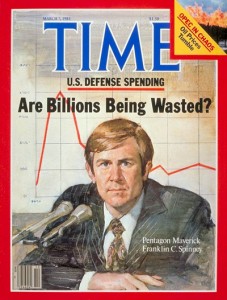
The first article is yet another in USA Today‘s Tom Vandenbrook's long and continuing series about DOD's “mentor” program. It describes corrupt behavior in indisputable terms. The second by POGO's Ben Freeman describes how the general officer corps has reversed former SecDef Gates' attempt at a modest reduction in officer bloat, a reversal enabled by Leon Panetta. (What next should we expect from this politician occupying the top position in America's most important national security agency?)
The issues are not just ethics and cost. Bloated officer corps are a characteristic of militaries in decline, or rather that have already declined and lose wars. The attachment is a briefing given in recent years by an anonymous and highly respected, at least by me, retired military officer.
It not just a budget crisis the Pentagon is experiencing; it's also a leadership crisis — especially at the top. Moreover, the two are directly related.
I strongly recommend watching the whole program, it’s an excellent discussion: “How does the Occupy Wall Street movement move from “the outrage phase” to the “hope phase,” and imagine a new economic model?
Excerpt: It’s perfectly possible that this perception will be borne out, that the raucous events of November 17 were the last gasps of a rigor-mortizing rebellion. But no one seriously involved in OWS buys a word of it. What they believe instead is that, after a brief period of retrenchment, the protests will be back even bigger and with a vengeance in the spring—when, with the unfurling of the presidential election, the whole world will be watching
WASHINGTON — Taking a broad swipe at the Securities and Exchange Commission’s practice of allowing companies to settle cases without admitting that they had done anything wrong, a federal judge on Monday rejected a $285 million settlement between Citigroup and the agency.
NOTE: I'm in the process of modernizing conflict theory (for wars, insurgencies, protests, etc.) and needed to get this backgrounder on John Boyd's thinking out of the way first. IF any part of it is unclear/difficult to understand, let me know. I'll improve it.
What is Conflict?
To answer this question, let's start with a theory of conflict developed by the late great John Boyd, America's best military thinker. It's a bit of a journey, but trust me, it's worth the effort.