Linux and open technologies deliver the Internet anywhere
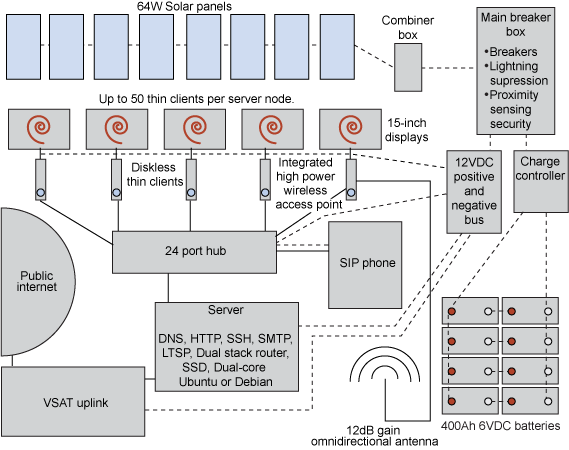
Summary: In many parts of the world, the power grid is shoddy, computers are scarce, and connectivity is even rarer. Thus, as with many other modern practices and technologies, populations are increasingly bifurcated into the “computing haves” and the “computing have-nots.” But many are addressing the divide. SolarNetOne is a turnkey Internet hotspot—power, computers, and satellite uplink—you can install virtually anywhere, for less than the cost of a subcompact car.
Phi Beta Iota: This is not to be confused with OpenBTS and $2 a month cellular service, but it does appear to be promising. Read more at the IBM developerWorks page for SolarNetOne.
Greetings! I hope this finds you well. There is a new reality upon us. We all sense it and we each experience it in our own unique way. We are more connected than ever and are discovering new ways to combine our power that are literally changing the world. Witness the youth-led, networked revolution started in the Middle East demonstrating the power of collective action.
We don't have to all agree on everything to advance our vision for a just and sustainable world. We can make this happen by participating in networks that promote the social good.
“Individually we’re a drop; together we’re an ocean.”
What we need are supportive, transparent networks that offer mutually reinforcing activities such as educating, informing, communicating, transacting, and sharing.
Ideal Network: Saving is Good; but Saving While Giving is Ideal!
The Ideal Network combines group buying with giving back to local causes. This social enterprise makes daily deals meaningful and grew out of our work on the Interra Project
For each sale, 25% of the purchase price goes to support local community projects. Yes 25%!
We launched four weeks ago in Seattle and have already generated more than $4,000 dollars in support of 16 great causes:
Simpler is always better. This entire site is about intelligence, and steele is the primary author and architect for Era Three in intelligence (Era One was secret war, Era Two strategic analysis–Era Three is smart nations and M4IS2).
WASHINGTON — For eight years, government officials turned to Dennis Montgomery, a California computer programmer, for eye-popping technology that he said could catch terrorists. Now, federal officials want nothing to do with him and are going to extraordinary lengths to ensure that his dealings with Washington stay secret.
Phi Beta Iota: Read the entire sorry tale….not only are all elements of the US Government stupid about contracting, but they do not talk to each other such that truly fraudulent very expensive propositions can make the rounds. Sadly, this applies to the bulk of DARPA, Irregular Warfare, and “advanced” Science & Technology “research,” and of course education, health, and what passes for justice–the prison slave farms. News flash for the White House: demand intelligence–and integrity–save $1 trillion a year. Duh.
“Without debate, without criticism, no Administration and no country can succeed and no republic can survive. That is why the Athenian lawmaker Solon decreed it a crime for any citizen to shrink from controversy. And that is why our press was protected by the First Amendment the only business in America specifically protected by the Constitution not primarily to amuse and entertain, not to emphasize the trivial and the sentimental, not to simply “give the public what it wants” but to inform, to arouse, to reflect, to state our dangers and our opportunities, to indicate our crises and our choices, to lead, mold, educate and sometimes even anger public opinion.” – President John F. Kennedy's “The President And The Press” Address Before The American Newspaper Publishers Association; Waldorf-Astoria Hotel – April 27, 1961
The world is assembled along the lines of certain logics. Human organisations are also outcomes of such logics.
Some organisations are assembled following the logic of the “cathedral”. Other organisations are assembled following the logic of the “bazaar”.
Cathedrals are organised as military-inspired command hierarchies. Superior humans give orders, which must be executed by subordinate humans. Bazaars are self-organising, based on voluntary co-operation among humans. Like molecules in a chemical reaction, humans join wherever their efforts are needed.
Cathedrals separate consumption from production. Consumers are not to understand or modify the products they consume. Bazaars allow humans to be both consumers and producers. Consumers are encouraged to create new products out of the products they consume.
Cathedrals cannot emerge unless the free spread of knowledge is prohibited. The underlying knowledge of products or production must be locked, and not released in public. Bazaars cannot emerge unless the locking in of knowledge is prohibited. The underlying knowledge of products or production must be kept public.
These two logics have always existed, yet humans have debated them only since the late 1990s. Computers, specifically software programming, has served as a laboratory for this discussion.
“Cathedrals” and “bazaars” have led humans to interpret their social history in new way. During the past couple of centuries, cathedrals have expanded, at the expense of bazaars.
However, programmers have proven that the bazaars can be more effective and creative than cathedrals. Other humans are now exploring how to use this same logic generically, in non-computer contexts.
In the face of such experiments, humans can hope for a 21st century civilisation assembled in novel ways, less dominated by the hierarchies of the past.