Tim Stock 2010
Teemu Arina (Finland) February 2008

The truth at any cost lowers all other costs — curated by former US spy Robert David Steele.

Jon Lebkowsky is, among many things, contributing editor of Extreme Democracy (Lulu.com, 2005). His briefing below brings up many points, among which three stand-out:
1. There is no lack of intelligence–what is lacking are the tools for achieving extreme democracy in the face of a tsunami of noise and electronic pollution, with five core functional requirements: gather data, analyze data, generate options, choose/vote, and implement.
2. The principle challenge to democracy at this point in time is not from governments, but rather from those corporations that presume to “own” the Internet and all content irrespective of who generates it.
3. Freedom Box (and what we have begun calling the Autonomous Internet) are an alternative–while he does not go into detail it is clear that there is a sufficiency of both money and knowledge to create a distributed Autonomous Internet.
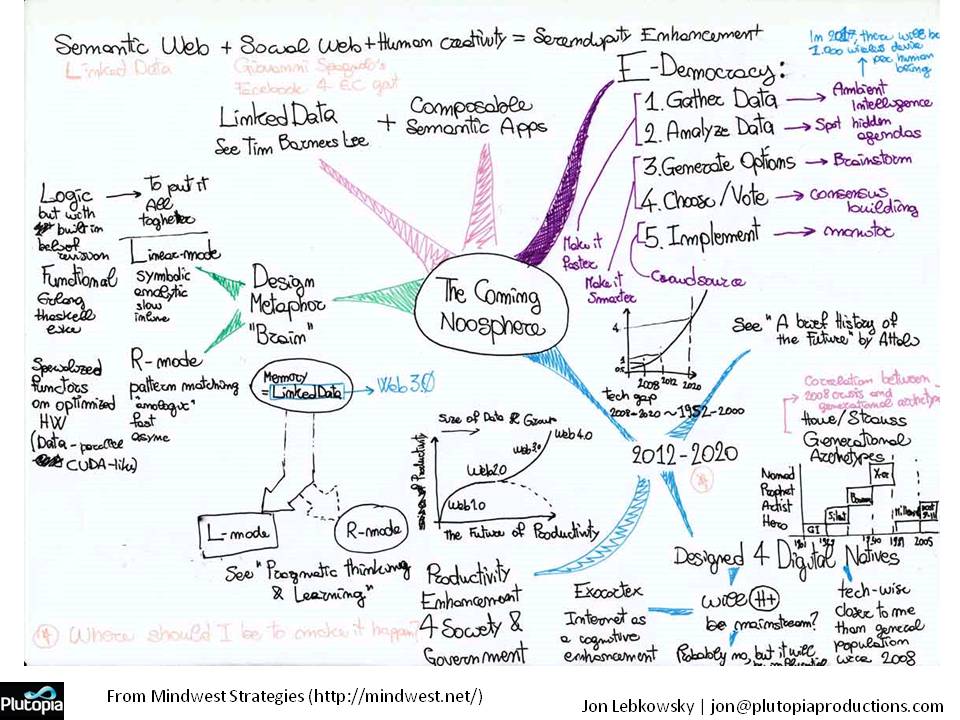
Briefing Online (Downloadable, No Notes)
See Also:
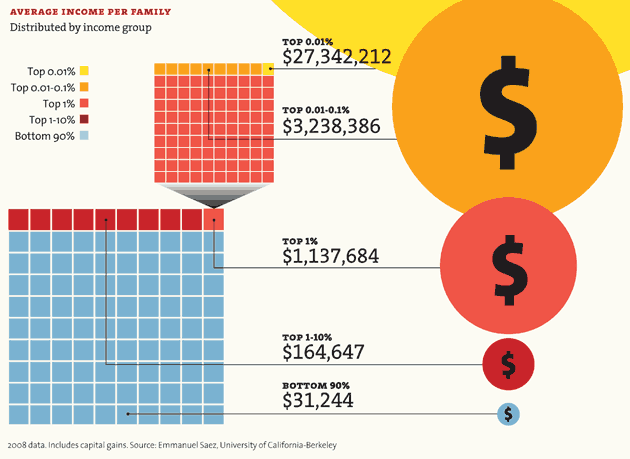
Eleven charts that explain everything that's wrong with America.
— By Dave Gilson and Carolyn Perot
Phi Beta Iota: We don't make this stuff up. Read all eleven charts.

O3b Networks delivers broadband connectivity everywhere on Earth within 45 degrees of latitude north and south of the equator.
Our vast coverage area includes emerging and insufficiently connected markets in Latin America, Africa, the Middle East, Asia and Australia, with a collective population of over 3 billion people.

SatMagazine 2010 Year In Review on O3b
O3b Networks: A far-out plan to deliver the Web (CSM)
Africa, Web Access: What Google's Doing Right (ABC)
Continue reading “O3b Satellite Broadband — Google Cell Play?”

http://liberationtechnology.stanford.edu
http://twitter.com/Liberationtech
Lying at the intersection of social science, computer science, and engineering, the Program on Liberation Technology seeks to understand how information technology can be used to defend human rights, improve governance, empower the poor, promote economic development, and pursue a variety of other social goods.
 See Also:
Autonomous Internet (36)
 VIDEO: Learning to See in the Dark: The Roots of Ethical Resistance Carol Gilligan April 24, 2009 Time: 1:10:34
Carol Gilligan is an ethicist and psychologist currently appointed as a University Professor at the New York University. She received an A.B. in English literature from Swarthmore College, a masters degree in clinical psychology from Radcliffe College and a Ph.D. in social psychology from Harvard University. Her landmark book, In A Different Voice (1982) is described by Harvard University Press as “the little book that started a revolution.” Following In A Different Voice, she initiated the Harvard Project on Women's Psychology and Girls' Development and co-authored or edited 5 books with her students: Mapping the Moral Domain (1988), Making Connections (1990), Women, Girls, and Psychotherapy: Reframing Resistance (1991), Meeting at the Crossroads: Women's Psychology and Girls' Development, (1992) and Between Voice and Silence: Women and Girls, Race and Relationships (1995). She received a Senior Research Scholar award from the Spencer Foundation, a Grawemeyer Award for her contributions to education, a Heinz Award for her contributions to understanding the human condition and was named by Time Magazine as one of the 25 most influential Americans. Her more recent publications include The Birth of Pleasure: a New Map of Love (2002), Kyra: A Novel (2008), and, with David A. J. Richards, The Deepening Darkness: Patriarchy, Resistance, and Democracy's Future (2009).
Review: Mapping the Moral Domain: A Contribution of Women’s Thinking to Psychological Theory and Education
Review: The Deepening Darkness–Patriarchy, Resistance, and Democracy’s Future
1992 E3i: Ethics, Ecology, Evolution, & intelligence (An Alternative Paradigm)
