Journal: China the Adult, US Barely Out of Diapers

02 China, 04 Inter-State Conflict, 07 Other Atrocities, 10 Security, Cultural Intelligence, Military, Peace Intelligence
0Shares

China-US-Vietnam: Defense Minister Liang Guanglie held talks with US Defense Secretary Gates in Hanoi on Monday on the sidelines of the 1st ASEAN Defense Ministers' Meeting Plus (ADMM-Plus) on bilateral military ties.

Defense Minister Liang invited Gates to visit China early next year, a Chinese official said. Gates accepted the invitation, according to the deputy head of external relations in the Chinese Defense Ministry.

The meeting in which the Chinese made the offer is the first meeting between the two senior defense officials in a year.

NIGHTWATCH Comment: The Chinese characterization of US ties bears attention. Liang said Sino-U.S. relations have maintained momentum of stable development in recent years as China and the United States have agreed to build a positive, cooperative and comprehensive relationship for the 21st century. China-U.S. relations are of increasing global influence, he added.

Liang said military relations constitute an important part of bilateral ties. Currently, the two countries are facing some obstacles in developing military relations, with the U.S. arm sales to Taiwan being the main reason.

NIGHTWATCH Comment: This part of Liang's remarks glosses over the brittleness of the “obstacles” involving Taiwan. The opening part of the comment minimizes the extent of US concern about China's lack of opacity and unwillingness to cooperate. The Chinese definition of a “positive, cooperative and comprehensive relationship” does not match the US definition. In the US definition, a positive, cooperative and comprehensive relationship does not yet exist. To try to develop such a relationship is the reason for Gates' persistence in soliciting an invitation.

NIGHTWATCH Comment on perception management: The US media has made clear that the US is the supplicant seeking a Chinese invitation for the US Secretary, after several Chinese rejections, most sensationally in Singapore by a low ranking Chinese general. Ties were set back by a US decision to sell Taiwan $6.4 billion in defensive arms, to which the Chinese objected strongly and froze defense contacts.

The imagery in Asia is that the rulers of the Central Kingdom finally granted the request for an audience from a recalcitrant supplicant because of his persistence. This is a scenario out of Chinese folklore. The folklore imagery and analogy suggest the Secretary should expect little because he is a player in a modern version of an old folk tale whose primary purpose was to showcase the superiority of the Central KIngdom.

The US is prone to interpret an invitation as a small political breakthrough. That might be an exaggeration. The Chinese are more likely to interpret it as their politicial victory that requires kneeling, head knockings (the imperial kowtow ritual was 3 kneelings and nine knocking of the head) and gifts.

Regarding Southeast Asia, Defense Minister Liang played to the audience and was his most unctuous. His purpose was to reassure China's Southeast Asian neighbors about China' s peaceful intentions. A quick look at Chinese territorial sea claims in the South China Sea puts the lie to China's peaceful intentions, but the Southeast Asian memory of resisting Chinese hegemony is long and fresh.

NIGHTWATCH KGS Home

Phi Beta Iota: China is a perfect and worthy counter-part for thinking about Whole of Government and 21st Century Leadership, both of which escape the US Government and its two-party political monopoly.  Strategic analytics is not something that CIA is capable of, nor is it something that the White House or Congress “compute” as essential to their still-imperial view of hegemony by right and ideological fantasy.  Beyond Chna lie Brazil, India, Indonesia, Iran, Russia, and Wild Cards such as Turkey.  The incapacity of the US Government to get its act together is brutally obvious and viscerally troubling.

Journal: Self-Diagnostics & Participatory Medicine

Uncategorized
0Shares

Jon Lebkowsky

Self-Diagnosis and Participatory Medicine

by jonl on October 11, 2010

The Journal of Participatory Medicine has published an interesting piece on Self Diagnosis, subtitled A Discursive Systematic Review of the Medical Literature. It’s a complex subject – as patients become more informed and empowered, they are more liable to want to have a role in diagnosis, and more apt to question a doctor’s perception or framing of their condition. This isn’t new for some of us – thirty years ago I was disagreeing with my physician to the extent that he would prescribe to treatments, one based on his assessment and one based on mine.

The systematic review published in the JOPM turned up 51 articles, of which 38 were suitable for inclusion in the review. There are three assessments of self-diagnosis: that it’s reliable and desirable (31%), that it’s not reliable but still desirable (23%), or that it’s neither reliable nor desirable (29%).

See Also:

Graphic: Health Quadrants & Open Source Information

Graphic: Health Quadrants & Open Source Information

Advanced Cyber/IO, Analysis, Balance, Citizen-Centered, Multinational Plus, Policies-Harmonization, Strategy-Holistic Coherence, True Cost
0Shares

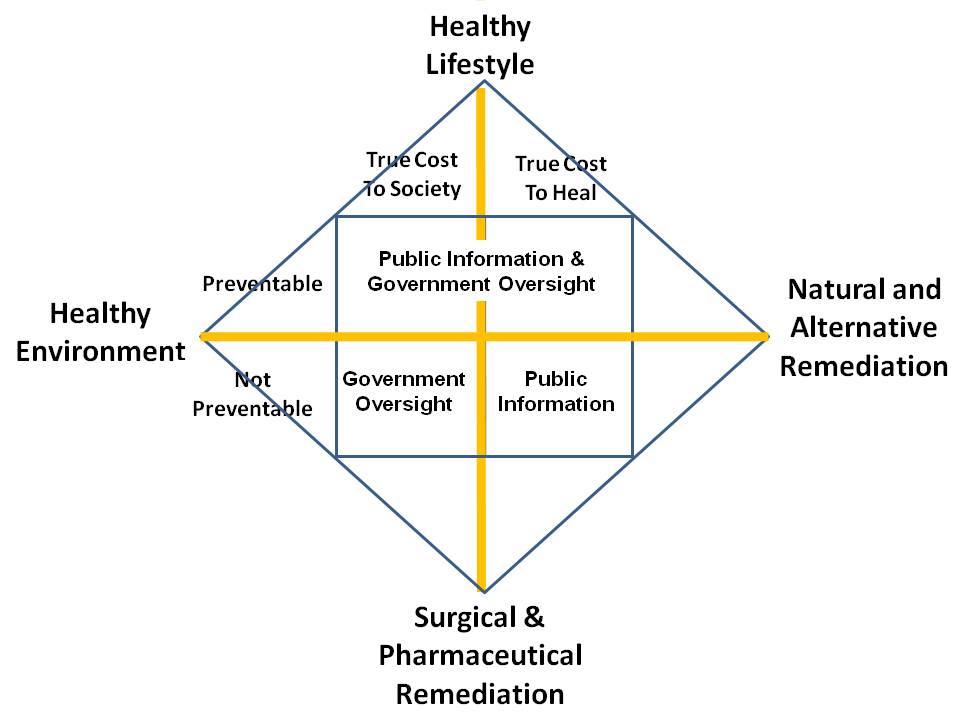
Phi Beta Iota: This is our preliminary construct for creating a global multinational, multiagency, multidisciplinary, multidomain information-sharing and sense-making (M4IS2) architecture for the Health portion of the World Brain and Global Game.

Journal: Pentagon Salad to Go With the Spagetti

Cultural Intelligence, Military
0Shares
DefDog

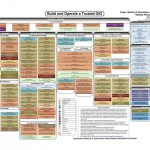
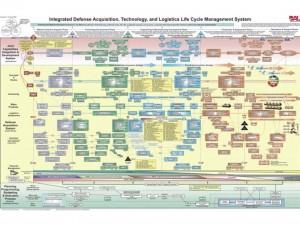
Phi Beta Iota: Our newest Contributing Editor, Defense Dog (DefDog), thought to add to Chuck Spinney's earlier sharing of the Pentagon spagetti charts by adding a touch of colorful salad–such good salad it has even been covered by WIRED Magazine.

Just a Hint--Click for the Whole Enchilada

NOTE:  The version at WIRED is High Resolution suitable for expanding to achieve drill down to every precious word.

And then, also from WIRED Magazine and courtesy of the same author, Noah Shachtman:

Pentagon’s Craziest PowerPoint Slide Revealed

Acquisition in Theory

See Also:

Graphic: DoD Intellectual Spagetti Modern Version

Graphic: DoD Intellectual Spagetti Cold War Version

Journal: Social Capital–Doing Good AND Making Money

03 Economy, 11 Society, Civil Society, Commerce, Commercial Intelligence, Cultural Intelligence, Gift Intelligence, Methods & Process, Non-Governmental
0Shares
DuckDuckGo on Social Capital

UpTake Institute October 11, 2010

There are some problems that neither pure capitalism nor charity can solve. Social capital is a new way of looking at solving those problems. This month, people from all over the world came to SOCAP10 in San Francisco to talk about social capital, and put their money where their mouths are.

Over the next several days we’ll be posting stories about companies that have what is called a “triple bottom line” — where they measure results not just in profit, but also in the business impact on people and the planet.

Our first video focuses on just what the social capital movement is about. We talk with people who run social capital companies such as Firefox maker Mozilla, people who are seeking funding for their businesses, and journalists who are covering the social capital movement.

Link to story and video

Tip of the Hat to  Leif Utne at LinkedIn.

See Also:

Review: Building Social Business–The New Kind of Capitalism that Serves Humanity’s Most Pressing Needs

Review (Guest): Cognitive Surplus–Creativity and Generosity in a Connected Age

Review: Nonzero–The Logic of Human Destiny

Review: The Hidden Wealth of Nations

Review: The Monk and the Riddle–The Art of Creating a Life While Making a Living

Journal: RYP thinks news is the killer app

Civil Society, Collective Intelligence, Commercial Intelligence, InfoOps (IO), Media, Methods & Process, Real Time
0Shares

RYP Recommends

The Media Equation

A Vanishing Journalistic Divide

By DAVID CARR
Published: October 10, 2010

If you were going to pick an epicenter for mainstream media, The Washington Post’s Howard Kurtz would not be a bad place to land. With his running scorecard on Beltway journalists, his interviews of other scorekeepers on his “Reliable Sources” show on CNN, and his ceaseless fascination with network news, Mr. Kurtz embodied the folkways of the traditional press.

Until last week, when he announced he was leaving his privileged perch to become the Washington bureau chief for The Daily Beast, a two-year-old toddler of the new digital press conceived by Tina Brown and owned by IAC, run by Barry Diller. Mr. Kurtz’s lane change evinced gasps reminiscent of when Dylan went electric at the Newport Folk Festival in 1965.

On the heels of decisions by Howard Fineman of Newsweek and Peter Goodman of The New York Times to go to The Huffington Post, it would seem like a bit of a tipping point.

Read balance of this thorough article…

Phi Beta Iota: Robert has it half right–news you can use.  The value has shifted from the T in IT to the I in IT.  We told NSA this in Las Vegas in 2000, but the money is in the T not the I, so they ignored us.  Public Intelligence about everything is about to emerge as the new arbiter of value.  True cost will be known, transparency will expose corruption as well as waste, and there will be, as our friend and mentor Alvin Toffler has written, a PowerShift.