Home > Asia > Afghanistan An Afghan construction worker places mud on a wall for a new building in a school in Taloqan, east of Kundus, April 23, 2009. (Kai Pfaffenbach/Reuters)
Obama's troop surge fails to address how to improve delivery of aid.
A dramatic shortage of program officers as well as auditors and investigators and poor security conditions on the ground have all conspired, the 128-page report concludes, to “significantly impair” the objectives of USAID’s mission, which is to provide economic development and humanitarian assistance in Afghanistan and around the world.
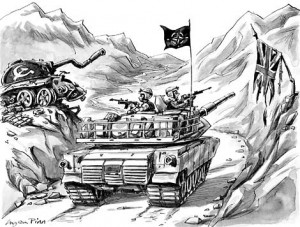
The failure of USAID to effectively monitor the development projects threatens to undermine the U.S. military’s new counterinsurgency strategy and troop surge, which is built upon the effective delivery of aid in the struggle against the Taliban for hearts and minds.
ICCS 2010 consist of three days, 50 unique lectures from distinguished, plenary, and parallel speakers in the disciplines of Emerging Technologies, Operations and Enforcement, and Real Life Experiences. Also included are panel discussions, sponsors' presentations, exhibitions and exceptional networking opportunities.
In response to heightened demand from cyber security leaders from around the world, ICCS 2010 is featuring two additional events: the Law Enforcement Workshop (LEW) and the Cyber Security Tutorial (CST).
INTELLIGENCE is DECISION-SUPPORT. The process of intelligence is separate from whether the sources and methods are secret or not. There is nothing secret, unethical, or illegal about the process of intelligence as decision-support.
Original “Class Before One” (2010 Class 001 in Planning)
The ICPVTR Terrorism Database – Global Pathfinder – is a one-stop repository for information on the current and emerging terrorist threat. The database focuses on terrorism and political violence in the Asia-Pacific region – comprising of Southeast Asia, North Asia, South Asia, Central Asia and Oceania.
In addition to providing the latest information on terrorist attacks and pronouncements, Global Pathfinder also includes over a hundred terrorist training manuals, counter terrorism legislations and conventions, analytical papers on terrorist ideologies, commentaries on terrorist trends and patterns, transcripts of landmark cases, interviews with terrorists as well as photographs from different conflict zones across the world. Further, Global Pathfinder also has a huge collection of jihadi websites, the contents of which are routinely translated and analysed by our analysts.
One of the main architects of the new al-Qaeda is a man named Abu Musab al-Suri. He put down his vision for the future of jihad in a book entitled Call for Worldwide Islamic Resistance, a one-thousand six-hundred page manifesto published on the Internet in 2004.
…he sought “…to transfer the training to each house of each district in the village of every Muslim….making appropriate training materials available to more than a billion Muslims….
Celebi's thesis focuses on the use of the Internet both in general and in the case of the Kurdish group PKK. The work is strongest in its discussion of what the author calls the training subsystem, and in his explication of that system as involving more than tradecraft and being increasingly based online. This training subsystem is seen as having four core functions:
1. The training subsystem creates, intensifies and sustains the competence, commitment and the skills that the terrorists will apply to reach their goals.
2. The training subsystem not only teaches the ways and means, but also justifies them by means of intensive indoctrination.
3. The training subsystem establishes ties to the group and creates a sense of belonging.
4. The training subsystem enables knowledge to be stored inside the boundaries of the system, and facilitates its passing through generations.
In a Dec. 21 interview with Lauren Lyster of Russia Today, Tarpley explores the case of David Coleman Headley, born Daood Gilani, a convicted heroin smuggler of Pakistani background working undercover for the DEA who is now accused by the Indian Home Ministry of functioning as a double agent for the CIA. Headley is now in jail in Chicago on charges of planning terrorism in Denmark, but India wants him extradited and wants to hear the tapes of FBI taps on his phone. There is every indication that, far from being a rogue, Headley masterminded the Mumbai false flag terror attacks of November 2008 precisely because the CIA wanted them to happen – to solidify Indian political support for the widely opposed US-India nuclear deal, to play India against Pakistan, and to brand Pakistan as a strategic enemy of the US — the policy reflected in Obama's Dec. 1 declaration of war against Pakistan. The outcry and scandal in the Indian media about the CIA's protection of Headley now give that nation a chance to pull back from the role of expendable pawn of the US and UK against Pakistan and China.
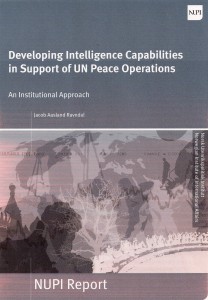
The author has produced a useful but slightly incomplete merger of information on the past decade of efforts to develop UN intelligence (decision-support) capabilities, within the prism of an imposed social science investigation construct which dilutes the practical value.