2008 COLLECTIVE INTELLIGENCE: Creating a Prosperous World at Peace

Books w/Steele
0Shares
Home Page for Book with Wiki, Full Text PDF, and Individual Chapters as Single Documents
Book as Free PDF

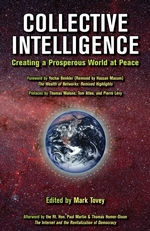
I conceptualized this book with help from Tom Atlee and George Por, but after discovering Mark Tovey, a Canadian PhD student exploring the intersection of Collective Intelligence (not yet an accepted academic discipline) and Cognitive Science (very scientific, not properly addressing the humanity of it all), I turned the book over to him and he literally doubled the content, added organizational coherence I would not have been capable of, and created the first book in the new discipline of Collective Intelligence.

This is also the first book published under the banner of Earth Intelligence Network, a 501c3 Public Charity developing public intelligence in the public interest.  We are especially focused on the EarthGame developed by Medard Gabel, who created the World Game with Buckminster Fuller, believing that in such a Serious Game we can achieve both a fully-informed public and the ability to self-govern at the line-item level as active members of multiple communities–Panarchy instead of Anarchy, with Zero Waste.

Visit Mark directly at http://marktovey.ca/

Tom Atlee's account on how this book came to be.

Free Chapter
Free Chapter
Amazon Page $39.95++

Journal: Budapest to become genocide-prevention hub

06 Genocide, Government, Peace Intelligence
0Shares

Budapest Business Journal Online

Tuesday 8:25, July 14th, 2009


An initiative by the Hungarian Foreign Ministry to establish a research center aimed at preventing genocide and mass atrocities is nearing fruition, with the center planned to be up and running by 2010.

Below are extracts from the feasibility study for the Budapest Center for the International Prevention of Genocide and Mass Atrocities, made available to the BBJ by István Lakatos Human Rights Ambassador and main proponent of the venture.

Despite the significant progress, the second half of the 20th century has, unfortunately, witnessed several genocides and mass atrocities even after the Holocaust. That fact stresses the need to continue the efforts to fill the gap between the political will for preventing genocide and establishing the necessary international mechanisms for effective operations. Recent research shows and makes evident that, even if escalation to mass violence often happens swiftly, the progression of events toward genocide is gradual, and that the months from initial threat to full genocide offer ample warning time for the international community to take preventive action. It means that genocide is preventable! The international community should make use of this fact to increase the efficiency of its activities in this field.

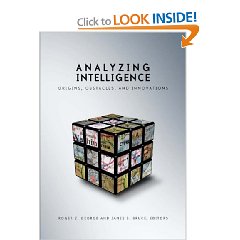
Review: Analyzing Intelligence: Origins, Obstacles, and Innovations

4 Star, Intelligence (Government/Secret)
0Shares

Amazon Page
Amazon Page

Of, By, and For USA Status Quo Bubbas–Essential but Very Partial

July 14, 2009
Roger Z. George
This is a very fine book, not least because of its inclusion of Jack Davis (search for <analytic tradecraft> as well as Carmen Medina (see her presentation to global audience via oss.net/LIBRARY), but in its essentials this is a book of, by, and for the status quo ante bubbas–the American bubbas, I might add.

If you are an analyst or a trainer of analysts or a manager of analysts, this is assuredly essential reading, but it perpetuates my long-standing concerns about American intelligence:

1) Lack of a strategic analytic model (see Earth Intelligence Network)

2) Lack of deep historical and multi-cultural appreciation

3) Lack of a deep understanding and necessary voice on the complete inadequacy of collection sources, the zero presence of processing and lack of desktop analytic tools, and the need for ABSOLUTE devotion to the truth, not–as is still the case, “within the reasonable bounds of dishonesty” aka “slam dunk”

4) Lack of integrity in so many ways, not least of which is the analytic abject acceptance of the false premise that the best intelligence is top secret/sensitive compartmented information–see the online CounterPunch piece on “Intelligence for the President–AND Everyone Else.”

Below are ten books I recommend as substantive complements to this book:
The Landscape of History: How Historians Map the Past
Lost History: Contras, Cocaine, the Press & ‘Project Truth'
Fog Facts : Searching for Truth in the Land of Spin (Nation Books)
Lost Promise
The Age of Missing Information (Plume)
Informing Statecraft
Bureaucratic Politics And Foreign Policy
A More Secure World: Our Shared Responsibility–Report of the Secretary-General's High-level Panel on Threats, Challenges and Change
Legacy of Ashes: The History of the CIA
The Shadow Factory: The Ultra-Secret NSA from 9/11 to the Eavesdropping on America

Vote on Review
Vote on Review

Click Here to Vote on Review at Amazon,

on Cover Above to Buy or Read Other Reviews,

I Respond to Comments Here or There

Review: Imperial Secrets–Remapping the Mind of Empire

5 Star, Intelligence (Government/Secret)
0Shares
Imperial Intelligence
Amazon Page

Delightful evidence of gravitas, provocative and refreshing,

July 14, 2009
by Patrick Kelley
Free PDF
Free PDF
Review or Download Free Copy
From National Defense Intelligence College
Kudos to NDIC for making this book available free online, simply search for the title. The book is easily downloadable and easily readable, and as much as I would have preferred to buy, mark up, and keep the book in hard-copy, the online availability permits me to both read and praise.

The book should NOT be priced above $34.95 and ideally at $24.95. Either NDIC is being cheated by its printer or it is not being thoughtful about making knowledge easily disseminable in the preferred printed form (hand eye coordination, marginal notes, sharing, etcetera). My printer would do this book for under $5 a copy.

I like this book, very much. The author studies the relationship between empire and knowledge, and specifically addresses the “information anxiety” and related intelligence (decision-support) pathologies associated with empire.

The following quote, on page 69, is quite consistent with all that I have both read and written:

“We rely too much on others to bring information to us, and too often don't understand what is reported back because we do not understand the context of what we are told.”

He cites James Baker and Lee Hamilton [Iraq Study Report], page 94.

At each turn the author recognizes that empires are militarily strong and can impose their own “rule of law,” but empires are NOT inherently capable of understanding exotic cultures and socio-economic domains.

The author's discussion of alternative renderings of information, and the importance of translation of meaning vice literal translation, is most interesting. His judgment of what we do now that passes for cultural intelligence is consistent with my own–checklists that apply an old process to a profoundly complex target, producing nothing more than facile templates.

I am much taken with his observation, on page 83

“Whether in the case of classical historiography or Ottoman tax administration, the idea of what constitutes knowledge changes depending on the contexts of both consumers and producers–eliminating these differences in some form of epistemological Esperanto may produce consensus and clarity, but it also sheds the information embedded in those differences.”

In the author's own words, words that describe our intelligence community from the time Ellsberg talked to Kissinger to my own depictions these past 15 years, on page 97:

“If power corrupts absolutely, it also tends to isolate completely–twin tendencies any executive authority risks as it ascends to the heights of imperial power. Bureaucracies rise in tandem with that isolation, providing the intellectual equivalent of walls and gates; but subverting that intellectual structure by act of will can prove nearly as impossible as escaping from the physical walls for reasons of status or security.”

This elegant study brought me back to Michael Foucault {{Archeology of Knowledge]]

The discussion of the British approach to information with respect to its governance of India is especially fascinating for me, and in particular the discussion of the British valuation and exploitation of past history to mask or justify present courses of action and future plans; and the British-US today error in assuming that imperial time was progressive and all other cultural times were not–I observe myself that China and Iran in their own way are both showing US and UK time to be at odds with strategic reality and sustainment.

It is about page 115 where the author briefly touches on warning and observes that the British did not lack for warning, they lacked for understanding. I hope those reading this review might care to look up my most recent article, “Perhaps We Should Have Shouted: A Twenty-Year Retrospective” (OSS.Net, Spring 2009).

The author is fascinating on education attacking authority, and on the displacement of traditional education having the negative side effect of displacing local elites previously well provided for by the traditional system.

The author segues into a reiteration of his key theme, to wit, to wit, intelligence with respect to the “other” is less a matter of specific fact, but rather more a matter of “negotiating” what truth means and defining what “knowing” actually encompasses.

I enjoy the author's integrated discussion of the failure of empire to understand that its behavior is a form of communication that is all too often very negative; that cultural understanding is about vastly more than compiling dates and names; and the intensity, messiness, and in some cases sordid nature of both the gathering and the explaining. The costs–and the benefits–of “going native” only to see t he West with native disdain and to be detested by one's own colleagues for having “gone over” is something I understand all too well from being in those circles where loyalty to the chain of command takes precedence over both the truth, and our oath to the Constitution.

One recurring theme that intrigues me in this book is that of needing to collect intelligence from different social levels–a network for the masters, another for the slaves. This is absolutely fascinating, since I and others know from experience that CIA does cocktail parties, not gutters. I can really see the value of a dedicated non-official cover cadre that specializes in the servant class.

I will end with a strong appreciation for the author's conclusion, and urge wide dissemination of this volume across the schoolhouses and into the international fellows program for incremental enhancement.

Page 184: “Where information is rich, and open to interpretation through sophisticated and polyvalent reading–we have knowledge. Where information grows and expands with organic profligacy while institutions of understanding grow increasingly rigid and formal, we have information overload, the Tower of Babel.”

Page 194: “The real secrets are the things we aren't looking for.”

The author's conclusion is almost spiritual, rich, and the bibliography a wonder. There are a number of areas where I could be critical, but not here, not now. This is a righteous work, and both the author and the NDIC research arm can be very proud of what has been created for all of us to consider.

Other books for the intelligence professional that wishes to go beyond “of by and for the bubbas”:
Strategic Intelligence & Statecraft: Selected Essays (Brassey's Intelligence and National Security Library)
The Landscape of History: How Historians Map the Past
Fog Facts : Searching for Truth in the Land of Spin (Nation Books)
The Age of Missing Information (Plume)
Forbidden Knowledge: From Prometheus to Pornography

Now the following three books I have not read, but the author has turned my attention to a slice of literature I have never before explored, that of empire intelligence (and non-intelligence):
Empires of Intelligence: Security Services and Colonial Disorder after 1914
Empire and Information: Intelligence Gathering and Social Communication in India, 1780-1870 (Cambridge Studies in Indian History and Society)
The Armies of Ignorance The Rise of the American Intelligence Empire

Finally, two books covering policy “rules of the game” anti-thetical to “hearing” intelligence or common sense:
Bureaucratic Politics And Foreign Policy
The Rules of the Game: Jutland and British Naval Command

AA Mind the Gap
Vote on Review

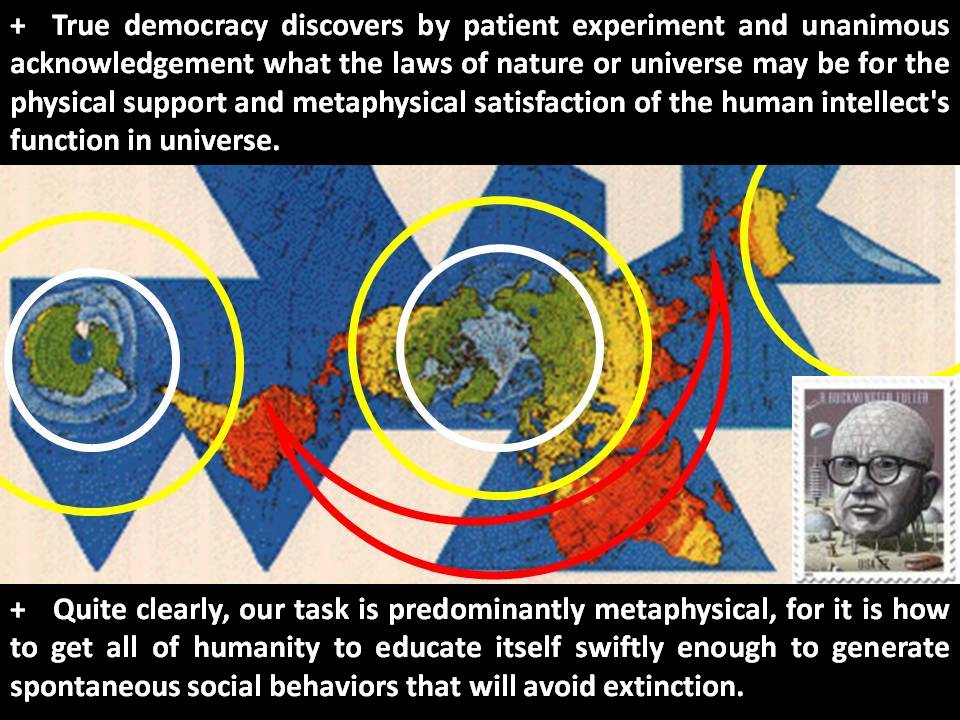
Graphic: Robert Steele Adopts Buckminster Fuller

Earth Orientation, Innovation, Leadership-Integrity
0Shares
Steele Adoption of Fuller

The pure integral consciiousness of Buckminster Fuller is finally coming into its own as sustainable design, natural capitalism, zero waste, and many other ideas that reflect INTEGRITY as the essence of life, all converge.  Buckminster Fuller is to re-engineering the earth as Will Durant is to re-thinking philosophy.

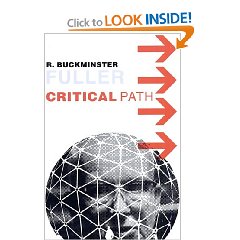
Review: Critical Path

5 Star, Atlases & State of the World, Banks, Fed, Money, & Concentrated Wealth, Complexity & Catastrophe, Complexity & Resilience, Economics, Environment (Problems), Environment (Solutions), Future, Survival & Sustainment, Values, Ethics, Sustainable Evolution
0Shares

Amazon Page
Amazon Page

History, Philosophy, Engineering, Architecture, & Education,

July 13, 2009
R. Buckminster Fuller
Although I heard Fuller speak at Muhlenberg College in 1973 or so, I had not read his books and for me Critical Path was a very healthy reminder that long before many of the current authors, Buckminster Fuller had a grip on the basics:

1) Economic theory of scarcity and secrecy is evil, benefitting the few at the expense of the many

2) Earth is NOT a zero sum Darwinian game for humans, in fact it is the human role–the human mind's role–to “synergize” Earth into a win-win for all.

3) Money is not wealth only an artifact that is representative of empty bank vaults and gross misrepresentation by the alleged wealthy. Only time-energy accounting and “true cost” of goods and services should be used.

4) Obstacles to displacing rule by scarcity and secrecy are the public ignorance of natural science and the collaboration among governments, corporations and large organizations such as religions and labor unions that “divide and keep conquered.”

5) Computers–and Fuller was clearly envisioning today's computers, not those of his time–if properly fed all of the relevant data can alter perceptions on a just enough, just in time basis. This coincides with my own view that we can and must educate the five billion poor one cell call at a time, but it also favors the ideas gaining currency of connecting the one billion rich (80% of whom do not give to charity) directly with the needs of the five billion poor at the household level of need.

I am hugely impressed with both specific actionable visions and specific actionable facts:

1) Now possible to create a global electrical grid that runs across Alaska into Canada and China, and eliminate the electrical shortfalls in both those countries and in Canada and the US West Coast.

2) In time-energy “true cost” accounting, every gallon of oil that we use cost $1 million (in 1981 dollars, which is to say, around $10 after the current Administration finished with its massive devaluation plans).

3) There are two critical paths that are not understood by the public or those who profess to represent the public: path one is those natural trends that proceed with or without human errors, omissions, and interventions; path two is the human path both local and as a global aggregate.

4) Considered in time-energy terms, both our industrial-era schools and our industrial-era office buildings are lunacy. He provides a fascinating discussion of inland versus island dwellers, concludes that most urban office buildings should be converted into mixed dwelling-telecommuting centers and is generally brutal about our national policies being 50 years out of date (in 1981–that would make them 80 years out of date today, and I agree).

5) He provides a BRUTAL discussion of banking and government bail-outs of banking as well as mortgage fraud that led to the Great Depression, how banks dispossessed the farmers not realizing that the land was over-valued AND that no one else wanted to do the hard work of farming, and I am generally thunder-struck by how history has repeated itself.

I am especially impressed by his “cosmic costing” which does not allow for hoarding (he joins others in cursing money as both a hoardable good and one that can draw interest beyond reason).

A goodly portion of the book covers the art of doing more with less; doing it faster; and ultimately benefitting increasing numbers of humans with the same technologies.

His discussion of “precession” revolves around not competing with anyone else, instead attending to the unattended. He has a gift for “comprehensive consideration” that we could all draw upon for inspiration.

I am completely absorbed by this book, which includes in the final third:

1) The challenge is to educate all humans, and to teach humans to learn in the shortest possible time–my kids have two answers: cell phones and video games. This is a no-brainer.

2) I offer some quotes below but am totally engaged with his discussion of the Geoscope, what some today might call an Earth Monitoring System, and his view that we can create a 200 foot version of the Earth where one inch equals three miles, and using computers, be able to illuminate for any human–however poorly educated or ideologically stunted–what actually IS the reality.

3) He spends time describing the World Game and cites two books by Medard Gabel that are no longer available via Amazon (but see the EarthGame(TM) technical description offered by Earth Intelligence Network), and describes it as a problem-solving choice-making educational game.

On page 287 I am stunned by his anticipation of the “de-sovereignization” of the United States of America, coincident with the bankruptcy of the US Nation at the hands of its out of control federal government.

On the architectural side I am fascinated by his discussion of flat slab building as the worst possible time-energy construction, and his discussion of the alternatives that he created, including floating cities that I now regard as inevitable.

The book contains an unexpected gem, a compendium created by Fuller based on US contractor experiences in Russia that was delivered to Brazil. It is still valid and it is a model for the kind of clear thinking that government engineers should be able to, but cannot do. [With credit to Chuck Spinney, I have learned that “government specification cost plus engineering” has fried the brains of multiple generations of engineers who are unable to computer biomimicry, cradle to cradle, green to gold, etc. We must wait for our children to rule the world, they are the “digital natives” who will not tolerate rankism, secrecy, scarcity, or lies.

A few quotes are in the comment as I must respect Amazon's 1000 word limit.

Below are some other books that strike me as very complementary of this one, but more recent.
The Fortune at the Bottom of the Pyramid: Eradicating Poverty Through Profits (Wharton School Publishing Paperbacks)
The Landscape of History: How Historians Map the Past
The Philosophy of Sustainable Design
Tragedy & Hope: A History of the World in Our Time
The Health of Nations: Society and Law beyond the State
Rule by Secrecy: The Hidden History That Connects the Trilateral Commission, the Freemasons, and the Great Pyramids
Don't Bother Me Mom–I'm Learning!
Conscious Evolution: Awakening Our Social Potential
Conscious Globalism: What's Wrong with the World and How to Fix It
Information Operations: All Information, All Languages, All the Time

Additional in Comment:

A couple of quotes:

xxv: “It is sa matter of converting the high technology from weaponry to livingry.”

xxxvi: “The race is between a better-informed, hopefully inspired young world versus a running-scared, misinformed brain-conditioned, older world.”

xxxviii: “The political and economic systems and the political and economic leaders of humanity are not in the final examination; it is the integrity of each individual human that is in the final examination. On personal integrity hangs humanity's fate.”

118-119 “The USA is not run by its would-be “democratic” governance…..Nothing could be more pathetic than the role thats has to be played by the President of the United States, whose power is approximately zero.”

169 “The objective of the game would be to explore ways to make it possible for anybody and everybody in the human family to enjoy the total Earth without any human interfering with any other human and without any human gaining advantage at the expense of another.”

See also page 199, page 202, 208, 221, 225, 287, 346

Simple awesome. If you want your children and grand-children to have an intellectual advantage, nurture their thinking on sustainable development and read in yourself on Buckminster Fuller.

Vote on Review
Vote on Review

Click Here to Vote on Review at Amazon,

on Cover Above to Buy or Read Other Reviews,

I Respond to Comments Here or There