The corruption of the leaders and the complacency of the West in accepting that corruption is a recurring theme. If the USA does not stop supporting dictators and embracing corruption as part of the “status quo” then no amount of good will or aid will suffice.
COULD YOU SURVIVE WITHOUT MONEY? MEET THE GUY WHO DOES
In Utah, a modern-day caveman has lived for the better part of a decade on zero dollars a day. People used to think he was crazy
By Christopher Ketcham; Photograph by Mark Heithoff
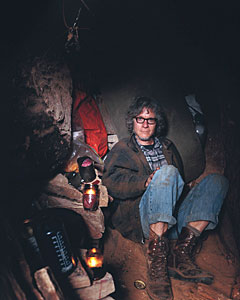
DANIEL SUELO LIVES IN A CAVE. UNLIKE THE average American—wallowing in credit-card debt, clinging to a mortgage, terrified of the next downsizing at the office—he isn't worried about the economic crisis. That's because he figured out that the best way to stay solvent is to never be solvent in the first place. Nine years ago, in the autumn of 2000, Suelo decided to stop using money. He just quit it, like a bad drug habit.
. . . . . . .
“Giving up possessions, living beyond credit and debt,” Suelo explains on his blog, “freely giving and freely taking, forgiving all debts, owing nobody a thing, living and walking without guilt . . . grudge [or] judgment.” If grace was the goal, Suelo told himself, then it had to be grace in the classical sense, from the Latin gratia, meaning favor—and also, free.
. . . . . . .
Suelo considers the riches of our own forage. “What if we saw gold for what it is?” he says meditatively. “Gold is pretty but virtually useless. Somebody decided it has worth, and everybody accepted this decision. The natives in the Americas thought Europeans were insane because of their lust for such a useless yellow substance.”
. . . . . . .
HE WASN'T ALWAYS THIS WAY. SUELO graduated from the University of Colorado with a degree in anthropology, he thought about becoming a doctor, he held jobs, he had cash and a bank account. In 1987, after several years as an assistant lab technician in Colorado hospitals, he joined the Peace Corps and was posted to an Ecuadoran village high in the Andes. He was charged with monitoring the health of tribespeople in the area, teaching first aid and nutrition, and handing out medicine where needed; his proudest achievement was delivering three babies. The tribe had been getting richer for a decade, and during the two years he was there he watched as the villagers began to adopt the economics of modernity. They sold the food from their fields—quinoa, potatoes, corn, lentils—for cash, which they used to purchase things they didn't need, as Suelo describes it. They bought soda and white flour and refined sugar and noodles and big bags of MSG to flavor the starchy meals. They bought TVs. The more they spent, says Suelo, the more their health declined. He could measure the deterioration on his charts. “It looked,” he says, “like money was impoverishing them.” The experience was transformative….
+++++++Phi Beta Iota Editorial Comment+++++++
There is a rich literature that decries “Rule by Secrecy” and “Rule by Scarcity.” There is an emerging literature on the importance of Open Money and the implications of recalculating wealth in time-energy (Buckminster Fuller's notion), in terms of “true cost” to future generations, and in terms of humanity–feelings, emotions, the articulation and expression of beauty, instead of materialistic excess.
The Digital Natives now reaching adulthood coiuld well be the Cultural Creatives on steroids, armed with hand-held devices more powerful that repressive weapons, armed with notions that would resonate with the Love generation of the 1960's, but also with those of the Mayans who worked only 60 days out of the year to maintain family, community, and civilization.
There is more than enough wealth to allow every person on the planet a good life with food, shelter, and the instruments for thinking. Our challenge is to use public intelligence in the public interest, to overcome the information asymmetries and the data pathologies that are endemic in the Weberian system of bureaucracy as a means of hoarding knowledge and controlling behavior.
The best behavior comes from shared values within shared wealth. It's time we inherited the Earth and fulfilled humanity's promise, to be the connector of dots to dots, dots to people, and people to people, here on Earth and beyond–with 100 million galaxies, we are quite certain there at least ten, if not more, planets with intelligent life on them. We will not go so far as to suggest that they are watching us and that we scare them for our war-mongering, thoughtless misbehavior that impoverishes the many for the benefit of a few, but we should live each day as if we were indeed being judged by a larger force.
Is our government acting in the public interest? Are banks allowed to charge 29.9% interest, banks that exist because they are chartered by our government, in the public interest?
Our national intelligence is lacking. Public intelligence must make up the deficit.
With a tip of the hat the University of British Columbia and Professor John Meech of the Faculty of Advanced Engineering, this is the latest briefing. As with most of my briefings, planned words for brevity can be found in the Notes.
General Peter Schoomaker–the same general that gave Open Source Intelligence (OSINT) a proper hearing at the U.S. Special Operations Command, created the first active duty Army Civil Affairs Brigade since WWII, stood up by Col Ferd Irizarry, USA. I personally believe that the theaters commands must become Whole of Government commands, and that Army Civil Affairs Brigade should become the hub for a global Earth Rescue Network that includes all relevant personnel from all eight “tribes” (government, military, law enforcement, academia, business, media, non-profit and non-governmental, and civil society including labor unions, religions and citizen wisdom councils and advocacy groups.
This monograph, commissioned by the Strategic Studies Institute (SSI) had *not* been validated and is offered in draft to avoid delay in sharing the core ideas for enhancing US Army performance in Stabilization & Reconstruction operations. I am *very* interested in having a dialog on this including errors and omissions, and will respond to any comments.