Table of Contents:
Continue reading “2008 Chapter: Annotated Bibliography on Reality”

The truth at any cost lowers all other costs — curated by former US spy Robert David Steele.
Table of Contents:
Continue reading “2008 Chapter: Annotated Bibliography on Reality”

Below is the Annotated Bibliography that completed ELECTION 2008: Lipstick on the Pig. It was designed to be a “handbook” of sorts on Reality. We like to paraphrase Trotsky, with a tip of the hat to Alvin Toffler who quoted him in War and Anti-War: Survival at the Dawn of the 21st Century:
“You may not be interested in reality, but reality is interested in you.”
Trotsky was referring to war. For the Public Intelligence Blog, reality is war, and our worst enemies are domestic in nature, causing self-inflicted wounds vastly more fatal than any foreign armed adversary could produce at any cost. The categories in the graphic below are repeated legibly below the graphic. This Blog superceeds the below bibliography, which only cover about 500 of the 1500+ books that are more easily accessed here within the Blog–as a gift to others, however, the below document can be useful as a starting point. This is all the stuff neither the government nor the media are willing to cover seriously in the public interest.
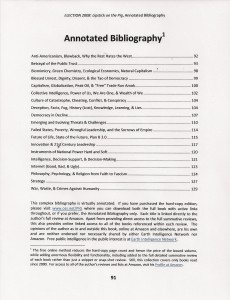
Anti-Americanism, Blowback, Why the Rest Hates the West. 92
Betrayal of the Public Trust. 93
Biomimicry, Green Chemistry, Ecological Economics, Natural Capitalism.. 98
Blessed Unrest, Dignity, Dissent, & the Tao of Democracy. 99
Capitalism, Globalization, Peak Oil, & “Free” Trade Run Amok. 100
Collective Intelligence, Power of Us, We Are One, & Wealth of We. 102
Culture of Catastrophe, Cheating, Conflict, & Conspiracy. 104
Deception, Facts, Fog, History (Lost), Knowledge, Learning, & Lies. 104
Democracy in Decline. 107
Emerging and Evolving Threats & Challenges. 110
Failed States, Poverty, Wrongful Leadership, and the Sorrows of Empire. 114
Future of Life, State of the Future, Plan B 3.0. 115
Innovation & 21st Century Leadership. 117
Instruments of National Power Hard and Soft. 120
Intelligence, Decision-Support, & Decision-Making. 121
Internet (Good, Bad, & Ugly). 123
Philosophy, Psychology, & Religion from Faith to Fascism.. 124
Strategy. 127
War, Waste, & Crimes Against Humanity. 129
 Primer for the Non-Professional, October 24, 2008
Gary Berntsen
This is a publisher's idea of a quick buck. The author did what he could within the constipated formula. It is recommended for anyone who knows very little about intelligence and wants a useful overview that avoids the nitty-gritty. Indeed, this is a very fine companion to Intelligence: From Secrets to Policy(3rd Edition), which is deficient in the very areas where this book offers a rather gross-level overview to the student new to the intelligence discipline. The price is reasonable, one reason I was tempted.
I tried hard to justify four stars but I just cannot do it. There is nothing wrong with this book, if you want a Middle School reader with a handful of ideas that are good but not unique, while avoiding anything that could have held the book up when being reviewed by the CIA, this is it. It is a small book with 19 brilliantly selected chapter titles each receiving as many as six or as few as two (small) pages.
I tried reading each “chapter's” Core Points a second time, and found little to arrest my attention (or that of a future President). Support Colombia. Spray crops in Afghanistan. Special Ops is under-represented. Hmmm.
The eleven recommended books are an afterthought. Obviously the author is an experienced case officer but he is not broadly read and none of the books deal with the profession of intelligence–a couple by bubbas, a couple on counter-insurgency, a couple on the Islamic mind–you get the idea. In this instance, “practical guide” appears to mean “my personal view, without bothering to look into anything anyone else has recommended…)
All of my books are free online, and of course here on Amazon, so I won't flog them. The core chapters can also be found online, notably “Presidential Leadership” from the first book, “New Rules for the New Craft of Intelligence” from the second, and so on.
I cannot do justice to all the deep books, including the author's own, Jawbreaker: The Attack on bin Laden and al-Qaeda: A Personal Account by the CIA's Key Field Commander which I strongly recommend instead of this book, as well as First In: An Insider's Account of How the CIA Spearheaded the War on Terror in Afghanistan. See my varied lists, especially the early ones before I started focusing on Earth Intelligence across the board.
Here are the aspects of intelligence as it pertains to national security, and a single recommended book for each, among many others I have read and reviewed here at Amazon:
1) Does it inform policy?
Informing Statecraft
2) Does it avoid doing harm?
Legacy of Ashes: The History of the CIA
3) Do policymakers abuse it for their own ends?
A Pretext for War: 9/11, Iraq, and the Abuse of America's Intelligence Agencies
4) Do we tell ourselves and the public the truth?
None So Blind: A Personal Account of the Intelligence Failure in Vietnam
5) Can intelligence make a difference?
Intelligence Power in Peace and War
6) Can intelligence see the invisible?
Seeing the Invisible: National Security Intelligence in an Uncertain Age
7) Do we do as well as we can analyzing what we collect?
Lost Promise
The author is a good, brave, and talented man in the field. We are losing too many like him now, before their retirement age, because we are allowing contractors to steal them and rent them back to us at twice the price. If anyone were listening to me, which they are not, I would have two policies:
1) Pay for performance at commercial rates
2) Lose your clearances for two years if you leave before retirement age, and start the clearance process over when you come back, but if you get to retirement, we hold your clearances for five to ten years without your having to commit to a vendor (or any single vendor) right away and to allow you to free lance while still having your original agency as “home base.”
The US Intelligence Community consists of incredibly good and earnest people trapped in a very bad system with multiple sucking chest wounds from security to acquisition to leadership (no middle, losing the seniors at the directorate levels) to you name it. Nothing in this book is going to fix that, I am sorry to say. We need a firehose, not another Happy Hour menu to throw on the fire.
 Disappointing, Some Value, October 22, 2008
Gregory F. Treverton
There are six (6) pages in this work that held my attention: pages 11-12 (Table 2.2 Analytic Concerns, by Frequency of Mention); page 14 (Figure 3.1, A Pyramid of Analytic Tasks); page 20 (Table 3.1, Wide Range of Analytical Tools and Skills Required); page 34 (Figure 5.1, Intelligence Analysis and Information Types), and page 35 (Table 5.1, Changing Tradecraft Characteristics). Print them off from the free PDF copy online (search for title).
My first review allotted two stars, on the second complete reading I decided that was a tad harsh because I *did* go through it twice, so I now raise it to three stars largely because pages 11-12 were interesting enough to warrant an hour of my time (see below). This work reinvents the wheel from 1986, 1988, 1992, etcetera, but the primary author is clearly ignorant of all that has happened before, and the senior author did not bother to bring him up to speed (I know Greg Treverton knows this stuff).
Among many other flaws, this light once over failed to do even the most cursory of either literature or unclassified agency publication (not even the party line rag, Studies in Intelligence). Any book on this topic that is clueless about Jack Davis and his collected memoranda on analytic tradecraft, or Diane Webb and her utterly brilliant definition of Computer Aided Tools for the Analysis of Science and Technology (CATALYST), is not worthy of being read by an all-source professional. I would also have expected Ruth Davis and Carol Dumaine to be mentioned here, but the lack of attribution is clearly a lack of awareness that I find very disturbing.
I looked over the bibliography carefully, and it confirmed my evaluation. This is another indication that RAND (a “think tank”) is getting very lazy and losing its analytic edge. In this day and age of online bibliography citation, the paucity of serious references in this work is troubling (I wax diplomatic).
Here are ten books–only one of mine (and all seven of mine are free online as well as at Amazon):
Informing Statecraft
Bombs, Bugs, Drugs, and Thugs: Intelligence and America's Quest for Security
Best Truth: Intelligence in the Information Age
Early Warning: Using Competitive Intelligence to Anticipate Market Shifts, Control Risk, and Create Powerful Strategies
The Art and Science of Business Intelligence Analysis (Advances in Applied Business Strategy,)
Analysis Without Paralysis: 10 Tools to Make Better Strategic Decisions
Strategic and Competitive Analysis: Methods and Techniques for Analyzing Business Competition
Lost Promise
Still Broken: A Recruit's Inside Account of Intelligence Failures, from Baghdad to the Pentagon
The New Craft of Intelligence: Personal, Public, & Political–Citizen's Action Handbook for Fighting Terrorism, Genocide, Disease, Toxic Bombs, & Corruption.
On the latter, look for “New Rules for the New Craft of Intelligence” that is free online as a separate document. Both Davis and Webb can be found online because I put them there in PDF form.
The one thing in this book that was useful, but badly presented, was the table of analyst concerns across nine issues that did not include tangible resources, multinational sense-making, or access to NSA OSINT.
Below is my “remix” of the table to put it into more useful form:
54% Quality of Intelligence
54% Tools of intelligence/analysis
43% Staffing
43% Intra-Community collaboration and data sharing
41% Collection Issues
38% Evaluation
32% Targeting Analysis
30% Value
Above are the categories with totals (first initial below connects to above). The top four validate the DNI's priorities and clearly need work.
32% T Targeting Analysis is important
30% V Redefine intelligence
30% Q Analysis too captive to current
30% To Directed R&D for analytic technology needed
27% T Targeting needs prioritization
27% S Analyst training important and insufficient
22% V Uniqueness
22% E PDB problematic as metric
22% To “Tools” of intelligence analysis are poor
22% To “Tools” limit analysis and limited by culture
The line items above are for me very significant. We still do priority based collection rather than gap-driven collection, something I raised on the FIRCAP and with Rick Shackleford in 1992. Our analysts (most of them less than 5 years in service) are clearly concerned about both a misdirection of collection and of analysis, and a lack of tools–this 22 years after Diane Webb identified the 18 needed functionalities and the Advanced Information Processing and Analysis Steering Group (AIPASG) found over 20 different *compartmented* projects, all with their own sweetheart vendor, trying to create “the” all-source fusion workstation.
19% C S&T underused, needs understanding
16% E Critical and needs improvement
14% E Assess performance qualitatively
14% Q Quality of analysis is a concern
14% Q Intelligence focus too narrow
14% S Language, culture, regional are big weaknesses
11% A Leadership
11% L Must be improved
11% Q Problem centric vice regional
11% Q Global coverage is important
11% C Open source critical, need new sources
11% I Lack of leadership and critical mass impair IC-wide
11% I IC information technology infrastructure needed
11% I Non-traditional source agencies need more input
8% V Unclear goals prevail
8% T Targetting analysis needs attn+
8% C Collection strategies/methods outdated
8% S Concern over lack of staff or surge capability
8% S Intelligence Community-wide curriculum desireable
8% I Should NOT pursue virtual wired network
8% I Security is a concern for virtual and sharing
5% E Evaluation not critical
5% Q Depth versus breadth an issue
5% Q Greater client context needed
5% C Law enforcement has high potential
5% S Analytic corps is highly trained better than ever
5% S Career track needs building
5% I Stovepiping is a problem, need more X-community
5% I Should pursue virtual organization and wired network
3% V Newsworthy not intelligence
3% L Radical transformation needed
3% E Metrics are not needed
3% E Evaluation is negative
3% E Audits are difficult
3% Q Long term shortfalls overstated
3% Q Global coverage too difficult
3% T Targeting can be left to collectors
3% C All source materially lacking
3% C Need to guard against evidence addiction
3% C Need to take into account “feedback”
3% S Should train stovepipe analysts not IC analysts
3% S Language and cultural a strength
For the rest, not now, but three at the bottom trouble me: the analysts do not have the appreciation for feedback; they do not understand how lacking they are in sources; and they don't know enough to realize that radical transformation is needed.
On balance, I found this book annoying, but two pages ultimately provocative.
A Gem, Free Online, Worth Buying Just for the Book Form, October 22, 2008
Army War College
I have long recommended that the Strategic Studies Institute (SSI) of the U.S. Army offer its many publications on Amazon, and I am very glad to see that finally happening. SSI, to which I contribute when asked, is my single best source of free serious books, and a real national asset. The URL for their online version is in the comment, but I do recommend purchase as it will then reach you in book form.
This is a reader, the result of a conference held in February 2008. We are fortunate to have the published record so soon.
The most important contribution of the gathering, drawing from over 70 submitted “principles of peace,” was its final consensus on the following six:
1. Ensure rule of law
2. Seek security: civil, military, economic
3. Pursue legitimacy
4. Encourage development
5. Foster self-empowerment and self-sufficiency
6. Foster communications
Appendix II, nine individual submissions of distinct principles of peace, is alone worth the time and money for the book, and ample cause for reflection. Appendix III offering six break-out group distillations, and then Appendex IV offers the six principles above.
Appendix V offers 15 “Policies and Procedures,” and with apologies to those that hate lists, I believe I serve the group by listing them here in short form. I am impressed. This is useful good stuff.
1. Be ready for a fight after the fight
2. Enlist reconciliable groups
3. Control population
4. Advise, rather than force, when appropriate
5. Prevent disease and unrest
6. Be an honest broker
7. Punish egregious violators insofar as it promotes national healing
8. Reconstruct institutions so that abuses will not be repeated
9. Secure sacred places, relics, and cultural features
10. Empower a culturally-nuanced judiciary
11. Facilitate appropriate sustainable development
12. Facilitate coordinated efforts with lead agency (both national and international
13. Respect culture
14. Define a clear, concise national mission with associated objectives
15. Pursue bottom-up policies where applicable, thereby creating self-sufficiency through individual empowerment.
[It is natural for the reader to wonder why we don't do this at home.]
I found roughly half the pieces arresting enough to demand attention.
10 Questions Before You Go by Marc Tyrrell of Carlton University
Question 1: What is the Mission?
Question 2: What is the Ongoing Moral Justification of the Mission?
Question 3: What is the Source of Legitimacy for the Mission?
Question 4: What Social Institutions Have Failed and Why?
Question 5: What Social Institutions Does Mission Success Require and Desire?
Question 6: What Cultural Institutions Support *Required* Social Institutions?
Question 7: What Are the Basic Narratives of the Culture?
Question 8: What Are the Basics of the Culture?
Question 9: What are the Core Narratives of the Culture That Relate to the Mission?
Question 10: Not offered–the Socratic open-ended inquiry.
Dr. Dewey Browder from Austin Peay State University (host of the event)
Demilitarization
Denazification
Decentralization
Democratization
On the latter point, I was impressed by several contributors who pointed out that “democracy” for many is based on tribal and other network forms of consensus, not on majority voting (and of course we have our own tyranny of fraudulent parties disenfranchising two thirds of the public).
Dr. Albert Randall, also with the host university, got my attention on religion, after pointing out that our failure to take this into account cost us heavily in Iraq. [I was told directly by Civil Affairs officers that the first few years they were told to ignore the imams and the tribal leaders, now of course we know better.] Here are his truncated six points (the last two complete):
1. Religion adds a higher intensity…
2. Religion offers a stronger identity…
3. Religion can motivate the masses quickly and cheaply…
4. Religion offers an ideology or a platform for an ideology…
5. Religious leaders are often the last leaders left when states fail, and they offer a voice to the disempowered or oppressed.
6. Religious leaders are often the first to seek peace and reconciliation after conflict.
Other contributions earned my attention, but the last I want to mention here is the early intervention of Jordy Rocheleau, also from the host institution, “Ethical Principles for State-Building.” This one chapter of 14 pages could usefully be integrated “as is” into our concepts and doctrine. After discussion, he provided sentences, I will only list the key word here (get the PDF or buy the book):
1. Necessity
2. Human Rights
3. Peace and Security
4. National Self-Determination
5. Rule of Law
6. International Legality/Legitimacy
7. Beneficience/Non-exploitation
8. Limited Retribution
9. Restorative Justice
10.. Reconciliation
I put the book down at peace, pleased with this intellectual construct, disappointed that I missed the event itself, and most impressed with Austin Peay State University, proven to be world-class in this volume.
OUTSTANDING.
Here are some other books to complement this one (other than Irregular War, which I am not ready to list yet).
The Search for Security: A U.S. Grand Strategy for the Twenty-First Century
Policing the New World Disorder: Peace Operations and Public Security
Faith- Based Diplomacy Trumping Realpolitik
The Unconquerable World: Power, Nonviolence, and the Will of the People
A More Secure World: Our Shared Responsibility–Report of the Secretary-General's High-level Panel on Threats, Challenges and Change (This one is free online as well but color is best bought)
Wilson's Ghost: Reducing the Risk of Conflict, Killing, and Catastrophe in the 21st Century
The leadership of civilization building: Administrative and civilization theory, symbolic dialogue, and citizen skills for the 21st century
How to Change the World: Social Entrepreneurs and the Power of New Ideas, Updated Edition
Deliver Us from Evil: Peacekeepers, Warlords and a World of Endless Conflict
Peacekeeping Intelligence: Emerging Concepts for the Future
See the slide (image) above, it is still valid and available as a model, the 1976 paper is at my web site (last portal page, under Early Papers).
 Making Connection to Obama, October 20, 2008
Jim Marrs
I gave Rule by Secrecy: The Hidden History That Connects the Trilateral Commission, the Freemasons, and the Great Pyramids a rave review and recommend it be read with Crossing the Rubicon: The Decline of the American Empire at the End of the Age of Oil.
The sole purpose of this review is to link readers to three books on the treason and betrayal of the public trust by BOTH parties (two branches of the same crime family), and to connect the thesis with three books on Obama.
Congressional Treason:
Running on Empty: How the Democratic and Republican Parties Are Bankrupting Our Future and What Americans Can Do About It
Breach of Trust: How Washington Turns Outsiders Into Insiders
Obama: The Dark Side
Obama – The Postmodern Coup
Barack H. Obama: The Unauthorized Biography
The Case Against Barack Obama: The Unlikely Rise and Unexamined Agenda of the Media's Favorite Candidate
Obama Unmasked: Did Slick Hollywood Handlers Create the Perfect Candidate?
In my view, all of the money flowing to Obama is NOT so much from individuals as from the major corporations and banks that are “changing the sheets” in the White House. This is all “theater” for the masses, and the “soft tyranny that Democracy in America (Penguin Classics) warns about is very likely if we are dumb enough to elect Obama, Pelosi, and Reid together. Obama is bought and paid for.
So one has to ask, Just How Stupid Are We?: Facing the Truth About the American Voter
This is NOT GOOD. I never thought Bush-Cheney could be outdone, but thinking about Obama-Pelosi-Reid makes Bush-Cheney look like second rate thugs overshadowed by the high theater of a Wall Street “daze” that shows us “democracy” on one hand while completing a national socialism fraud on the other, as the fat cats slip out the back door to Dubai.
McCain's campaign staff borders on being sheer idiots–I don't think he had taken the bribe that Gore took in 2000, but his campaign staff well might be bought and staging the fall.

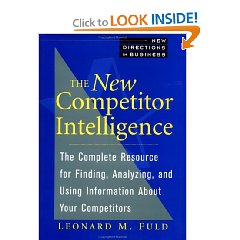
We regard Leonard Fuld as “the original” pioneer for competitive intel
Leonard Fuld is a pioneer in the field of competitive intelligence. He has created many of the intelligence-gathering techniques currently used by corporations around the globe. Mr. Fuld's company, Fuld & Company, founded in 1979, specializes in providing business intelligence to corporations to improve their decision-making for strategy, operations and tactical applications.
Mr. Fuld is a widely published author. In addition to his latest book, The Secret Language of Competitive Intelligence (Crown Publishing, a division of Random House, Inc., 2006), and The New Competitor Intelligence (Wiley, 1995), Fuld has previously published Competitor Intelligence: How to Get It – How to Use It (Wiley, 1985) and Monitoring the Competition: Find Out What's Really Going On Over There (Wiley, 1988).