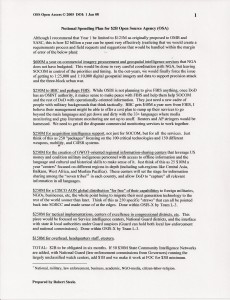
This is the budget created to support Col Vincent Stewart, USMC, then the action officer for surveying Open Source Intelligence (OSINT) reequirements and capabilities across the Department of Defense (DoD). This amount–not necessarily these specific priorities–was offered to the U.S. Special Operations Command (USSOCOM), which continues to have the only full-spectrum OSINT capability in the USA, but turned down by subordinates to the Combatant Commander who did not understand that the Long War is a war of both ideas, and universal coverage at the neighborhood level of granulaty, as Dr. Stephen Cambone so wisely called for in January 2004.
If $1.5 Billion is added to this budget for 50 Community Information-Sharing and Sense-Making Networks, a total of no less than $3 billion a year, and ideally $3.5 billion a year, is recommended.
I am adding this book to my list of outrageously expensive books that will never become mainstream because the substance of the author has been overwhelmed by the greed of the publisher. This book cost less than a penny a page to produce and received no marketng to speak of.
As a publisher and author myself, I strongly recommend that all authors publish their word in PDF form free online, and also ensure their contract with any publisher includes a not-to-exceed price for a hard or soft cover copy for the publisher.
Amazon allows URLs in the comment section. I now search for books like this on the web rather than paying such an outrageous price. I have sent email to the author encouraging him to identify an online location for a PDF(not necessarily of the book, but of the core ideas). If I receive that, I will post the link as a comment.
I take the Nordics very seriously, both in peace operations and in peace intelligence. They taught me (in Sweden) the importance of what they call Multinational Multiagency, Multidisciplinary, Multidomain Information Sharing (M4IS). In the comment below I provide two links, one to the new book on Peace Intelligence that is being edited by Col Jan-Inge Svensson, the other to the one page portal to Open Source Intelligence which now gives way to Public Intelligence.
Best in Class, Very Technical, Saluting and Moving On, May 31, 2008
John H. Miller
Sometime I encounter books that are extremely important, that give me an appreciation for a knowledge domain I do not know enough about, and that I simply cannot read and review.
Howard Bloom, in Global Brain: The Evolution of Mass Mind from the Big Bang to the 21st Century teaches us that the only way to create a sustainable peace in the Palestine region is to provide absolute security for an entire generation, and raise two whole generations, one on each side, from kindergarten on us, generations that do not consider “the other” to be “pigs and monkeys” by the age of five.
Similarly, the literature on wealth of networks and the fortune at the bottom of the pyramid is growing, and I am convinced that public intelligence (decision support, full disclosure, end of information asymmetries) is going to accomplish two things in the next twenty years:
1) Eradicate corruption and enforce the triple-bottom line
2) Elevate five billion poor by teaching them one cell call at a time so that they can create infinite stabilizing wealth.
So the very best thing I can say about this book is that I am glad I bought it, I am very glad to have a sense, however weak, of this important exploratory area, and now I know that I need a team of generative social scientists that can do complex modeling for peace and prosperity solutions.
I urge one and all to become familiar with World Index of Social and Environmental Responsibility (WISER), as best I can tell that is the center of gravity for empowering individuals with deep knowledge of the true costs and many human rights abuses and other crimes that we support today for lack of knowledge. I also recommend the pioneering EarthGame work of Medard Gabel, at BigPictureSmallWorld.
Instead of Can You Explain It, Can You Build It?, May 31, 2008
Joshua M. Epstein
Sometimes I encounter books that are extremely important, that give me an appreciation for a knowledge domain I do not know enough about, and that I simply cannot read and review in the traditional sense. However, having invested good money and time in the book, if I admire I book, I generally seek to use my broad reading as a base for putting the book in an appreciative context with useful links for other readers.
Howard Bloom, in Global Brain: The Evolution of Mass Mind from the Big Bang to the 21st Century teaches us that the only way to create a sustainable peace in the Palestine region is to provide absolute security for an entire generation, and raise two whole generations, one on each side, from kindergarten on us, generations that do not consider “the other” to be “pigs and monkeys” by the age of five.
Similarly, the literature on wealth of networks and the fortune at the bottom of the pyramid is growing, and I am convinced that public intelligence (decision support, full disclosure, end of information asymmetries) is going to accomplish two things in the next twenty years:
1) Eradicate corruption and enforce the triple-bottom line
2) Elevate five billion poor by teaching them one cell call at a time so that they can create infinite stabilizing wealth.
So the very best thing I can say about this book is that I am glad I bought it, I am very glad to have a sense, however weak, of this important exploratory area, and now I know that I need a team of generative social scientists that can do complex modeling for peace and prosperity solutions.
I urge one and all to become familiar with World Index of Social and Environmental Responsibility (WISER), as best I can tell that is the center of gravity for empowering individuals with deep knowledge of the true costs and many human rights abuses and other crimes that we support today for lack of knowledge. I also recommend the pioneering EarthGame work of Medard Gabel, at BigPictureSmallWorld.
Eventually I see the USA Waging Peace, with a Multinational Decision Support Center providing unclassified intelligence to all actors on the world stage, and publishing an annual and constantly updated Global Range of Gifts Table to connect the billion rich with the five billion poor at the $1-$100 level.
In commenting on this book, I am primarily seeking to point readers toward other books on the substance of peace and prosperity and our many ills. If you are technically inclined, this is a very top work that also inspires the lay reader who “does not do math.”
I own this set. As I pass through the 55-year old mark, I keep coming back to it and will read it from start to finish one day. The price is a bargain.
Useful Contribution, Neglects Outputs & Constituencies, May 28, 2008
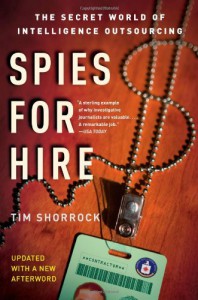
Tim Shorrock
Edit of 4 Jun 08 to strongly recommend Retired Reader's review as a companion to my own observations.
I sat down with this book today and found it absorbing. It is perhaps the best overview for anyone of names and numbers associated with the $60 billion (or more, perhaps as much as $75 billion) a year we waste on the 4% we can steal, and next to nothing on Open Source Intelligence (OSINT). The book loses one star for failing to integrate over 300 relevant books (see the annotated bibliographies to my first two books), and for failing to apply any visualization at all. This book is a mass of facts and figures, names and places. With or without visualization, it is a seminal reference point and recommended for all university and public libraries.
The book focuses mostly on technical waste–the inputs–and does not cover outputs nor constituencies. The reality is as General Zinni has put it so well: the IC produces 4% of what is needed, at a cost so horrendously wasteful as to warrant severe outrage among all taxpayers.
Having read the book, I can state that the author's agenda, if he has one, is to expose the risk to our civil liberties of creating a national surveillance state in which the bulk of the expertise is outside the government and subject to corruption and cronyism as well as lack of oversight.
Here are three tid-bits that strongly support the author's general intent, and some links.
1) Secret intelligence scam #1 is that there is no penalty for failure. Lockheed can build a satellite system that does not work (for NASA as well as the secret world–two different failures–or get the metrics wrong so priceless outer space research does not deploy a parachute–}and get another contract. Similarly SAIC with Trailblazer, CACI in Iraq, Blackwater murdering civilians and ramming old men in old cars out of the way, this is all a total disgrace to America.
2) “Butts in seats” means that most of our money goes to US citizens with clearances who know nothing of the real world, *and* the contractor gets 150% of their salary as “overhead.” That is scam #2.
3) Scam #3 is that the so-called policy world, when it exists, does not really care what the secret world has to say, unless it justifies elective wars, secret prisons in the US (Halliburton) and so on. Dick Cheney ended the policy process in this administration. But even without Cheney and his gang of proven liars, the dirty little secret of the secret world is that a) there is no one place where all information comes together to be made sense of; and b) less than 1% of what we collect gets looked at by a human; and c) most of the policy world could care less what Top Secret Codeword information is placed before them–as Colin Powell says so memorably in his autobiography, he preferred the Early Bird compilation of news clippings.
I have been saying since 1988 that the secret emperor is not just naked, but institutionalized lunacy. Books like this are helpful, eventually the public will hear our voice.
Here are specific tid-bits that caught my attention as I went through the book.
+ Two errors in reference to me: I was neither a committee chair nor a program director. The author does quote me accurately.
+ Early on I am impressed to note documented facts:
– 50% of the clandestine case officers at CIA are contractors
– 35% of the Defense Intelligence Agency workforce is contracted
– Virtually 100% of the National Reconnaissance Office (NRO) is contracted
– 70% of all US Intelligence Community funds are spent on external contracts rather than internal capabilities.
– Booz Allen Hamilton has 10,000 employees with Top Secret Codeword clearances
– Revolving door is gutting the agencies (and most retirements will take place between 2007 to 2012–we have no middle management, no bench).
– Total Information Awareness (TIA) program never died, it went underground
– Pentagon under Cheney, then Cheney-Rumsfeld, now Cheney-Gates appears committed to outsourcing everything except the shooting–this is very very bad for all of us
– SIGINT data stream is wagging the dog–three V's of unstructured data are volume, velocity, and variety (183 languages we don't speak) but the author cited General Tony Zinni, USMC (Ret) telling a conference that all the high-tech in the world cannot give him plans and intentions on the battlefield.
– History of outsourcing goes back to the Odeen (CEO BDM) report sponsored by the Defense Science Board, this was the beginning of trying to privatize everything possible. Combined with the Pentagon's inherent disrespect for the CIA, it made privatizing intelligence even more attractive.
– McConnell comes out of this book looking respectable, Woolsey and Tenet less so. Dempsey was not a Navy officer by career–they sent her to knife and fork school when she managed the Navy intelligence budget within GDIP, much as the USMC took care of Arnold Punaro who ultimately made one-star while being Staff Director of the SASC. Although the author excels at naming names, and he discusses failures where they are known, there is very little substantive understanding of how the US IC has collapsed on all fronts–personnel, budget, finance, facilities, global presence, global coverage, relevance to the customer, etcetera.
– CACI and SAIC come out of this book looking truly terrible, while ManTech and Booz Allen Hamilton come out as moderately competent. I have to remind myself that contractors are not evil–they do what we incentivize them to do, and right now it is OUT OF CONTROL.
– He names LtGen Ken Minihan, USAF, as the de facto ideologist for the intelligence-industrial complex, and provides a good review of how venture capital funds were created to focus specifically on secret contracts.
– John Brennan emerges from this book as the man behind the curtain, levering the International and National Security Alliance (INSA) to further the complex. I disagree with the author's characterization of the DNI and INSA alliance as unethical. I do however agree that it is unprofessional in that INSA is executing myopic orders and not contributing at all to the needed cross-fertilization and understanding of where the real innovation is happening, in Collective, Peace, and Commercial Intelligence (the latter the complete opposite of Contractor Intelligence, or butts in seats).
I put this book down wishing that the field of cognitive science would evolve more quickly. Our profession is in disarray, in confusion, seeking to substitute butts in seats and dollars for cultural, linguistic, historical, and other forms of context. We need several multinational life boats of change catalysts–such as a Multinational Decision Support Center in Tampa, taking over the rapidly vacating Coalition Coordinating Center, in order to create the world's first unclassified intelligence center dedicated to providing open decision support to all parties active in stabilization & reconstruction, humanitarian assistance, and disaster relief (both at home and abroad). The IC is, as I said in Forbes ASAP, Inside Out and Upside Down. This is not the contractor's fault. It is our fault. We are a Dumb Nation instead of a Smart Nation. Bad. Very bad.