Review: An Enormous Crime–The Definitive Account of American POWs Abandoned in Southeast Asia

5 Star, Atrocities & Genocide, Congress (Failure, Reform), Corruption, Crime (Government), Culture, Research, Diplomacy, Empire, Sorrows, Hubris, Blowback, Executive (Partisan Failure, Reform), Impeachment & Treason, Insurgency & Revolution, Intelligence (Government/Secret), Misinformation & Propaganda, Power (Pathologies & Utilization), Voices Lost (Indigenous, Gender, Poor, Marginalized)
0Shares
Amazon Page

5.0 out of 5 stars USG Has Betrayed Us All

November 28, 2007

Bill Hendon, Elizabeth Stewart

Edit of 26 Jan 08: see the comments for additional give and take that illuminates the treason of our own government against those “left behind.”

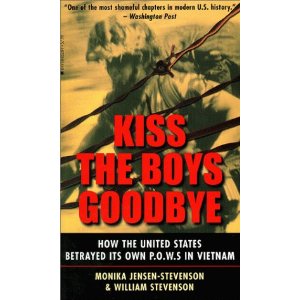
I recommend my review of Is Anybody Listening?: A True Story About POW/MIAs In The Vietnam War and also Kiss the Boys Goodbye: How the United States Betrayed Its Own POWs in Vietnam.

This book is more of a scholarly work and has eye-glazing detail. However, as best I can tell, this is the single best and most carefully documented book, with the stellar advantage of having as a co-author the Honorable Bill Hendon, who is not only a former Representative (R-NC) but was on the POW/MIA beat while there.

I am very very very angry. Our politicians, both Republican and Democratic, have betrayed us all, and this brings me to tears, betrayed the honorable warriors who became POWs or were MIA in Viet-Nam.

There are several points that grab me:

Over 1,500 POWs still known to be in Viet-Nam and probably alive.

Viet-Nam had a clear strategy for capturing AND KEEPING ALIVE our personel in order to charge the US for reparations after the war was inevitably won by the Vietnamese

The authors explicitly suggest that Senator John McCain has been fully witting of the reality of how many have been left behind, and complicit in our federal government's deliberate decision to abandon them rather than pay Viet-Nam the compensation they appear to fully merit given our violation of the Geneva Convention and our intrusion into the civil war between North and South.

I hold the authors of this book, and the excrutiating detail that they have assembled, in the greatest regard.

It is now clear to me that the Federal Government as it is now constituted, cannot be trusted. We need Electoral Reform, open books, and an end to secrecy.

See also:
Vice: Dick Cheney and the Hijacking of the American Presidency
Running on Empty: How the Democratic and Republican Parties Are Bankrupting Our Future and What Americans Can Do About It
The Trial of Henry Kissinger
Secrets: A Memoir of Vietnam and the Pentagon Papers
None So Blind: A Personal Account of the Intelligence Failure in Vietnam
Why We Fight
The Fog of War – Eleven Lessons from the Life of Robert S. McNamara

Vote on Review

Who’s Who in Peace Intelligence: Matthew M. Aid

Alpha A-D, Peace Intelligence
0Shares

Matthew M. Aid is a native of New York City. He holds a Bachelor’s degree in International Relations from Beloit College in Beloit, Wisconsin.  He has served as a senior manager with several large international financial research and investigative companies for more than 15 years. He is currently a Managing Director in the Washington, D.C. office of Citigate Global Intelligence & Security, where his responsibilities include managing the company’s international investigative and security operations. Aid was the co-editor with Dr. Cees Wiebes of Secrets of Signals Intelligence During the Cold War and Beyond (Cass, 2001), and is currently completing a history of the National Security Agency and its predecessor organisations. He is also the author of a chapter about the National Security Agency in a book published by the University of Kansas Press in 1998 entitled A Culture of Secrecy: The Government Versus the People’s Right to Know, as well as a number of articles on signals intelligence in Intelligence and National Security.

International Peacekeeping Operations: The Intelligence Challenge for America in the 21st Century

The Book
The Book

Review (Guest): Kiss the Boys Goodbye–How the United States Betrayed its Own POWs in Vietnam

5 Star, Atrocities & Genocide, Congress (Failure, Reform), Corruption, Crime (Government), Culture, Research, Empire, Sorrows, Hubris, Blowback, Executive (Partisan Failure, Reform), Impeachment & Treason, Insurgency & Revolution, Intelligence (Government/Secret), Misinformation & Propaganda, Values, Ethics, Sustainable Evolution, Voices Lost (Indigenous, Gender, Poor, Marginalized)
10Shares
Amazon Page

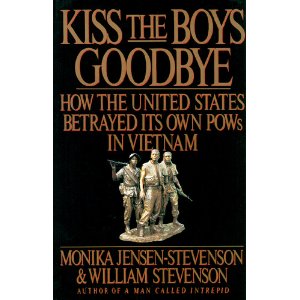
To the right is the current mass paperback cover that is available.  Below is the cover of the original hard-copy, and a guest review (Amazon is deleting top reviewer's old reviews to make room for new reviewers, we missed this one when creating this web site to counter that “lost history”).

Amazon Page

5.0 out of 5 stars Stunning Expose Of Government DesertionOf Its Vietnam Vets!

May 20, 2002

William Stevenson, Monika Jenson-Stevenson

Review by Barron Laycock “Labradorman”

This is a book that should make ordinary American citizens exceedingly sad and angry. Although some may argue that its message is old news, and certainly very dated information, the horror and outrage it should occasion is neither old nor dated. For what the authors contend, and go on to impressively prove, is that our national government deliberately and maliciously betrayed its own soldiers trapped as Prisoners Of War (POWs) in Vietnam, abandoning them in favor of a quick and otherwise painless exit from the war in Southeast Asia. This, as the authors argue, is a truly devastating indictment of the Nixon administration, and one for which they cannot be forgiven.

However, it is more than that. It is also a bizarre story of men left behind for the sake of political expedience and due to a number of highly classified clandestine operations, which were purposely kept from the American people. The story line begins with the sad saga of a young ex-marine who escaped from Vietnam on the late 1970s and claimed to have seen a large number of fellow American servicemen still being held by the Vietnamese. However, he was quickly charged with desertion and collaboration with the enemy, in what seemed to be a desperate effort on the part of governmental officials to bury both him and his story of American prisoners as deeply as possible from public view. From here the plot takes a number of bizzare twists and turns.

As the authors began to investigate the young marine's story, layers of deception, half-truths, and active censorship began to emerge. What they finally uncovered was an amazing tale of official deception from the highest levels in government, and also a very well organized and relentless abuse of official governmental power. This book reveals convincing evidence of American soldiers and sailors deliberately abandoned for political expedience, and of families torn apart by these acts. It also raises quite provocative questions concerning the very nature of democracy, and the corruptibility of ordinary men given such power. Similarly, they show how the use of claims of national security were used to derail efforts to learn the truth, and of an active conspiracy to keep the public from discovering the truth.

There are many of us who have long believed that Nixon and Kissinger made a pact with the devil himself in order to to extricate the United States fro the ongoing horror of Vietnam. What is truly mind-boggling is to discover just how right we were to suspect that they, and many others in the government since that time, would take such drastic action as they have to conceal these facts and to evade the truth. This is a worthwhile book, and one that demands to be read. I hope you can approach it with an open mind. Its arguments and the evidence associated with it are, in my opinion, very convincing. Enjoy!

Vote on Review

Who’s Who in Peace Intelligence: Richard Connaughton

Alpha A-D, Peace Intelligence
0Shares

Richard Connaughton is a former officer of the British Army. His last appointment was head of Defence Studies with the rank of colonel, from which he took early retirement. He set up his own consultancy, National & International Consultancy, working for clients in the politico-military field world-wide. He has a post-graduate degree in International Relations from Cambridge and his PhD from Lancaster University is in Politics. He is an honorary research fellow for the Centre for Defence and International Security Studies. He has recently written papers for the Joint Forces Quarterly, Civil Wars and Small Wars and Insurgencies. Details of his books appear on his website: www.connaughton.org.uk  His most recent books are MacArthur and Defeat in the Philippines (New York: The Overlook Press 2002) and Military Intervention and Peacekeeping:  the Reality (Aldershot: Ashgate 2001). His next book, The Rising Sun and the Tumbling Bear, on the Russo-Japanese War of 1904-5, is to be published by Orion in 2003.

The Second Iraq Intervention 2002-2003

The Book
The Book

Who’s Who in Peace Intelligence: Patrick J. Cammaert

Alpha A-D, Peace Intelligence
0Shares

Patrick C. Cammaert is a major-general of the Marine Corps of the Royal Netherlands Navy. Since early 2003 he is Military Advisor to the Secretary-general of the United Nations. Until October 2002 he was in command of the United Nations Mission to Ethiopia and Eritrea (UNMEE). Before commanding UNMEE, general Cammaert served as Commander of the Multinational United Nations Stand-by Forces High Readiness Brigade (SHIRBRIG) and as battalion commander with the United Nations Transitional Authority in Cambodia (UNTAC) and as assistant chief of staff of the Multinational Brigade of the Rapid Reaction Force of the United Nations Protection Force (UNPROFOR).

Intelligence in Peacekeeping Operations: Lessons for the Future

The Book
The Book

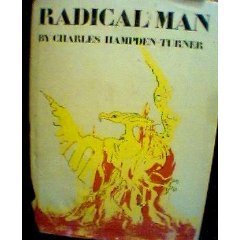
Review: Radical Man–The Process of Psycho-Social Development

Uncategorized
0Shares
Amazon Page
5.0 out of 5 stars Seminal Work, Get It Used, Should Be Reprinted
November 23, 2007
Charles Hampden-Turner

This book changed my life in the sense that it served as a foundation for my first Master's thesis on Predicting Revolution, work that has not yet been surpassed.

I myself developed one side of the matrix, finding through the secondary literature that revolutions were generally distinct within each of the following domains:

Political-Legal
Military-Law Enforcement
Socio-Economic
Ideo-Cultural
Techno-Demographic
Natural-Geographic

It was not until I chanced across this work, which the author points out is the first ever theoretical dissertation at the Harvard Business School. I share the author's disdain for the Know-Nothings stepped in their rote learning who label all that they do not understand as “naive idealism.” They've become prostitutes, while the author and those like him continue to “live free.”

What this book did for me personally was provide and explain “Radical Man” in terms precisely suited to explode my first thesis from something pedestrian to something that today, a quarter of a century later, is still “best in class” (available at OSS.Net in Library, Steele's Early Papers).

He provided a model of psycho-social development with the following elements:

+ Perception
+ Identity
+ Competence
+ Investment
+ Suspension & Risk
+ Transcendance
+ Synergy
+ Integration
+ Complexity

Along the other side of the matrix, that allowed me to create a framework in which the secondary literature could be pigeon-holed into a third of the boxes, and then I did primary research to both complete the other two thirds, and to operationalize each element (identify specific collectable data with which to determine the degree of risk, scope, etc.).

Charles Hampden-Turner is in my view one of the great minds of our time, and I point readers to my review of The Black Swan: The Impact of the Highly Improbable so as to meet the second mind that I most admire in my time (there are others, of course, like E. O. Wilson, Alvin Toffler, but see my reviews for the details).

See also:
Maps of the Mind: Charts and Concepts of the Mind and its Labyrinths
Riding The Waves of Culture: Understanding Diversity in Global Business
Public Philosophy: Essays on Morality in Politics
The Tao of Democracy: Using Co-Intelligence to Create a World That Works for All
The New Craft of Intelligence: Personal, Public, & Political–Citizen's Action Handbook for Fighting Terrorism, Genocide, Disease, Toxic Bombs, & Corruption

This one is free online at Army War College Strategic Studies Institute
The new craft of intelligence: Achieving asymmetric advantage in the face of nontraditional threats (Studies in asymmetry)

Vote on Review

Two Graphics from the Book:

Graphic: Human Intelligence (HUMINT) 101 (Wrong Way)

Graphic: Human Intelligence (HUMINT) 102 (Right Way)

Work Inspired by this Book:

Preconditions of Revolution in the USA Today

Graphic: Pre-Conditions of Revolution

1992 MCU Thinking About Revolution

1976 Thesis: Theory, Risk Assessment, and Internal War: A Framework for the Observation of Revolutionary Potential

Who’s Who in Peace Intelligence: Tony van Diepenbrugge

Alpha A-D, Peace Intelligence
0Shares

Tony van Diepenbrugge is a major-general in the Royal Netherlands Army. After his initial Staff course at the Army Staff College in The Hague he was sent on a Peace Support Mission to Lebanon in 1981 where he worked as a member of the UNIFIL staff. In 1996-97, then colonel Van Diepenbrugge served for six months in the former Yugoslavia as director of the Joint Operation Centre of IFOR headquarters in Sarajevo. From September 2001 until September 2002 major-general Van Diepenbrugge was commander of the Multi-National Division South West in Bosnia-Herzegovina. Since October 2002 he is deputy commander in chief of the Royal Netherlands Army.

Peacekeeping and Intelligence: An Experience in Bosnia-Herzegovina

The Book
The Book